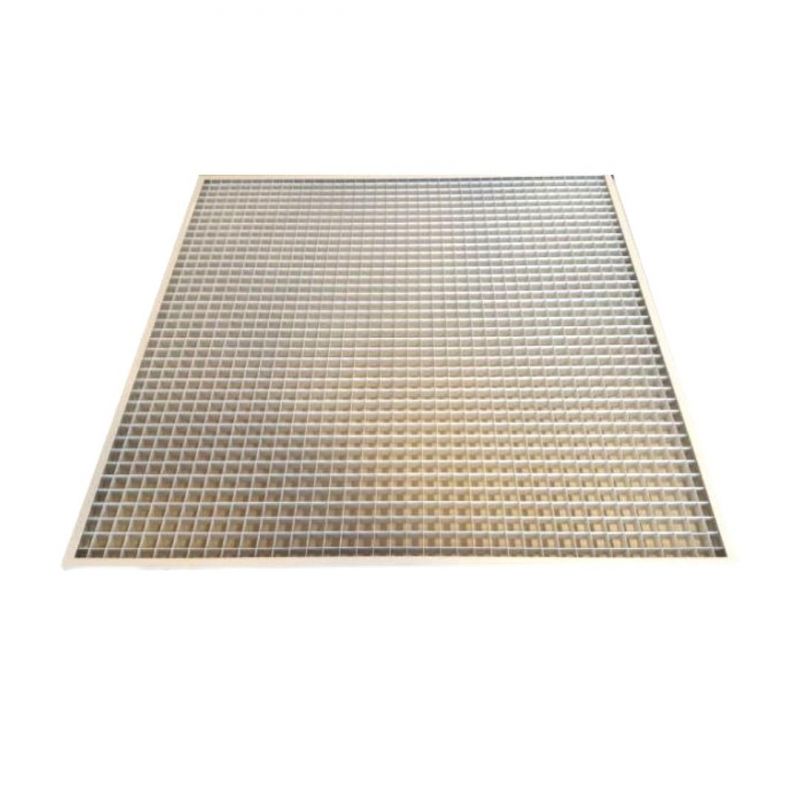
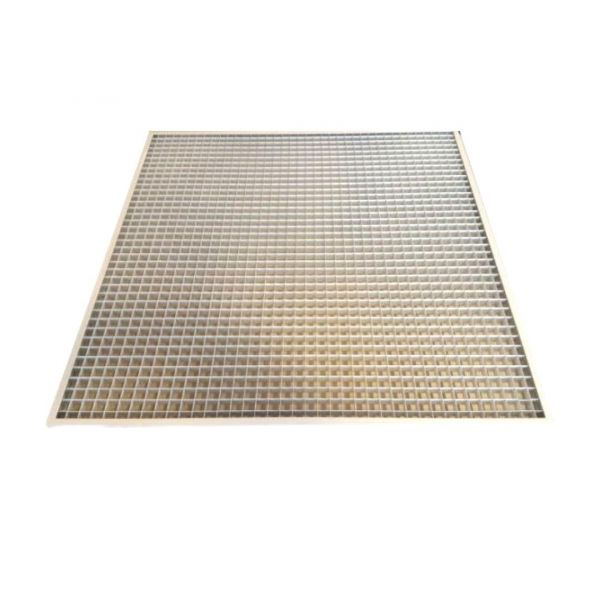
EG 595x595 mm Eggcrate Grille — for Suspended Ceilings
What an eggcrate grille is
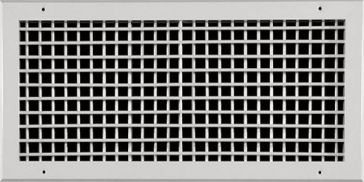
The EG grille has a square-cell structure, formed by a lattice of thin aluminium blades set perpendicular to each other. The look that gave it its name — eggcrate — is also the explanation of what it does.
Unlike bladed grilles (deflection or fixed-blade), where solid profiles occupy a significant share of the face, the cell lattice leaves almost the entire section open. It has the highest free area of any grille type in the range.
Why maximum free area matters
This is the advantage that translates directly into money.
Every grille resists airflow. The smaller the free area, the greater the resistance — and that resistance must be overcome by the fan.
With eggcrate grilles, at the same airflow:
- Lower pressure drop → the fan works less hard
- Possibly a smaller fan → lower initial investment
- Lower consumption, permanently, for the life of the system
- Less noise, because air passes at lower velocity through the larger open area
On an installation with 20–30 ceiling points, the cumulative pressure-drop difference can change the class of fan required.
595x595 mm: straight into the ceiling grid
Standard suspended ceilings use the 600x600 mm module. The 595x595 mm size is made for exactly that module: lift out a ceiling tile, drop in the grille.
No cutting. No trim frame. No plasterboard work. No making good.
Where it is used — and where it isn't
Use it for:
- Extract / return air in suspended ceilings — the most common application
- High-airflow supply where jet direction doesn't matter
- Screening ceiling-mounted air conditioning units
- Plant rooms, server rooms, warehouses
- Cases where minimum pressure drop matters more than air direction
Not suitable for:
- Conditioned supply air in occupied rooms, where the jet must be aimed. An eggcrate has no adjustable blades — air leaves perpendicular to the face, i.e. straight down. In an office, that means a draught felt directly by the people below.
- For directed supply, use ceiling diffusers or deflection grilles.
Eggcrate or fixed-blade grille for extract?
| |
Eggcrate (EG) |
Fixed 45° blades (TEP) |
| Free area |
maximum |
smaller |
| Pressure drop |
minimum |
higher |
| Appearance |
open cell lattice |
horizontal blades, "classic" look |
| Ductwork visibility |
higher — visible through cells |
lower, blades screen it |
| Price |
lower |
higher |
Practical rule: if the system is tight on pressure loss or has many extract points, choose eggcrate. If the ductwork must be completely hidden, choose a bladed grille.
Installation tip: the space behind an eggcrate is partly visible through the cells. Painting the plenum interior black makes the grille look deep and clean — a trick architects use in retail spaces.
Specifications
| Feature |
Value |
| Type |
Eggcrate (open cell) grille, square cells |
| Size |
595 x 595 mm — for 600x600 ceiling grids |
| Material |
Anodised aluminium |
| Optional finish |
Electrostatic paint, any RAL colour |
| Mounting |
In a suspended ceiling, replacing a standard tile |
| Use |
Extract, return or high-airflow supply |
FAQ
Will it fit my suspended ceiling? If the module is 600x600 mm — yes. The 595x595 mm size is made for that module, with the clearance needed for the grid. Measure an existing tile before ordering.
Can I use it for supply air? Technically yes, but only where direction doesn't matter. It has no adjustable blades — air leaves perpendicular, straight down. Above a workstation, that means a direct draught. For supply, use ceiling diffusers.
Why is it cheaper than a bladed grille? Simpler construction: a lattice of thin blades, no solid profiles, no mechanisms. That simplicity is also its technical advantage — maximum free area and minimum pressure drop.
Is the ductwork visible through it? Partly, yes — the cells are open. If that's a concern, paint the plenum interior black or choose a bladed grille.
How is it cleaned? With a soft cloth or by vacuuming, without solvents or abrasives. With no moving parts, it needs no other maintenance.



 Sales
Sales




























 My account
 View cart