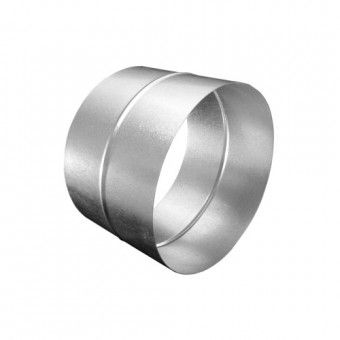
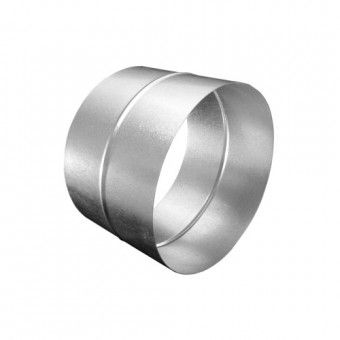
MF 160 Coupler — Ø160 mm Connector for Ventilation Ducting
What it does
The MF 160 coupler joins two ventilation fittings end to end: two sections of rigid ducting, two bends, a bend and a T-piece, or any combination of Ø160 mm components.
Its role isn't only to connect, but to keep the run aligned. An improvised joint, with sections forced into one another, distorts the cross-section and creates turbulence exactly at the transition point — adding pressure loss and noise for the entire life of the installation.
Ø160 or Ø150? Check before ordering
This is the most common mix-up with ducting accessories. One centimetre isn't visible by eye, but the coupler simply won't fit if the diameter doesn't match exactly.
How to check: measure the outside diameter of the existing duct or fitting — not the wall opening. If the system was installed by someone else and you have no documentation, send us a photo with a ruler next to the duct end and we'll confirm the diameter the same day.
For Ø150 mm systems, use the MF 150 coupler.
Where Ø160 mm is used
Ø160 mm appears where airflow exceeds what a Ø150 duct can carry comfortably without high velocities and noise:
- House heat recovery units — main supply and extract runs
- Small commercial spaces — consulting rooms, offices, shops
- Kitchen extract with high airflow or long runs
- Collector runs gathering several Ø125 or Ø150 branches
Practical rule: at the same airflow, a larger diameter means lower velocity — therefore less noise and lower fan consumption. Where space allows, Ø160 is the better choice over a forced Ø150.
Supplied without a gasket
Modern ventilation fittings come factory-fitted with a sealing gasket in the connecting end. The coupler is used together with these, so it needs no gasket of its own — a second one would be redundant and make assembly harder.
If your fittings have no gasket, you'll need a sealed version or separate taping. Ask us if you're unsure.
Installation and sealing
The connection is made by inserting both fittings into the coupler. No tools, no adhesives.
Practical recommendation: on long runs, continuously operating systems or ducting concealed above a false ceiling, add a wrap of aluminium tape over every joint. Individual leaks seem negligible but they add up: a system with 15 unsealed joints can lose a significant share of its design airflow — and with concealed ducting, fixing it later means taking down the ceiling.
Frequently bought with
FAQ
How do I know whether I need Ø160 or Ø150? Measure the outside diameter of your existing duct or fitting. If unsure, send us a photo with a ruler next to the duct end. For Ø150 use the MF 150 coupler.
Why does it have no gasket? Because it's used with fittings that already carry their own. A second seal would be redundant and make assembly harder.
Can I join a Ø160 duct to a Ø150 one? Not with a coupler — you need a Ø160/Ø150 reducer. A coupler joins components of the same diameter.
Is extra sealing required? Not necessarily, if your fittings are gasketed. On long runs, continuous systems or concealed ducting, taping the joint is still recommended.
Do you stock other diameters? Yes — our coupler range covers all common sizes. Just tell us what you need.
📞 +40 722 667 239 — we'll confirm the diameter and the accessories you need 💬 WhatsApp — send a photo of your ducting and get an answer the same day



















 Solutions KIT
 Sales
Sales


















 My account
 View cart