










 Solutions KIT
 Sales
Sales



















 My account
 View cart
Axial vs Centrifugal Fans: What's the Difference and When to Use Each
Axial or centrifugal? This article explains in plain terms how each fan type works, when to choose one over the other, and why the wrong choice can cost you performance.
One of the most common questions we receive from customers — whether installers, architects or homeowners trying to solve a ventilation problem themselves — is this: what's the difference between an axial fan and a centrifugal fan, and which one do I choose?
The short answer: it depends on your installation. The full answer is below.
How an Axial Fan Works
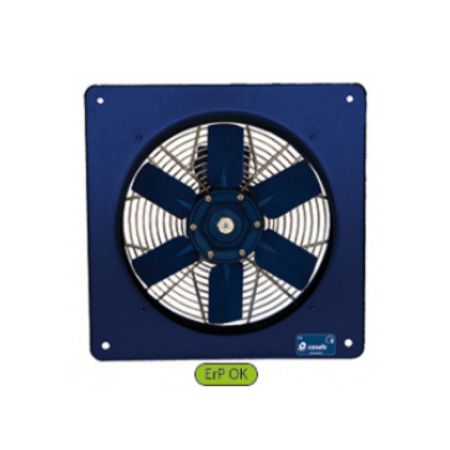
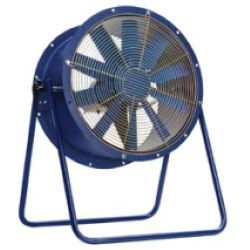
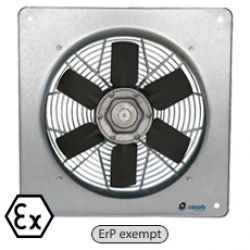
An axial fan moves air in a straight line, parallel to the axis of rotation of the rotor. Think of an aircraft propeller or a ceiling fan — air enters from the front and exits from the back, in the same direction.
The rotor of an axial fan has angled blades, similar to a propeller, which "cut" through the air and push it forward. The construction is simple, compact and relatively lightweight.
Key characteristics:
- High airflow at low static pressure
- Compact dimensions, low weight
- Simple installation, often directly through a wall or window
- Higher noise levels compared to centrifugal fans at similar airflow
- Good efficiency on short installations with minimal resistance
How a Centrifugal Fan Works
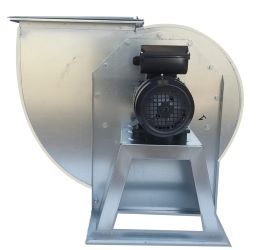
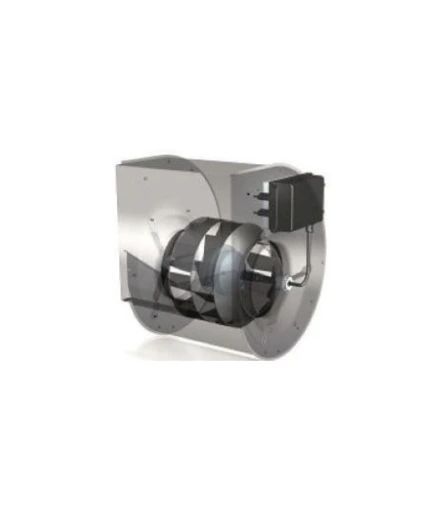
A centrifugal fan (also called a "squirrel cage" or "radial" fan) works differently: air enters axially (along the rotor axis), but is expelled radially (perpendicular to the axis), through a spiral-shaped casing — hence the common nickname "snail fan".
The centrifugal force generated by rotation accelerates air outward, and the spiral casing directs it towards the discharge outlet. The result is a static pressure far greater than that of a similarly sized axial fan.
Key characteristics:
- High static pressure — pushes air efficiently through long and complex installations
- Lower airflow than an axial fan of the same power, but with significantly superior pressure
- Quieter operation under the same load
- More robust, heavier construction
- Suitable for systems with ducting, filters, bends and multiple resistances
The Essential Difference: Static Pressure
If there's one thing to take away from this article, it's this: axial fans are for high airflow at low pressure; centrifugal fans are for high pressure, regardless of airflow.
Static pressure is the resistance the fan must overcome to move air. Every element of an installation — every metre of duct, every bend, every grille, every filter — adds resistance. The longer and more complex the installation, the higher the pressure required.
An axial fan works well when there is virtually nothing in its path — directly through a wall, through a window, or through a very short duct. If you place a few metres of duct with two bends and a grille in front of it, the real-world airflow drops dramatically compared to the manufacturer's specification. In an extreme case, it may move almost nothing — even while running at full speed.
A centrifugal fan is designed exactly for these situations. It maintains airflow even when installation resistance is high.
Quick Comparison Table
| Criterion | Axial | Centrifugal |
|---|---|---|
| Airflow direction | Axial (inline) | Radial (perpendicular) |
| Airflow volume | High | Medium–high |
| Static pressure | Low | High |
| Noise | Higher | Lower |
| Ducted installations | Poor for long runs | Ideal |
| Direct wall/window mounting | Ideal | Rarely used |
| Weight and size | Compact, light | Larger, heavier |
| Cost | Typically lower | Typically higher |
| Typical applications | Warehouses, equipment cooling, direct extraction | HVAC systems, residential ducted ventilation, industrial |
When to Choose an Axial Fan
Direct extraction through a wall or window
If your space has direct access to the outside and air doesn't need to travel through a duct run, an axial fan is the logical choice. Installation is simple: fit it into the wall or window opening and it works immediately.
Common applications: garages, workshops, small warehouses, utility spaces, farms, greenhouses.
Ventilating large-volume industrial buildings
High-ceilinged warehouses accumulate hot air under the roof. Large-diameter axial fans mounted in the roof or in upper side walls can evacuate enormous volumes of air with relatively low energy consumption. The required pressure is low — air exits directly to the outside.
Cooling equipment and electrical panels
Small axial fans are widely used for cooling electronic equipment, electrical switchboards and server cabinets. Their compact dimensions and good airflow at low resistance make them ideal for this application.
Air circulation in open spaces
Not all axial fans extract air outside — some simply circulate air within a space, for temperature equalisation or to create a comfortable draught. Typical applications: production halls, cold storage facilities, greenhouses.
👉 See the full range of axial fans — from compact models for electrical panels to large-diameter industrial fans.
When to Choose a Centrifugal Fan
Ducted ventilation systems
Any installation involving more than 2–3 metres of duct or more than one bend needs the pressure that a centrifugal fan provides. Residential ventilation systems with ducts running through false ceilings, commercial and industrial HVAC systems, and mechanical ventilation systems (MVHR) use centrifugal fans almost exclusively.
Quiet residential ventilation
If the fan will be installed in a bathroom, kitchen or bedroom where noise matters, centrifugal fans are quieter than axial fans at similar airflow rates. Many residential in-duct ventilation models use centrifugal fans for exactly this reason.
Systems with air filtration
Filters add significant resistance to an installation — the finer the filtration, the greater the resistance. An axial fan cannot maintain the required airflow in such systems. Centrifugal fans are the standard choice for any installation with filtration.
Commercial and industrial spaces with complex duct runs
Restaurants, offices, clinics, laboratories, controlled production spaces — all involve branched installations with multiple grilles, filters and long duct runs. Centrifugal fans handle these resistances without performance issues.
Pneumatic conveying and high-pressure applications
Pneumatic conveying of granules, powders or lightweight materials requires high static pressure. High-pressure centrifugal fans are the only suitable option for such applications.
👉 Explore centrifugal fans — available in residential, commercial and industrial variants, including ATEX and corrosion-resistant models.
Special Cases: When the Situation Isn't Clear-Cut
Inline fans
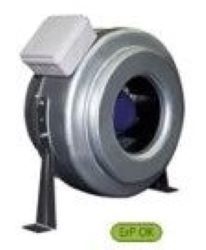
A useful intermediate category: inline fans are mounted directly in the duct, have a compact profile and offer better pressure than axial fans, though less than full centrifugal fans. They are suitable for light residential or commercial installations where there's no space for a standard centrifugal unit.
👉 Discover inline fans — a compact solution for space-constrained installations.
BOX-type fans
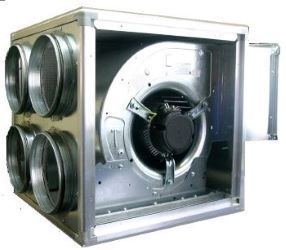
BOX fans are essentially centrifugal rotors mounted in a square casing without a spiral housing. They offer intermediate pressure and are commonly used in industry for local extraction, cooling or general ventilation in more demanding spaces.
👉 See BOX-type fans available in stock.
Explosive or corrosive environments
If your installation is in an environment with flammable vapours, explosive dust or corrosive substances, the type of fan (axial or centrifugal) matters less than its certification. Both axial and centrifugal fans are available in ATEX and corrosion-resistant variants — the choice between the two types follows the usual technical criteria, but the chosen unit must be certified for the specific environment.
👉 See the range of ATEX fans and corrosion-resistant fans.
Decide in 3 Questions
If you're still not sure after all of the above, answer these three questions:
1. Does air exit directly to the outside (through a wall or roof) or does it travel through a duct run? Directly outside → axial. Through ducts → centrifugal.
2. Does the installation have filters, multiple bends or air outlets at several points? Yes → centrifugal, regardless of duct length.
3. Is noise a significant concern? Yes → centrifugal or inline fan; avoid high-powered axial fans in occupied spaces.
Conclusion
Axial and centrifugal fans are not one better than the other in absolute terms — they are designed for different applications. The axial excels when air can exit directly, with no obstacles in the way; the centrifugal is indispensable when the installation puts resistance in the path of the air. The wrong choice doesn't necessarily produce a broken fan, but an underperforming one: insufficient airflow, unnecessary noise, or higher-than-needed energy consumption.
If you have a specific project and you're not sure which type suits you, our technical team can help you make the right choice from the start.
Find Both Fan Types at ventilation.ro
At ventilation.ro you have access to an extensive range of axial and centrifugal fans for any application — residential, commercial or industrial, including ATEX, corrosion-resistant and smoke extraction variants.
📞 Contact us for technical advice: +40 722 667 238
Relevant categories:


Post comment