









 Solutions KIT
 Sales
Sales
















 My account
 View cart
Industrial fans: complete buying guide — everything you need to know before you order
How to choose the right industrial fan? Types, airflow calculation, static pressure, ATEX, noise and pricing explained clearly. Complete guide with real examples.
If you're in the process of buying an industrial fan and don't know where to start — this article is for you. You won't find endless lists of technical specifications here. You'll find clear answers to the questions people ask most often before buying: what type of fan do I need, how do I calculate the airflow, what does static pressure mean, when is ATEX mandatory, and how do you avoid the classic mistakes that cost time and money.
What is an industrial fan and how is it different from an ordinary one?
An industrial fan is a mechanical ventilation unit designed for continuous operation under demanding conditions — high temperatures, dust, moisture, chemical substances — and for moving large volumes of air. Unlike a domestic or bathroom fan, an industrial fan:
- Runs for hours at a time, day after day, without interruption
- Is built from materials resistant to the specific conditions of the space (galvanised steel, polypropylene, fibreglass)
- Can move thousands or tens of thousands of m³ of air per hour
- Has motors rated IP55 or higher, resistant to dust and moisture
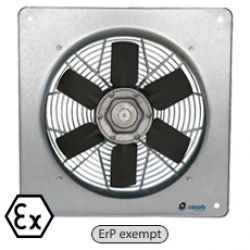
- Is available in certified variants for specialist applications: ATEX for explosive atmospheres, F300/F400 for smoke extraction in the event of fire
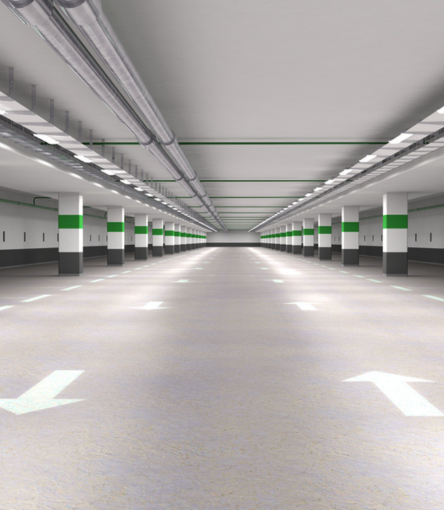
Industrial fans are wall-mounted, roof-mounted or installed in ventilation duct runs, and cover applications from production halls and logistics warehouses to spray booths, farms, greenhouses and underground car parks.
What are the main types of industrial fans?
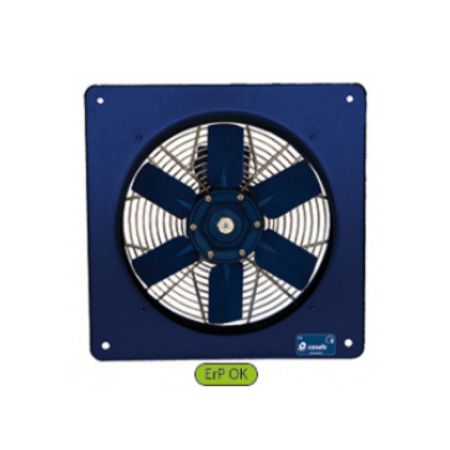
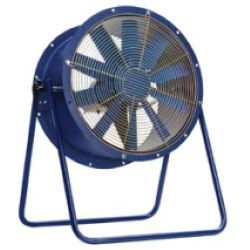
Industrial axial fans
Move air parallel to the rotor axis — like a propeller. Generate high airflow at low pressure. The ideal choice whenever air exits directly to the outside without travelling through long duct runs.
Where they are used: tall industrial halls where hot air accumulates under the roof, garages, workshops, warehouses, farms, greenhouses, direct extraction through an external wall or roof.
When they are NOT suitable: when the installation has long ducts (over 2-3 metres), multiple bends or filters — hydraulic resistance dramatically reduces the real airflow compared to the manufacturer's specification.
👉 See the range of industrial axial fans
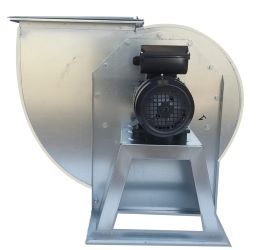
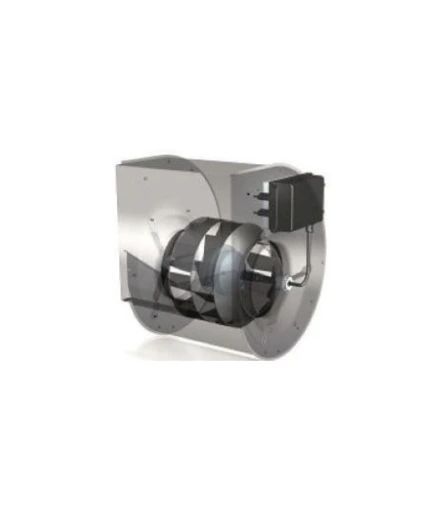
Industrial centrifugal fans
Draw air in axially and discharge it radially through the spiral casing (hence the common nickname "snail fan"). Generate high static pressure — they can push air efficiently through complex installations with long ducts, bends, filters and multiple grilles.
Where they are used: ducted ventilation systems in offices, commercial spaces, industry, medical facilities, industrial extraction hoods, any installation with a duct network.
Advantage over axial fans: they operate more quietly at similar airflow rates and maintain airflow even when installation resistance is high.
👉 See the range of centrifugal fans
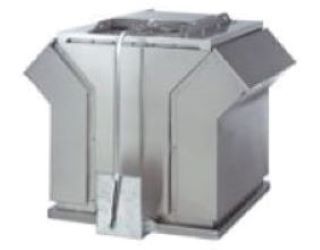
Roof extract fans (tureles)
Mounted on the roof, they extract warm air through natural thermal draught or mechanical means. Available as axial and centrifugal variants, with or without motor.
Where they are used: industrial halls, warehouses, shopping centres, any flat-roofed building where hot air stratifies at the top.
👉 See the range of industrial roof extract fans
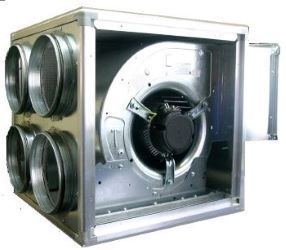
BOX fans
Centrifugal rotor in a square casing without a spiral housing. Intermediate pressure, flexible mounting in multiple discharge directions.
Where they are used: local extraction, equipment cooling in technical spaces, general ventilation in low-ceiling halls.
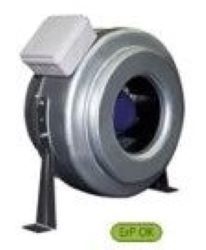
Inline fans
Mounted directly in the duct, invisible in the installation. An intermediate solution: better pressure than axial fans, more compact than classic centrifugal fans.
Where they are used: small offices, light residential or commercial ventilation, boosters on existing duct runs.
👉 See the range of inline fans
How do I calculate the airflow I need? (simple formula with examples)
This is the first calculation to make before anything else. Without the correct airflow, every other choice is arbitrary.
The basic formula
Required airflow (m³/h) = Space volume (m³) × Number of air changes per hour
Space volume = Length × Width × Height (in metres)
Recommended number of air changes per hour by space type
| Space type | Recommended changes/hour |
|---|---|
| Warehouse — low activity | 4–6 |
| Warehouse — high activity | 8–12 |
| Production hall — light loads | 8–15 |
| Production hall — heavy loads, heat sources | 20–40 |
| Spray booth, chemical emissions | 20–60 |
| Mechanical workshop | 10–20 |
| Professional kitchen | 30–60 |
| Underground car park | 4–6 (CO-regulated) |
| Livestock farm | 20–60 (seasonal variation) |
| Greenhouse | 40–60 (summer) |
| Office | 5–10 |
Practical examples
Example 1 — Warehouse: Warehouse 40m × 20m × 6m height = 4,800 m³ volume Required air changes: 8/hour Required airflow: 4,800 × 8 = 38,400 m³/h
At 10,000 m³/h per axial fan, you need 4 fans.
Example 2 — Production hall with thermal loads: Hall 60m × 30m × 8m = 14,400 m³ volume Required air changes: 20/hour (machinery with heat output) Required airflow: 14,400 × 20 = 288,000 m³/h
This requires a combined solution: large roof units plus high-diameter axial fans on the walls.
Example 3 — Small mechanical workshop: Workshop 15m × 8m × 4m = 480 m³ volume Required air changes: 15/hour Required airflow: 480 × 15 = 7,200 m³/h
A single axial fan rated at 7,500–8,000 m³/h solves the problem.
Important: The manufacturer's rated airflow is measured at zero static pressure. In practice, ducts, grilles, filters and bends reduce real airflow by 20–40%. Add this margin to your calculation.
On ventilation.ro there are two interactive tools:
- Duct pressure loss calculator — enter airflow, length, diameter, number of bends and filters → obtain total pressure loss in Pa
2. Required air ventilation airflow guide — step-by-step guide for airflow calculation based on space type
What is static pressure and why does it matter?
Static pressure (measured in Pascals — Pa) is the resistance the fan must overcome to move air through the installation. Every element of the installation adds resistance:
- 1 metre of circular ductwork ≈ 1–3 Pa
- A 90° bend ≈ 10–20 Pa
- A ventilation grille ≈ 5–15 Pa
- A clean G4 filter ≈ 20–50 Pa
- A clean F7 filter ≈ 50–100 Pa
Simple practical guide:
| Installation type | Required static pressure |
|---|---|
| Direct extraction through wall (no duct) | 10–30 Pa |
| Short duct 3–5 m, 1–2 bends | 50–100 Pa |
| Duct 10–20 m, multiple bends | 150–300 Pa |
| Complex system with filtration | 300–600 Pa |
| Pneumatic conveying, high pressure | 600–2,000+ Pa |
The practical consequence: an axial fan (max pressure 100–200 Pa) installed on a duct requiring 400 Pa will run, but will deliver far less airflow than its rated figure — sometimes below 30% of the specified airflow. This is one of the most common reasons why "the fan doesn't pull enough."
Axial or centrifugal? How to decide in 3 questions
Question 1: Does the air exit directly to outside or does it travel through ducts?
- Directly outside (through a wall or roof) → axial
- Through ducts → centrifugal
Question 2: Does the installation have filters, multiple bends or air outlets several metres away?
- Yes → centrifugal, regardless of duct length
- No → axial if the run is short and straightforward
Question 3: Is noise level important?
- Yes (offices, spaces with permanent staff) → centrifugal or inline fan
- No (halls, warehouses without permanent staff) → axial is acceptable
What does IP mean and which rating do I need?
IP (Ingress Protection) is the code indicating the degree of protection of the motor against dust and water. It consists of two digits:
- First digit = protection against solid particles and dust (0–6)
- Second digit = protection against water (0–9)
| IP code | What it means | Recommended for |
|---|---|---|
| IP20 | No special protection | Indoor electrical cabinets, dry environments |
| IP44 | Protection against splashing | Bathrooms, spaces with moderate humidity |
| IP54 | Dustproof + splash protected | Industrial standard, halls, workshops |
| IP55 | Dustproof + water jets | Wet spaces, food industry |
| IP65 | Fully dust-tight + water jets | Very humid environments, severe applications |
| IP66 | Fully dust-tight + powerful jets | Installations exposed to wash-down |
Minimum recommendation for industrial applications: IP54. For wet environments (swimming pools, food industry, laundries): IP55 or IP65.
When is an ATEX fan legally mandatory?
ATEX is legally mandatory (Directive 2014/34/EU) in any space where there is a risk of explosion from flammable gases, vapours or dust. This is not a recommendation — it is a legal requirement with criminal liability in the event of an incident.
Spaces requiring ATEX fans:
- Spray booths and surface coating workshops (solvent vapours)
- Fuel distribution stations
- Solvent, lacquer and flammable liquid storage
- Chemical and petrochemical industry
- Silos and mills (grain or flour dust)
- Woodworking factories (wood dust)
- Pharmaceutical industry (powders)
- Sewage treatment plants (methane)
- Battery manufacturing (hydrogen)
The common mistake: using a "high-quality" standard industrial fan instead of an ATEX one. Any non-ATEX fan is prohibited in these environments — the motor can produce electrical sparks that trigger an explosion.
👉 See the range of ATEX-certified explosion-proof fans
When do I need a corrosion-resistant fan?
Corrosion-resistant fans (built from polypropylene, PVC or fibreglass) are needed in environments with aggressive chemical agents that destroy galvanised steel or aluminium:
- Installations with hydrochloric, sulphuric or nitric acid vapours
- Electroplating and pickling halls
- Indoor swimming pools (chlorine vapour destroys a standard fan within 12–24 months)
- Wastewater treatment plants
- Chemical industry with corrosive substances
How to identify the need: if the metal equipment in the space shows accelerated rust or visible corrosion after a few years, a standard fan will not last either.
👉 See the range of corrosion-resistant fans
What are EC motor fans and is the higher price worth it?
EC (Electronically Commutated) motors are the current generation of fan motors: they combine a permanent magnet rotor with an integrated electronic controller.
Advantages over traditional AC motors:
- 30–50% lower energy consumption at partial loads (the most common operating regime in practice)
- Continuous speed adjustment via 0-10V or Modbus signal, without an external controller
- Lower noise levels at partial speeds
- Direct BMS integration and automation system compatibility
- Longer service life — less thermal stress on the motor
When the additional investment is worthwhile: any fan that operates more than 6–8 hours per day. The price difference compared to an AC motor is recovered in 1.5–3 years through electricity savings.
When it is not a priority: fans that run occasionally, a few hours per week.
👉 See the range of EC motor fans
What noise level should I choose?
Fan noise is measured in dB(A). Some useful reference points:
| Noise level | Equivalent | Recommended for |
|---|---|---|
| Below 35 dB(A) | Quiet library | Offices, spaces with permanent staff |
| 35–45 dB(A) | Normal conversation | Commercial spaces, light workshop |
| 45–60 dB(A) | Busy restaurant | Halls with noisy activity |
| Above 60 dB(A) | Street traffic | Heavy industrial halls (hearing protection mandatory above 85 dB) |
Factors that increase noise in practice:
- Fan undersized for the required airflow → runs at maximum speed constantly
- Duct too small → air velocity too high → aerodynamic noise
- Rigid mounting without flexible sleeve → motor vibration transmitted to building structure
- Grilles undersized for the airflow → whistling air through the grille
Single-phase or three-phase — what power supply do I need?
Single-phase (230V, 50Hz): available from any standard socket. Suitable for fans up to 1.5–2 kW — residential and light commercial applications.
Three-phase (230/400V, 50Hz): requires a three-phase distribution board. Mandatory for medium and large industrial fans (from 0.75–1 kW upwards for continuous operation). More energy-efficient, quieter and more durable than single-phase at equivalent power.
Practical rule: if your space has a three-phase distribution board (standard in any industrial or commercial building), choose three-phase motors for all industrial fans. If you only have single-phase 230V, single-phase industrial fans are available up to airflows of 15,000–20,000 m³/h.
What common mistakes should you avoid?
Mistake #1 — Choosing by price rather than application. A cheap fan in a corrosive environment or on a long duct run will prove far more expensive in the long run. Total cost of ownership (purchase + maintenance + premature replacements) looks completely different from the quoted price.
Mistake #2 — Undersizing. Calculations are made for average conditions, not for peak load. A hall with 50 active workers and machinery with thermal output requires a flow rate calculated for peak conditions, not the average.
Mistake #3 — Axial fan on a ducted installation. The most common reason for "the fan doesn't pull enough." An axial fan on a long duct with bends can deliver less than 30% of its rated airflow in practice.
Mistake #4 — Ignoring make-up air compensation. An extraction fan needs air to enter from somewhere in order to be effective. Without correctly sized fresh air inlets, the fan creates high negative pressure and low actual airflow — particularly in well-sealed halls.
Mistake #5 — Standard fan instead of ATEX. With potentially catastrophic consequences. There is no acceptable economic justification.
Mistake #6 — No flexible duct sleeve. Rigid fan mounting on ductwork transmits motor vibrations throughout the entire duct network and into the building structure. A flexible sleeve costs very little and eliminates the problem completely.
How to order correctly — what information is needed?
To receive a correct quotation or to select independently from the catalogue, prepare the following information:
- Type of space — hall, warehouse, workshop, kitchen, spray booth, etc.
- Space dimensions — length × width × height
- Calculated required airflow (or let us calculate it for you)
- Installation type — direct extraction through wall/roof or ducted system
- Duct length and configuration — if applicable (metres, number of bends)
- Conditions in the space — maximum temperature, moisture presence, chemical agents, dust, explosion risk
- Available power supply — single-phase 230V or three-phase 400V
- Special requirements — maximum noise level, ATEX certification, smoke extraction
Why buy from a direct importer?
As the sole importer in Romania of the Casals, Nicotra Gebhardt and Vent-Axia brands, ventilation.ro offers several concrete advantages over an intermediary distributor:
- Prices without intermediate margins — direct access to the manufacturer eliminates one level of pricing
- Permanent local stock for standard models — immediate delivery, no waiting for imports
- Access to the manufacturer's complete catalogue — including non-standard specification models or made-to-order items
- Technical documentation direct from the manufacturer — data sheets, performance curves, manuals, certificates
- Technical consultancy based on genuine product knowledge — not just what appears on a website
Conclusion: 5 steps to choosing the right industrial fan
Step 1: Calculate the required airflow — space volume × air changes per hour, with a 20–30% margin.
Step 2: Determine the installation type — direct extraction (axial) or ducted system (centrifugal).
Step 3: Calculate the static pressure required along the duct run.
Step 4: Check special requirements — ATEX, corrosion-resistant, certified smoke extraction, maximum noise level.
Step 5: Choose the power supply and control options — three-phase recommended for industrial use, EC motor for continuous operation.
If any of these steps creates uncertainty, we are available for free technical consultancy.
Explore the complete range of industrial fans at ventilation.ro
- Axial fans — direct extraction, high airflow
- Centrifugal fans — ducted systems, low/medium/high pressure
- Roof extract fans — roof ventilation
- ATEX explosion-proof fans — explosive atmosphere environments
- Corrosion-resistant fans — chemical environments
- EC motor fans — maximum energy efficiency
- Smoke extraction fans F300/F400 — certified smoke control
- BOX fans — versatile, flexible mounting
- Inline fans — compact, direct duct mounting
📞 Free technical consultancy: +40 722 667 238 Describe your space and the problem — we'll identify the right solution together.
Frequently asked questions (FAQ)
How much does an industrial fan cost? Prices vary enormously depending on type, airflow and certifications: from a few hundred lei for small axial models to tens of thousands of lei for large industrial fans or those with special certifications (ATEX, F400 smoke extraction). Contact us with your space specifications for an accurate quote.
Can I use a domestic axial fan in an industrial hall? No. Domestic fans are not designed for continuous operation or industrial conditions. Motor service life will drop dramatically, the warranty does not cover industrial use, and performance will be inadequate.
How many fans do I need for a warehouse or hall? It depends on the total required airflow and the rated airflow of each chosen fan. Formula: Total required airflow ÷ Airflow of one fan = Number of fans. Add a 20% margin and round up.
What happens if I oversize the fan? An oversized fan operates below its optimal airflow, with lower efficiency and may produce additional noise (turbulence). It is better to be slightly oversized than undersized, but correct calculation remains the ideal.
Do industrial fans require maintenance? Yes. Periodically: cleaning the rotor (dust and deposits), checking bearings, tightening mounting screws and replacing filters if present. A quality fan correctly maintained can operate for 15–20 years.
Can I order a fan with custom specifications? Yes. As direct importers from European manufacturers, we can access made-to-order models with particular specifications: non-standard voltages, special materials, atypical dimensions or combinations of characteristics not available in the standard catalogue.
Article created by the ventilation.ro team — IOANNINA IMPEX SRL


Post comment