








 Solutions KIT
 Sales
Sales













 My account
 View cart
 Ventilation for logistics halls and warehouses — legal obligations, the cost of mistakes and choosing the right equipment
Logistics hall ventilation: legal obligations, airflow calculation, permitted temperatures, smoke extraction and recommended equipment. Guide for managers and developers.
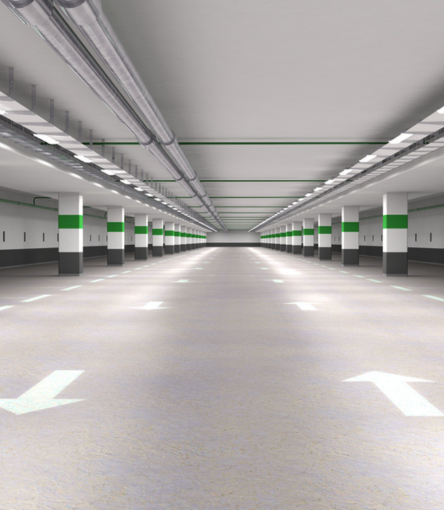
Romania now has over 7.5 million square metres of modern industrial and logistics space and continues to build at pace, driven by nearshoring and European funds. If you are an operations manager, facility director or developer designing or managing a logistics hall or warehouse, ventilation is one of those systems you ignore until it becomes a problem — and when it does, it becomes an expensive one.
This article is not written for engineers. It is written for decision-makers: what a wrong ventilation system costs, what you are legally required to provide, how to recognise that an existing installation is not working correctly, and which equipment makes the difference.
Why logistics hall ventilation is not optional
There are two arguments that matter to an operations manager: the legal one and the economic one.
The legal argument — Standard I5-2022
Standard I5-2022, in force since 2023, regulates the ventilation and air conditioning of all new industrial and storage buildings and those undergoing modernisation or change of use. It is not a recommendation — it is a mandatory technical requirement that forms part of the operating authorisation file.
Specifically, the standard requires:
- A minimum number of air changes per hour depending on activity type
- Maintaining indoor air quality below maximum admissible concentrations for specific pollutants
- Airflow control systems based on occupancy and activity
If your hall was built or renovated after 2023 without a ventilation system designed to I5-2022, the operating authorisation can be challenged at the first ISC or DSP inspection.
The economic argument — productivity and staff retention
Industrial ergonomics studies are consistent: at indoor hall temperatures above 28°C, warehouse staff productivity falls by 8–12% per additional degree Celsius. At 34°C — common in summer in unventilated metal halls — actual productivity is 40–50% below normal, workplace accidents increase and staff turnover soars.
Translated into operational figures: a 5,000 m² hall with 50 employees working at 34°C in summer loses the equivalent of 20 person-days per month compared to a hall ventilated to 26°C. At an average cost of 150 lei per person-day, that means 3,000 lei monthly loss from productivity alone — before accounting for recruitment and training costs for staff leaving due to conditions.
A correctly sized ventilation system for a 5,000 m² hall costs 30,000–80,000 lei — meaning it pays back through productivity in 1–2 years.
What temperatures are you required to provide for staff
Romanian labour legislation (GD 1091/2006 on minimum occupational safety and health requirements) imposes:
| Activity type | Minimum temperature (winter) | Maximum recommended temperature (summer) |
|---|---|---|
| Light physical work (office, light sorting) | 18°C | 26°C |
| Moderate physical work (picking, packing) | 16°C | 28°C |
| Heavy physical work (manual loading/unloading) | 14°C | 30°C |
The summer values are not strict legal limits, but exceeding them provides grounds for ITM enforcement action and employee complaints. In practice, a hall at 34°C in summer is a hall with high operational and legal risk.
How much air do you need? The quick calculation for managers
The basic formula is simple:
Required airflow (m³/h) = Hall volume (m³) × Air changes per hour
| Hall type / activity | Air changes/hour |
|---|---|
| Warehouse with low activity (pallet movements) | 4–6 |
| Warehouse with moderate activity (picking, sorting) | 6–10 |
| Distribution centre with intensive activity | 10–15 |
| Hall with heat-generating equipment (electric forklifts) | 12–20 |
Concrete example — 10,000 m² logistics warehouse:
- Hall volume: 10,000 m² × 9 m height = 90,000 m³
- Moderate activity: 8 changes/hour
- Required airflow: 90,000 × 8 = 720,000 m³/h
With a roof axial fan (roof unit) of 25,000 m³/h, you need a minimum of 29 roof units — or a combination of roof units and axial wall fans for optimal air distribution.
This is a simplified estimate. The precise calculation also accounts for equipment heat load, lighting and solar gain through the roof. The ventilation.ro team can perform the full calculation free of charge — contact us with the hall area and height.
The 3 ventilation systems for logistics halls — advantages and limitations
System 1 — Axial roof units + axial wall fans
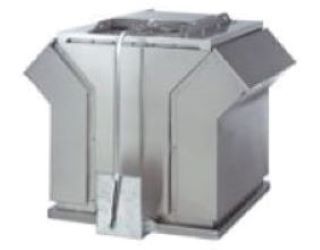
The most widely used in Romania. Roof units extract hot air accumulated at ceiling level, while wall fans introduce fresh air at the lower level. This creates a bottom-to-top airflow that eliminates thermal stratification.
Advantages: low initial cost, rapid installation, high airflow, simple maintenance. Limitations: works best in halls without complex internal partitioning. In warehouses with racking at 10–12 m, the vertical airflow must be calculated carefully to avoid dead zones.
Recommended equipment:
- Casals or Nicotra Gebhardt axial roof units, diameters 500–1,000 mm, airflows 8,000–40,000 m³/h per unit
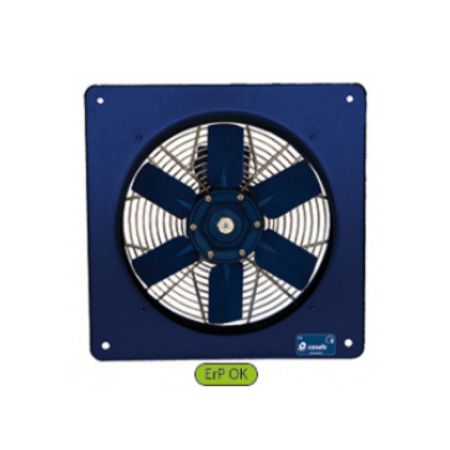
- IP55 three-phase axial wall fans for lateral air supply
👉 Axial roof units 👉 Axial wall fans
System 2 — EC motor axial roof units with automatic control
The intelligent variant of System 1. The integrated EC motor allows automatic speed adjustment based on hall temperature — roof units speed up as temperature rises, reduce speed at night and on cool days. Energy consumption falls by 30–50% compared to AC motors at average annual operation.
Advantages: significant electricity savings, constant comfort without manual intervention, integration with temperature sensors and BMS. Payback calculation: the price premium over AC is recovered in 12–24 months for halls operating 10+ hours per day.
Recommended equipment:
- Nicotra Gebhardt or Casals EC motor roof units, 0-10V signal, BMS compatible
- HVAC temperature sensors for automatic control
👉 EC motor roof units 👉 HVAC sensors for automatic control
System 3 — Belt-drive wall fans (for halls with elevated temperatures)
For halls with industrial processes generating significant heat — production lines, ovens, dryers. The motor is positioned outside the hot airstream, extending service life compared to direct-drive models.
Smoke extraction — a legal obligation ignored in many Romanian halls
The new Standard P118/1-2025, which came into force in May 2025, significantly tightened smoke extraction requirements for industrial and logistics halls. Any hall with a floor area exceeding 600 m² or a height exceeding 7 m must have a designed and certified smoke extraction system.
Smoke extraction systems for halls have two components:
Smoke evacuation — fans certified F300 or F400 to EN 12101-3, operating at 300°C or 400°C for 60 or 120 minutes. Every fan must carry notified body documentation.
Makeup air admission — for smoke to be efficiently extracted, there must be openings or inlet dampers introducing fresh air at the lower level while smoke is extracted at the top.
Practical warning: standard axial roof fans are NOT smoke extraction fans. They are different equipment with different certification. Installing a standard fan in place of a certified smoke extraction fan is illegal and invalidates all fire safety documentation for the building.
👉 Certified F300/F400 smoke extraction fans
Air curtains at access gates — real savings or a gadget?
Every logistics hall has access gates for HGVs and trucks that open dozens of times per day. Each opening introduces cold air in winter or warm air in summer, disrupting the internal microclimate.
Air curtains mounted above gates create an air barrier that separates interior from exterior without impeding the passage of people and vehicles. The benefits are quantifiable:
- Reduction in thermal losses through gates: 40–60% compared to uncurtained gates
- Elimination of draughts at operator level near the gates
- Prevention of insect and dust ingress from outside
For HGV gates (4 m × 4 m or larger), industrial air curtains with three-phase motors and high airflow are the correct solution — not undersized residential models that fail to cover the actual opening width.
Common mistakes in logistics hall ventilation — and what each costs
Mistake 1 — Undersizing for the actual activity. The initial design calculates ventilation for a simple storage warehouse. Actual activity becomes a distribution centre with 80 employees and 20 electric forklifts. Result: hall at 36°C in summer, low productivity, high staff turnover. The cost of post-opening correction is 2–3× higher than correct initial design.
Mistake 2 — Roof units without supply fans on the walls. The roof unit extracts air from above, but fresh air has no controlled path in. The hall goes into negative pressure, uncontrolled draughts through doors and gates, reduced extraction efficiency. Solution: balancing the system with supply fans at the lower level.
Mistake 3 — Missing or uncertified smoke extraction system. At the fire authority inspection, the hall receives a remediation notice. Operations may be suspended if non-conformities are deemed serious. Cost of a correctly installed certified smoke extraction system from the project stage: 15,000–50,000 lei. Cost of one day of suspended operations for a medium distribution centre: similar or higher.
Mistake 4 — AC motors instead of EC for continuous operation. A 1.5 kW AC roof unit running 14 hours/day, 250 days/year consumes 5,250 kWh annually. The EC equivalent consumes 3,150–3,675 kWh — saving 1,575–2,100 kWh per unit per year. For a hall with 20 roof units at an electricity tariff of 0.80 lei/kWh: annual saving of 25,200–33,600 lei.
Checklist — is your hall ventilation correctly sized?
Answer these 6 questions. If you have more than 2 negative answers, your installation has problems:
☐ Does indoor temperature exceed 30°C frequently in summer?
☐ Do staff complain of excessive heat or uneven air distribution?
☐ Are there areas of the hall where air feels stagnant or smells stale?
☐ Do the roof fans lack a separate certified smoke extraction system?
☐ Are there no fresh air supply fans at the lower level?
☐ Does ventilation energy consumption exceed 8–10% of total hall consumption?
How to order — the process with ventilation.ro
As direct importer of Casals, Nicotra Gebhardt and Vent-Axia, ventilation.ro can provide for your hall:
Free airflow calculation — send us the floor area, height, number of employees and activity type. We calculate the airflow, number of roof units and fans required and send you the technical specifications.
Complete technical documentation — original manufacturer data sheets, performance curves, CE declarations and, for smoke extraction, EN 12101-3 notified body documentation — everything needed for the authorisation file or for the installation designer.
Local stock in Romania — standard models available immediately, with no import lead times.
Formal quotation for tenders and projects — with complete specifications, fixed prices and delivery timescales.
📞 +40 722 667 238 🌐 ventilation.ro/en/category/341/aplicatii-industriale.html
Related articles: Complete industrial fans buying guide · Axial roof units · F300/F400 smoke extraction fans · Airflow calculator


Post comment