















 Solutions KIT
 Sales
Sales
















 My account
 View cart
 Mould in Bathroom and Flat — Where It Really Comes From and How to Get Rid of It Permanently
You have cleaned the mould with spray, with vinegar, with products from the supermarket. You have repainted. You may have replaced the silicone at the shower cubicle. And yet, a few months later, the black patches are back. If this has happened to you, it does not mean you cleaned badly — it means you treated the symptom, not the cause. This article explains where mould actually comes from, why chemical solutions work only temporarily, and what you need to do once to never see it again.
Where mould comes from — the answer nobody gives you
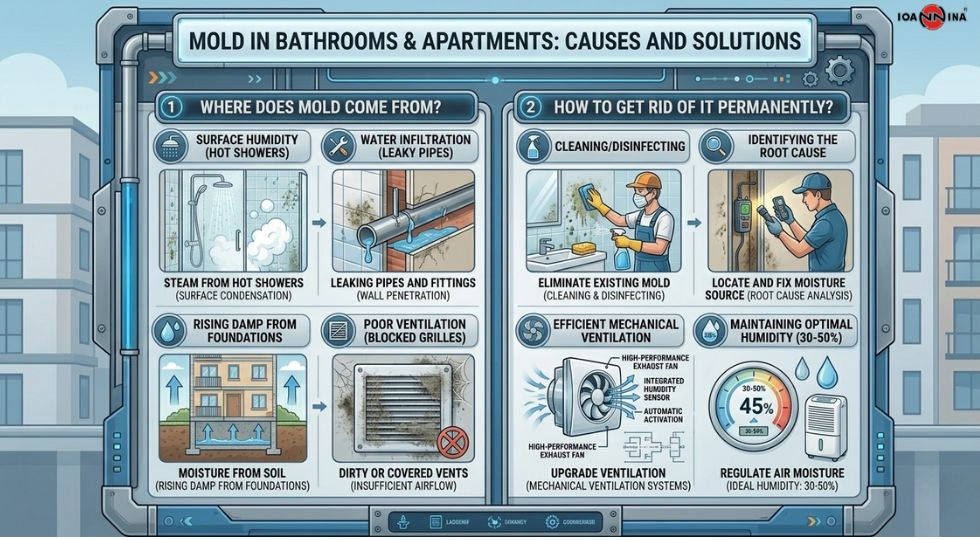
Mould does not come from dirt. Mould spores are permanently present in the air of every home, clean or not — this is normal and harmless as long as they do not have the conditions to grow.
The only condition spores need to grow: relative humidity above 65–70% on a surface, for a minimum of 24–48 hours.
The source of this humidity in 90% of Romanian flat cases is one thing: humid air from the bathroom and kitchen that is not efficiently evacuated and condenses on cold surfaces — ceiling, corners, exterior walls, windows, silicone sealants.
Why anti-mould spray doesn't solve the problem: Spray eliminates existing colonies from the surface. But if humidity continues to accumulate — because the fan is missing, undersized, or the building stack is blocked — spores from the air settle again on humid surfaces and recolonise in 6–12 weeks. You spray again. You buy again. Infinite cycle.
The real solution: eliminating the source of humidity through correct ventilation. Once the bathroom humidity is evacuated quickly and efficiently, mould spores no longer have growing conditions — regardless of how many are in the air.
The mould map — where it appears and what each location tells you
Where mould appears is not accidental. It tells you exactly what the source of the problem is:
Mould on the bathroom ceiling or shower/bath silicone
Cause: insufficient ventilation in the bathroom. Shower steam rises, condenses on the ceiling (coldest surface) and is not evacuated. Solution: correctly sized bathroom fan or replacement of the existing one with a more powerful model.
Mould on the exterior wall of the bedroom or living room (top corner)
Cause: exterior wall insufficiently insulated thermally + insufficient ventilation in the room. The wall is colder than the interior air, relative humidity at its surface exceeds 70%, mould colonises. Combined solution: improved thermal insulation of the wall + controlled ventilation with heat recovery (MVHR).
Mould on double-glazed windows (frames, sills)
Cause: generally elevated humidity in the flat + modern double-glazed windows are airtight and no longer allow the natural infiltration of cold air that used to ventilate older flats. Solution: mechanical controlled ventilation (MVHR) with heat recovery.
Mould in the kitchen (above the hob or on the back wall)
Cause: cooking steam and grease not evacuated. The kitchen fan or extractor hood is not working correctly, or recirculates air without evacuating humidity. Solution: correctly sized extractor with discharge to exterior (not recirculation type).
Mould on bedroom furniture or behind it
Cause: elevated humidity throughout the flat, combined with furniture close to the wall blocking air circulation. Solution: residential MVHR system that keeps humidity under control in all rooms.
Mould in a new flat or after renovation
Cause: new construction materials (concrete, screed, plasterboard) contain elevated humidity that evaporates slowly over the first 6–18 months. If the flat is not sufficiently ventilated during this period, mould is guaranteed. Solution: intensive ventilation during the drying period and permanent MVHR thereafter.
The measurement that tells you in 30 seconds whether you have a ventilation problem
Buy a digital hygrometer (available at any shop, 8–15 euros). Measure relative humidity in the bathroom 5 minutes after a 10-minute shower.
| Relative humidity 5 min after shower | Diagnosis |
|---|---|
| Below 70% | Ventilation is working well |
| 70–80% | Insufficient ventilation — mould risk |
| Above 80% | Weak or absent ventilation — mould is guaranteed over time |
Humidity in a well-ventilated bathroom returns below 65% within 15–20 minutes after the shower ends. If in your bathroom it takes 1–2 hours, you know exactly what the problem is.
Free alternative test: hold a piece of paper near the ventilation grille in the bathroom. If it is drawn toward the grille, the stack has draught. If it stays still or is pushed away, the stack is blocked or ventilation is completely absent.
Solutions, from simple to complete — by budget and type of dwelling
Solution 1 — Bathroom extractor fan (75–130 euros, solves bathroom mould permanently)
If mould appears exclusively in the bathroom and you have a functional building ventilation stack, a correctly sized bathroom fan solves the problem permanently.
What to know before buying:
Most common mistake: buying a fan that is too small. A Ø100 mm fan delivers 80–95 m³/h. A 6 m² bathroom requires at least 125 m³/h (8 air changes per hour). Conclusion: for any bathroom with a shower or bath larger than 5 m², you need Ø150 mm with 300–350 m³/h.
Second common mistake: fan without a timer. A fan that stops with the light stops exactly when steam is at its maximum — 3–5 minutes after the shower ends. You need a model with a run-on timer that continues operating for 10–20 minutes after the light is switched off.
Recommended models from ventilation.ro — Casals range, manufactured in Spain:
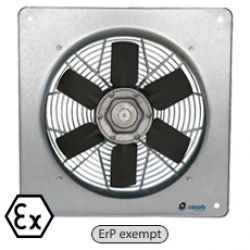
Casals Erelis 150 T — 340 m³/h, Ø150 mm, integrated run-on timer, 17 mm ultra-slim panel (sits completely within a false ceiling without protruding), 40,000+ hour bearings, IPX4. Our primary recommendation for any bathroom with a shower or bath.
Casals Lidero 150 — 340 m³/h, Ø150 mm, automatic backdraft damper. Best price-to-performance ratio in the Casals range. Available with timer.
Casals Tekstur 120 T — 180 m³/h, Ø120 mm, 3–20 min adjustable timer, paintable front panel (disappears into the bathroom wall). The right choice for small bathrooms (4–5 m²) where aesthetics matter.
👉 Complete range of Casals residential fans
Solution 2 — MVHR for the whole flat (650–2,000 euros, solves mould throughout the dwelling)
If mould appears in multiple rooms — bedroom, bathroom, kitchen, corners — the problem is not one missing fan. It is generally elevated humidity throughout the flat, which occurs when ventilation is insufficient in the whole dwelling.
This is the typical situation in new apartment blocks with very airtight double-glazed windows: old, humid air no longer exits naturally, humidity accumulation is continuous.
The correct solution: an MVHR (Mechanical Ventilation with Heat Recovery) system that supplies fresh air and extracts stale air from all rooms simultaneously, recovering 75–85% of thermal energy — so the heating bill does not increase.
Such a system automatically maintains relative humidity in the flat below 55–60% — below the mould development threshold — with no manual intervention.
Models available on ventilation.ro:
Vent-Axia HR 300 — 300 m³/h, mounted on the exterior wall of a single room (no ductwork). Quick solution for a bedroom or living room with chronic mould problems. Installation without major structural work.
Vent-Axia HR 500D — 550 m³/h, the more powerful version for large rooms or combined spaces.
Casals CHR 800 — central ductwork unit for the whole dwelling, 800 m³/h, for flats up to 80–100 m². The complete solution that ventilates all rooms uniformly simultaneously.
Casals CHR 1500 — 1,500 m³/h, for flats and houses up to 200 m².
👉 Complete range of heat recovery units
Quick comparison: which solution suits you
| Your situation | Correct solution | Indicative budget |
|---|---|---|
| Mould only on bathroom ceiling | Casals Ø150 mm fan with timer | 90–130 EUR + installation |
| Mould in bathroom + persistent smell | Casals Erelis 150 T + check building stack | 100–140 EUR |
| Mould in bedroom or on windows too | MVHR Vent-Axia HR 300 per affected room | 300–450 EUR/room |
| Mould in multiple rooms, new flat | Central MVHR Casals CHR 800 + ductwork | 900–1,500 EUR complete |
| New nZEB home or major renovation | Central MVHR CHR 1500 integrated at build | 1,300–2,200 EUR complete |
Why mould in modern apartment blocks is a growing problem
This is not a problem that existed in the same way 20–30 years ago. Older flats had air infiltration through window frames — they "breathed" naturally, with all their thermal inefficiency. Modern flats with double-glazed windows are airtight: energy consumption has fallen, but natural ventilation has disappeared.
The result: in modern well-insulated flats, every shower, every cooked meal, every person breathing adds humidity to the interior air without it naturally escaping. Without an active ventilation system, humidity concentration inevitably rises, creating perfect conditions for mould.
Relevant facts:
- One person produces through breathing ~0.4 litres of vapour per hour
- A 10-minute shower produces 150–200 ml of vapour
- Cooking for one hour produces 400–600 ml of vapour
- A family of 4 produces 8–12 litres of vapour per day inside the flat
Without active evacuation, all this vapour condenses somewhere in the flat. Where it finds the coldest surface, mould appears.
Common mistakes that keep the problem going indefinitely
Mistake 1 — Treating visible mould and ignoring what's behind the furniture Visible mould on the ceiling is 20% of the real problem. Behind the bedroom wardrobe, inside the plasterboard wall or under the floor, colonies can be 5–10 times larger. If you treat only the visible surface without fixing the ventilation, reproduction from invisible colonies continues.
Mistake 2 — Opening the window and thinking that's sufficient Airing for 5 minutes per day is insufficient and inefficient. It requires at least 15–20 minutes with the window fully open, 3–4 times per day, to effectively exchange the air in a room. In winter, this means massive heat losses and a higher bill. A bathroom fan or MVHR does the same air exchange automatically, continuously, without heat loss.
Mistake 3 — Using chlorine spray on silicone Chlorine bleaches surface mould patches but does not penetrate the silicone. Colonies inside survive and recolonise the surface in 4–8 weeks. The only effective treatment for mouldy silicone is complete replacement — followed by correct ventilation to prevent recurrence.
Mistake 4 — Applying anti-mould paint without fixing ventilation Anti-mould paints contain biocides that inhibit growth. They work for a few years, but if humidity is chronically high, the biocide is exhausted and mould returns. Anti-mould paint is an additional protective layer, not a primary solution.
Frequently asked questions
Is mould dangerous for health? Depends on type and concentration. Black mould (Stachybotrys) and yellow mould (Aspergillus) produce mycotoxins that can cause respiratory allergies, mucosal irritation and, in chronic exposure, can aggravate asthma or pulmonary conditions. Children and people with compromised immune systems are most vulnerable. At the first sign of mould, action must be immediate.
How much does it cost to get rid of mould permanently? Minimum solution (Casals bathroom fan with timer): 90–130 EUR + installation — solves bathroom mould permanently. Complete solution for the whole flat (centralised MVHR): 900–2,200 EUR complete installation. Cost of repeated chemical treatment every 6 months over 10 years: 150–300 EUR — without solving the problem.
Can a bathroom fan be installed without breaking the tiles? Yes. If there is an existing ventilation grille in the wall or ceiling, the fan mounts in its place without any tile work. If there is no grille, a Ø100–150 mm hole is drilled through the wall/ceiling — a matter of a few hours with a carbide-tipped drill bit.
What if the building's ventilation stack no longer draws? A frequent problem in older blocks. The stack may be blocked by debris from another flat, clogged with dust or reversed by other fans. Solution: a more powerful fan motor can force a weak draught, but for completely blocked stacks the building management must intervene. Alternative: a separate duct directly through the exterior wall, independent of the building stack.
Are you sure your ventilation is working? The 3-step test
Step 1: Buy a digital hygrometer (8–15 euros, any shop). Measure humidity in the bathroom 5 minutes after a shower. If it exceeds 80% — you have a problem.
Step 2: Hold a piece of paper near the ventilation grille. If it is not drawn toward the grille — the stack is not working or ventilation is absent.
Step 3: Call us. We tell you in 5 minutes what solution you need and at what cost.
Why ventilation.ro — direct importer, not intermediary
DIY chains and online marketplaces sell whatever brands they stock. At ventilation.ro, we exclusively sell premium brands that we import directly:
- Casals Spain — residential fans with 40,000+ hour bearings, IPX4, integrated timer, 24-month warranty
- Vent-Axia UK — single-room heat recovery units and residential MVHR systems
- Free consultancy — tell us your bathroom area, dwelling type and exact problem, we recommend the right solution
- Direct importer prices — no distributor mark-up
- Delivery from local stock — no import waiting time
📞 +40 722 667 238 — call now, we tell you free of charge which fan permanently solves your problem 🌐 Residential fans 🌐 Heat recovery units MVHR
Related articles: How to choose the right bathroom extractor fan — complete guide · Heat recovery for new homes 2026 · Airflow calculator


Post comment