











 Solutions KIT
 Sales
Sales










 My account
 View cart
High-Temperature Fans in 2026: F400 vs Continuous 250°C Operation — The Difference Nobody Explained to You
A customer orders a "high-temperature fan." They receive a certified F400 unit with full European approval. It gets mounted on a paint-drying oven. Three weeks later, the motor is burnt out.
Nobody made a deliberate mistake. The mistake was in the terminology — and in industry, wrong terminology costs tens of thousands of lei.
There are two completely different categories of fans that operate at elevated temperatures. They are designed for opposite situations and built with technologies that are not interchangeable. This article explains the difference, shows when each applies, and presents the specific products you can order in Romania today.
The Two Categories — It Is Not the Same Fan
The confusion arises because both categories get described with the same phrase: "resistant to high temperatures." But the underlying engineering is completely different.
Category 1 — Continuous operation in hot air (industrial processes)
The fan runs permanently — hours or days at a time — through air at elevated temperatures. Typical applications: drying ovens, thermal tunnels, industrial dryers, equipment cooling in hot production halls, food processing. The temperature of the transported air can reach 80°C, 110°C, 150°C or even 250°C depending on the process. What matters is that the motor and mechanical components must withstand this temperature continuously (duty cycle S1) — not for a few minutes or hours, but permanently.
Category 2 — Fire resistance for smoke extraction (F300 / F400)
The fan does not normally operate at 300°C or 400°C. It is a fire safety device that activates exclusively in an emergency and must operate for a maximum of 2 hours at its certified temperature — long enough for occupants to evacuate the building. During normal operation it runs at ambient air temperature. The applicable European standard is EN 12101-3:2015, and in Romania it is mandated by fire safety regulation P118-1:2025.
| Characteristic | Continuous operation | F300 / F400 |
|---|---|---|
| Working temperature | 80°C–250°C | 300°C–400°C |
| Duration at max. temp. | Continuous, 24/7 | Maximum 2 hours |
| Purpose | Active industrial process | Fire emergency |
| Motor duty | S1 (continuous) | S2 (short-time) |
| Applicable standard | ErP, IE2/IE3 | EN 12101-3:2015, P118 |
| Certification required | Not mandatory | Yes — APPLUS or equivalent |
The classic mistake: An F400 fan is purchased for a drying oven. The F400 is engineered to survive 2 hours at 400°C under emergency conditions — not to run continuously at 150°C. The S2-rated motor is not thermally dimensioned for permanent operation and deteriorates rapidly.
Fans for Continuous Operation in Hot Air
If your application involves permanently transporting hot air — an oven, thermal tunnel, dryer, or equipment cooling — you need a fan designed for S1 duty at that specific temperature.
What to check when selecting
Temperature of the transported air — this is the temperature of the air passing through the fan, not the ambient temperature. These are two distinct values in the datasheet: air temperature and ambient temperature (usually lower).
Motor insulation class — Class F (max 155°C), Class H (max 180°C). For higher air temperatures, the motor must be appropriately rated or positioned outside the airflow.
Material of the impeller and casing — rolled steel or stainless steel for high temperatures; aluminium for moderate temperatures. Stainless casings are also recommended when the air contains aggressive vapours.
Motor position relative to the airflow — at high temperatures, a motor positioned outside the airflow is essential to prevent direct thermal exposure.
Products available in Romania
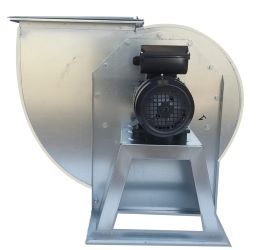
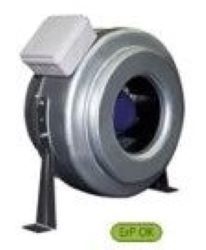
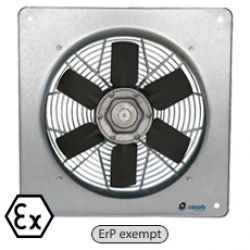
CF 0.5 HP 200 M4 — Casals Medium-pressure centrifugal fan designed for continuous operation between -20°C and +150°C for the transported air. IE2 motor, IP55, Class F insulation. Mounted on vibration-absorbing brackets — reducing noise and mechanical wear. Variable speed, controllable by voltage and frequency — allowing airflow to be matched to process requirements. Steel casing with heat-resistant coating.
Direct applications: industrial hoods, paint drying ovens, thermal tunnels, textile dryers, ceramic industry, electrical equipment cooling in hot production halls.
MB 12/5 T4 0.08kW — Casals Compact centrifugal fan, available in a version for air temperatures up to 250°C. Rolled steel casing with polyester finish. Standard asynchronous motor, IP-55. Also available in stainless steel for corrosive environments.
Maximum airflow: 250 m³/h. Compact dimensions — ideal for integration into installations with limited space.
Direct applications: hot air transport in high-temperature industrial processes, cooling of heat-generating machines, evacuation of hot vapours from equipment.
Technical note: For operating temperatures above 80°C, it is mandatory to verify the performance curve at the actual working temperature, not at the standard test temperature (20°C). Both airflow and static pressure decrease as temperature rises, due to the reduction in air density. A correction factor must be applied during system design.
F300 and F400 Fans — Fire Safety Equipment
These fans have a single purpose: to operate in the event of fire, at 300 or 400 degrees Celsius, for 2 hours, so that smoke and toxic gases are evacuated from the building — enabling occupant evacuation and firefighter access.
They are not process fans. They are not dimensioned for permanent operation at their certified temperatures.
What Romanian regulations require
Fire regulation P118-1:2025 (currently in force) mandates the installation of smoke extraction systems in:
- Underground and covered car parks with area > 300 m²
- High-rise (IGH) and very high-rise (IVGH) buildings
- Shopping centres, theatres, hospitals
- Industrial halls with a high fire risk
Fans used in these systems must be certified under EN 12101-3:2015 by a European notified laboratory. Ventilation.ro supplies exclusively Casals products approved by APPLUS — one of Europe's leading reference laboratories for this certification.
Products available in Romania
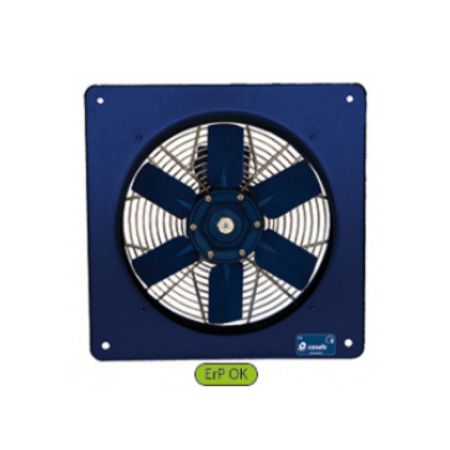
HBF 50 T4 0.75kW — Casals | Fire resistance F300 (300°C/2h) Industrial axial fan, asynchronous motor IP-55, Class H insulation, certified 300°C/2 hours. Ideal for medium-risk buildings where the regulation requires F300 — warehouses, medium-sized office buildings, production units. Anti-corrosion treated casing.
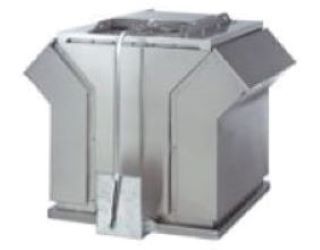
DHUMAT 400 T4 0.75kW F400 — Casals | Fire resistance F400 (400°C/2h) Centrifugal roof fan, designed for roof mounting or vertical duct installation. Maximum airflow: 4,890 m³/h. Casing in galvanised steel sheet with connecting flanges and inspection door for easy maintenance. Self-cleaning, dynamically balanced centrifugal impeller with backward-swept blades. Continuous operation possible up to 110°C (S1 duty).
Certification: APPLUS, EN 12101-3:2015, No: 0370-CPR-2681.
Applications: covered car parks, tertiary buildings (IGH and ERP), high fire-risk industrial facilities.
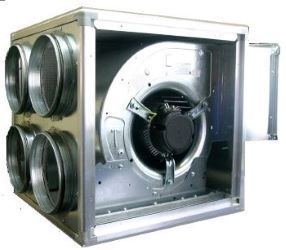
BOX BSTB 400 F400 1.5kW — Casals | Fire resistance F400 (400°C/2h) Centrifugal fan in a sound-insulated box — the ideal solution when noise attenuation is important or when the plant room is space-constrained. Maximum airflow: 8,710 m³/h. Continuous operation up to 130°C (S1 duty) — can be used as a process fan as well as for emergency use. Available with options: two-speed motor, custom outlet orientations LG90/LG0.
Certification: APPLUS, EN 12101-3:2015, No: 0370-CPR-1371.
Applications: large professional kitchens, combined ventilation + smoke extraction systems, refurbishments where plant room space is limited.
DHUMAT 355 T2 2.2kW F400 — Casals | Fire resistance F400 (400°C/2h) Higher-power centrifugal roof fan for applications requiring greater airflow. Same construction features as the DHUMAT 400 T4, 2.2kW motor for larger areas or multi-zone smoke extraction systems.
HMF 80 T4 2.2kW — Casals | Fire resistance F400 (400°C/2h) Large-capacity industrial axial fan — maximum airflow 37,370 m³/h. Long, robust casing with modular motor-rotor assembly. Cast aluminium impeller with variable blade pitch. Asynchronous motor IP-55, Class H, F400 certified. IE3 motor from 0.75kW to 45kW. Motor access door for easy connection and maintenance.
Certification: EN 12101-3:2015.
Applications: large industrial halls, perimeter smoke extraction, multi-zone systems.
IGNÉO 711 T4 7.5kW — Casals | Fire resistance F400 (400°C/2h) Medium-pressure centrifugal fan for large-scale projects. Maximum airflow: 28,410 m³/h. Reinforced carbon rolled-steel casing. Motor with S1 service class for continuous operation. Maximum transported air temperature: 130°C (S1) or 400°C/2h (S2). Approved by APPLUS under EN 12101-3:2015.
Applications: large multi-storey buildings, shopping centres, hospitals, upper-category hotels, projects where a single fan covers a very high airflow requirement.
Quick Decision Table
Use this table to identify the right product based on your application:
| Application | Operating condition | Recommended product |
|---|---|---|
| Industrial hood, drying oven | 150°C continuous | CF 0.5 HP 200 M4 |
| Hot air transport in process | up to 250°C continuous | MB 12/5 T4 |
| Smoke extraction, medium buildings | F300, emergency | HBF 50 T4 |
| Car parks / small IGH smoke extraction | F400, emergency, low flow | DHUMAT 400 T4 |
| Combined ventilation + smoke extraction | F400, continuous to 130°C | BOX BSTB 400 F400 |
| Industrial hall smoke extraction | F400, high airflow | HMF 80 T4 |
| Large complex project | F400, very high airflow | IGNÉO 711 T4 |
How to Size Correctly — Three Mandatory Parameters
Regardless of category, selecting a fan for high-temperature applications requires at minimum three parameters from the designer or end user:
1. Actual transported air temperature Not the ambient temperature, but the temperature of the air passing through the fan. The difference can be significant.
2. Required airflow (m³/h) Calculated from the volume of the space, the number of air changes per hour required by the applicable standard, and the correction factor for air density at the working temperature.
Airflow correction formula:
Q_actual = Q_standard × (293 / (273 + T°C))
Example: at 150°C, the factor = 293/423 = 0.69 → actual airflow is 31% lower than at 20°C.
3. Required static pressure (Pa) Determined by the length and configuration of the ductwork. At elevated temperatures, air viscosity increases slightly, but the dominant effect remains the reduction in air density.
Documentation Required for Purchase and Installation
For F300/F400 fans used in smoke extraction systems, the mandatory documentation includes:
- Certificate of conformity to EN 12101-3:2015 issued by a notified body (APPLUS for Casals products)
- Declaration of Performance (DoP) under Regulation 305/2011 (CPR)
- Technical datasheet with performance curves at the certification temperature
- Ventilation installation schematic prepared by an accredited designer
- Commissioning record and entry in the building's technical log
All Casals products available from ventilation.ro are supplied with complete technical documentation and certificates valid in Romania.
Frequently Asked Questions
Can I use an F400 fan for an industrial oven running continuously at 200°C? No. An F400 fan is designed for emergency duty (S2) — short-duration operation at extreme temperatures. The motor is not dimensioned for continuous operation at 200°C. You need a fan explicitly designed for S1 duty at your process temperature.
What is the difference between "transported air temperature" and "ambient temperature"? Transported air temperature is the temperature of the air passing through the fan, which the fan must withstand. Ambient temperature is the temperature surrounding the casing and motor. Both values appear in technical datasheets — for example: "transported air 110°C, ambient 60°C."
Is F400 mandatory or can F300 be used? It depends on regulation P118-1:2025 and the building's fire risk classification. F300 is permitted for some building categories; F400 is required for car parks, IGH buildings and high-risk structures. The fire safety designer specifies the required certification.
How much does maintenance of a smoke extraction fan cost? The regulation requires annual periodic inspections and functional tests. Casals products feature a modular motor-rotor assembly — replacement is carried out without dismantling the casing, significantly reducing maintenance costs.
Can I order a fan with a special voltage (60Hz) or for export markets? Yes. Products from the IGNÉO and DHUMAT ranges are available on request for 60Hz frequencies and special voltages. Contact the ventilation.ro team for non-standard specifications.
Conclusion
Confusing fans for continuous high-temperature operation with F300/F400 certified smoke extraction fans is not a minor error — it can result in destroyed equipment, significant replacement costs, and, in the case of smoke extraction systems, non-compliance with regulation P118 and genuine risk in the event of fire.
The simple rule: if the air is always hot, you need S1 duty at the process temperature. If you are talking about fire, you need F300 or F400 with an EN 12101-3:2015 certificate.
Ventilation.ro stocks and delivers across Romania the full Casals range for both applications — with complete documentation and free technical consultation to ensure the right selection.
Contact the ventilation.ro team for free technical consultation →
Technical references: EN 12101-3:2015, Romanian Fire Regulation P118-1:2025, Casals technical documentation, ErP Regulation 327/2011/EU.


Post comment