













 Solutions KIT
 Sales
Sales
















 My account
 View cart
Home Ventilation, Room by Room: Which Fan to Choose for the Bathroom, Kitchen, Bedroom, Laundry and Garage — The Complete 2026 Guide
A family of four releases 10–15 litres of water into the air of their home every single day — from breathing, showering, cooking and drying laundry. If that water is not extracted in a controlled way, it settles exactly where you only notice it too late: on windows as condensation, in cold corners as mould, inside the walls as damp. Add the CO₂ that builds up overnight in a closed bedroom — crossing the threshold where sleep becomes shallow — and you have the full portrait of an unventilated home.
The good news: every room has a precise ventilation solution, and the cost of a correct whole-house system is almost always lower than a single post-mould renovation. This guide walks through the home room by room — exactly like the application schematics of European manufacturers — and shows you which equipment fits, what airflow is needed and which mistakes to avoid.
The house test · Bathroom & WC · Kitchen · Bedroom · Laundry & pantry · Garage · Complete shopping list
The basic rule: extract from "wet" rooms, supply into "dry" ones
Every correct residential ventilation system works on the same principle: stale air is extracted from the rooms that generate humidity and odours (bathroom, WC, kitchen, laundry, pantry), while fresh air enters the living rooms and bedrooms, flowing through the home from clean zones towards wet ones. Reverse the direction — or ventilate a single room in isolation — and odours and moisture migrate through the whole house.
Recommended indicative airflows for homes:
| Room | Recommended airflow | Mode |
|---|---|---|
| Bathroom with shower/bath | 50–110 m³/h | Intermittent, with timer or humidistat |
| Separate WC | 25–50 m³/h | Intermittent |
| Kitchen (general ventilation) | 60–120 m³/h | Intermittent + separate cooker hood |
| Bedroom | 0.5–1 air changes/hour | Continuous (fresh air supply) |
| Living room | 0.5–1 air changes/hour | Continuous |
| Laundry room | 60–100 m³/h | Intermittent or humidity-controlled |
| Pantry | 15–30 m³/h | Continuous at low speed |
| Attached garage | 4–6 air changes/hour | During use |
Legal framework: in Romania, ventilation system design is governed by Standard I5-2022 (approved by Order 173/2023, in force since February 2023), which sets minimum airflows and air change rates per room type. The values in the table are common European practice recommendations aligned with this framework; for exact sizing use our airflow calculation guide or call us.
The test for your home: 7 signs ventilation is failing
Before choosing equipment, run this 2-minute diagnosis. Each symptom points to a precise problem — and a precise solution:
| Symptom | What it actually means | The solution |
|---|---|---|
| Condensation on windows in the morning | Humidity above 60% + stagnant air overnight | Continuous fresh air supply (heat recovery) |
| Mould in bathroom corners | Missing or undersized extraction | Correctly sized extractor with humidistat |
| Mirror stays fogged >10 min after a shower | Insufficient airflow or no make-up air | Stronger fan + 1–1.5 cm gap under the door |
| Cooking smells reach the bedrooms | Air circulation direction reversed | Extract in the kitchen, supply in the rooms |
| Waking up with "heavy air" and headaches | CO₂ built up overnight in the closed bedroom | Fresh air supply into the bedroom |
| Laundry dries slowly, smells musty | Chronic humidity in the laundry room/house | Humidity-controlled extractor in the laundry |
| Petrol smell in the hallway next to the garage | Garage air migrating into the home | Garage extractor + sealing the access door |
If you ticked 3 or more: your home has a system problem, not a room problem — read the guide to the end, then let's talk.
The bathroom and WC — where every system starts
The short answer: a bathroom with a shower needs a 50–110 m³/h extractor with a backdraught damper, ideally with a humidity sensor, wall or ceiling mounted; a separate WC needs only 25–50 m³/h. Realistic budget: 250–670 lei for a European-brand model that solves condensation for good.
The bathroom produces the largest amount of humidity in the house: a single shower releases hundreds of grams of vapour into the air. Without extraction, it condenses on cold walls and feeds mould.
What to choose:
- Bathroom with an external wall/ceiling or short ductwork — an axial bathroom extractor with an automatic backdraught damper. Noise matters next to bedrooms: modern slim models drop below the annoyance threshold even in en-suites.
- Windowless bathroom with long ductwork — an inline mixed-flow fan mounted in the loft or above the false ceiling, with a discreet grille in the bathroom. It pushes air through several metres of duct without losing flow.
- The automation that makes the difference — timer versions keep extracting 5–15 minutes after the light goes off, while humidity sensor (humidistat) versions switch on by themselves exactly when needed. For children's bathrooms or rented homes, the humidistat is the safest anti-mould investment.
The classic mistake: an undersized fan "because it's just a small bathroom", plus no 1–1.5 cm gap under the door for make-up air. An extractor with no incoming air pulls in vain.
Our in-stock recommendations, on three budgets
| Option | Model | What you get | Indicative price |
|---|---|---|---|
| Budget | Vent-Axia Basics 150 SLT | 5–30 min timer + backdraught damper — solves the standard bathroom | ~258 lei |
| Silent | Vent-Axia Silent VASF 100 T | 12 dB(A) — practically inaudible, ideal next to a bedroom, timer | ~570 lei |
| Automatic | Vent-Axia Silent VASF 100 HT | 12 dB(A) + humidity sensor + timer, IPX5, 2 speeds — switches itself on, you forget it exists | ~745 lei |
Prices include VAT and may vary — check the product page. All models are in stock with fast delivery and a 24-month warranty.
The difference in short: all three remove steam — but the humidistat model does it even when nobody is home to switch the light on: after drying laundry in the bathroom, after the children's baths, in rented flats. For recurring mould, it is the only option we recommend without reservation.
💬 Not sure which fits? Send a photo of your bathroom and the existing outlet on WhatsApp — we reply the same day with the exact model.
The Casals alternatives in stock — for those who prefer the Spanish desigNtial range: Lidero 150 (340 m³/h, automatic damper — the robust option), Erelis 150 T (340 m³/h, ultra-thin 17 mm panel that sits flush with the false ceiling, timer) and Tekstür 120 T (double-textured panel paintable in your wall colour — the only extractor that visually disappears into the bathroom).
For the separate WC, without a shower: you don't need 340 m³/h — Casals Tekstür 100 T (85 m³/h) delivers 15–20 air changes per hour in a 2–3 m² WC, with timer and the same paintable panel, in a compact Ø100 mm format.
The kitchen — the cooker hood is not enough
The hood handles vapour and grease above the hob, but not the general ventilation of the room: boiling humidity, lingering smells and the CO₂ from a gas cooker stay in the air.
What to choose: a wall or window extractor separate from the hood. In stock: Vent-Axia TX 9 WW (~2,038 lei) — the UK's no. 1 window fan for decades: 795 m³/h, dual direction (extracts and supplies air), patented electronic shutter that seals shut when off, mounts directly in double glazing up to 32 mm — no wall drilling, ideal for flats. For smaller kitchens, its sibling TX 7 WW (485 m³/h) does the same job at a smaller scale.
Important: the hood and the extractor are never connected to the same ductwork, and in kitchens with a naturally vented boiler, forced extraction must be sized carefully — always ask for a professional check.
The bedroom — where ventilation is felt the most
The short answer: you don't install an extractor in a bedroom — you install a fresh air source: a heat recovery unit continuously supplying 15–60 m³/h of pre-warmed air, keeping CO₂ below the 1,000–1,500 ppm threshold where sleep quality degrades. The whole-home alternative: a central MVHR unit with 90% recovery.
Overnight, in a closed bedroom, the CO₂ concentration quickly climbs past the point where sleep becomes shallow and waking up feels tired. Here you don't extract — you supply fresh air, without losing heat and without noise.
The modern solution: heat recovery. For individual rooms, wall-mounted recovery units supply fresh air and extract stale air through a single opening, recovering 70–80% of the heat — contact us for available models. For flats and whole houses, the in-stock solution is the Vent-Axia Lo-Carbon Sentinel Kinetic BH — an MVHR unit with 90% heat recovery, integrated humidity sensor and EC motor, so compact it fits inside a standard 600 mm kitchen cupboard: bedrooms continuously receive pre-warmed fresh air, bathrooms are extracted automatically, and in winter you stop losing heat through open windows.
👉 Heat recovery units — residential range
The lounge — continuous, discreet comfort
The same principles as the bedroom: continuous fresh air supply, at low flow, silent. Room recovery units work excellently here too, and in houses with a central system the lounge receives the main supply grilles. For living rooms with a fireplace, beware: fire consumes oxygen and needs a dedicated air supply — never extraction only.
The laundry room and pantry — small rooms, big problems
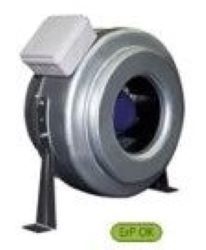
The laundry room concentrates the dryer, the washing machine and drying laundry — constant humidity in a small space. In stock: Vent-Axia ACM 100 / 100T — an inline mixed-flow fan delivering 306 m³/h at only 16 dB(A) on low speed, mounted on ductwork above the ceiling; the 100T version includes a timer. Unlike simple axials, the mixed-flow geometry maintains airflow even on long duct runs with bends.
The pantry needs little, but continuously: 15–30 m³/h at low speed keeps the air dry and the temperature even, extending food life. The same ACM 100 on its lowest speed, or a small inline fan on a timer, is enough.
The attached garage — safety, not just comfort
The garage attached to the house is the one room where ventilation is a safety matter: engine carbon monoxide and fuel vapours have no business in air that migrates towards the home. A wall extractor with a backdraught damper, sized at 4–6 air changes per hour, switched on at every use (ideally on a sensor or linked to the garage door), solves it. In workshop garages where paints or solvents are used, increase the airflow accordingly.
The barbecue and fireplace — the special case on the roof
For outdoor barbecues and fireplaces with difficult draught there is a dedicated category: roof fans for hot flue gases (such as the Casals Focceta), built to withstand combustion gas temperatures and guarantee draught regardless of wind. Mounted at the top of the chimney, they turn any "smoky" fireplace into one that draws perfectly.
The whole house: the central ducted system
For new builds or major renovations, the complete solution is centralised mechanical ventilation with heat recovery (MVHR): a unit in the loft or utility space, ductwork to every room, extraction from wet zones and supply into dry ones — all silent, filtered and with minimal heat loss.
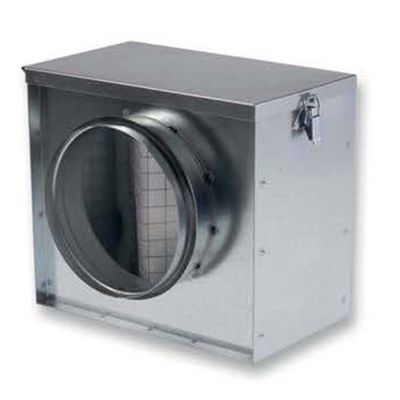
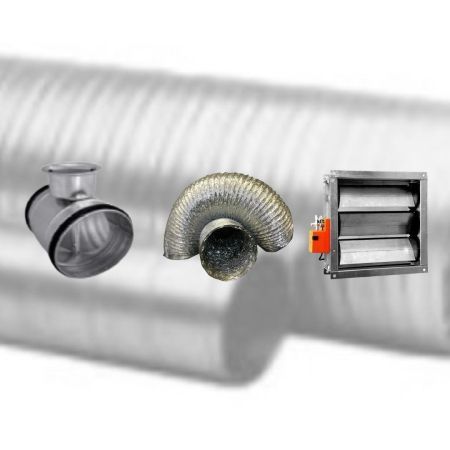
The system components, all in stock: the central unit — Sentinel Kinetic BH for flats and houses (90% recovery, 600 mm cupboard) or the Casals CHR range for large houses and commercial spaces (8 models, 800–6,000 m³/h, Eurovent-certified aluminium exchanger, low-profile from 300 mm height, starting with the CHR 800); inline ACM fans for individual runs; F100–F300 filter boxes with G4 filters on the fresh air intake; and ductwork with accessories — don't forget the aluminium sealing tape, without which any system loses airflow.
EC motors deserve a separate mention: they consume 40–60% less than AC equivalents and comply with the new European efficiency requirements of ErP 2026 — a criterion that matters for every purchase from now on.
The complete shopping list: the whole house, in one table
For those who want to solve everything in a single order — every zone, the recommended in-stock product and the indicative budget:
| Zone | Recommended product | Indicative price |
|---|---|---|
| Main bathroom | Vent-Axia Silent VASF 100 HT (humidistat) or Casals Erelis 150 T | ~450–670 lei |
| Second bathroom | Vent-Axia Basics 150 SLT or Casals Lidero 150 | ~250–400 lei |
| Separate WC | Casals Tekstür 100 T (paintable panel) | ~300–400 lei |
| Kitchen (besides the hood) | Vent-Axia TX 9 WW — window mount, dual direction | ~2,040 lei |
| Bedrooms + lounge (fresh air) | Sentinel Kinetic BH — MVHR 90% recovery, whole home | ~12,650 lei |
| Laundry room | Vent-Axia ACM 100T — inline, 16 dB(A), timer | ~500–700 lei |
| Pantry | ACM 100 on low speed or Ø100 inline | ~400–600 lei |
| Attached garage | Wall axial fan with backdraught damper | ~400–900 lei |
| Barbecue / fireplace | Roof fan for flue gases Focceta type | ~5.500 lei |
| Intake filtration | F filter box with G4 filter on your duct diameter | ~200–400 lei |
| Duct sealing | Aluminium tape 75 mm x 50 m — one roll covers the whole house | ~75 lei |
Two ways to use the table: the staged route — start with the bathrooms (under 1,000 lei) and add the rest over the following months; or the complete route — send us your room list on WhatsApp and receive a quote for the whole package, with project discount and single delivery. Prices include VAT and are indicative — check the product pages.
Where to start — 3 typical scenarios, with real budgets
Flat with condensation and mould — humidistat extractor in the bathroom + room heat recovery in the bedroom. Indicative budget: 1,500–3,000 lei including installation. Visible effect within the first week; bathroom mould disappears for good from 350–500 lei if you start with just the extractor.
Existing house, no ductwork — individual extractors in bathrooms, kitchen and laundry + room recovery units in bedrooms and lounge. Indicative budget: 4,000–9,000 lei, stageable room by room — start with the bathrooms this month, add the bedrooms next payday. No building site, no dust.
New build or major renovation — central MVHR system designed from the architecture phase. Indicative budget: from 3,500–8,000 lei for flats, more for houses depending on floor area. The lowest running cost and the best comfort — and for energy-efficient new homes, practically the only correct solution.
Budgets are indicative, for European-brand equipment with a 24-month warranty; your exact quote is free, based on your house plan.
Why buy from us and not from a DIY store
- Direct importers of Casals, Vent-Axia and Nicotra Gebhardt — no intermediaries, so fair prices on equipment DIY stores don't carry: motors with 40,000+ hour bearings, real humidistats, a measured 12 dB(A), not marketing "silent"
- Free sizing before purchase — we tell you exactly what airflow you need, so you neither overpay nor buy in vain
- Local stock and 24-month warranty — with spare parts and technical support afterwards, not just up to the checkout
As a direct importer, we hold the entire residential range in stock — from bathroom extractors to central units — and we help you size the solution for your home free of charge.
📞 +40 722 667 238 — free sizing consultancy, answered on the spot 💬 WhatsApp — send your house plan or photos and receive a concrete proposal with models and prices the same day
👉 Residential fans 👉 Complete KIT solutions 👉 General residential ventilation
Frequently asked questions
Is mechanical ventilation mandatory in a home? Standard I5-2022 requires indoor air quality and minimum fresh-air flows in the design of new buildings; the solution (natural, mechanical or hybrid) is set by the designer. In practice, in modern airtight homes (high-performance windows, insulation), mechanical ventilation is the only way to guarantee the flows — natural infiltration no longer exists.
What CO₂ level is acceptable in a bedroom? Below 1,000 ppm is considered good air quality; between 1,000 and 1,500 ppm the "heavy air" feeling and reduced sleep quality appear, and above 1,500 ppm most people feel the effects. In a closed bedroom with two people, the 1,500 ppm threshold is usually crossed in the first hours of the night — which is why continuous fresh-air supply matters more than airing out before bed.
What airflow should a bathroom fan have? Indicatively, 50–110 m³/h for a bathroom with a shower and 25–50 m³/h for a separate WC, depending on room volume and duct length. With ductwork over 2–3 m, choose an inline fan instead of a simple axial extractor.
Timer or humidity sensor? The timer is enough if users always switch the light/fan on. The humidistat works autonomously and is the safe choice for families with children, tenants, or condensation-prone bathrooms.
Does a room heat recovery unit create draughts? No — the flows are small (15–60 m³/h) and diffused, and the incoming air is pre-warmed by heat recovered from the extracted air, so there is no cold-draught sensation like an open window.
Can I connect a bathroom extractor to the hood's ductwork? No. The hood and general ventilation always use separate runs — grease in the hood duct would compromise the fan, and backdraught dampers do not guarantee odour separation.
How much does it cost to run a fan continuously? Modern EC-motor models consume 3–10 W at low speed — comparable with an LED bulb, i.e. a few tens of lei per year. Negligible compared with the damage caused by condensation and mould.
Related articles: Mould in the bathroom and flat — where it really comes from and how to eliminate it · Loft ventilation — the complete guide · EC vs AC motors — how much you save


Post comment