









 Solutions KIT
 Sales
Sales











 My account
 View cart
Air Filter Classes P1, P2, P3 Explained — What They Mean, When to Use Them and How to Choose the Right Filter
Why filter class matters — and why most people ignore it until something goes wrong
When designing or installing a ventilation system, it's easy to focus on the fan, the airflow, the ductwork — and treat the filter as a secondary accessory. A wrong filter class choice isn't immediately visible. It shows up six months later when the filter is clogged at half its expected service life. Or two years later when indoor air quality doesn't meet standards and you have to redesign the system.
Filter classes P1, P2, P3 are not arbitrary labels. Each class defines precisely which particles the filter stops, at what efficiency and at what energy cost. If you know how to read these classes, you can choose the right filter from the start — and explain to your client why a more expensive filter can be cheaper in the long run.
The standard that defines everything: EN ISO 16890
Before 2018, air filters were classified under European standard EN 779 into classes G1–G4 (coarse filters) and F5–F9 (fine filters). If you work with older projects or imported equipment, you'll still encounter this notation.
From 2018 onwards, EN ISO 16890 replaced EN 779 across Europe. The key difference: the new standard classifies filters by PM particle filtration efficiency — the exact same particles for which WHO and the EU have set outdoor air quality limits.
The three main classes:
| Class | What it filters | Target particles |
|---|---|---|
| ePM10 (formerly G/F coarse) | Particles > 10 µm | Pollen, visible dust, insects |
| ePM2.5 (formerly medium F) | Particles 1–10 µm | Mould spores, fine dust, bacteria |
| ePM1 (formerly fine F/HEPA) | Particles < 1 µm | Smoke, viruses, combustion particles |
The letter e stands for "efficiency" — followed by the percentage of particles retained. An ePM1 70% filter retains 70% of particles below 1 µm. An ePM2.5 85% filter retains 85% of particles below 2.5 µm.
P1, P2, P3 — what each class means in practice
The P1/P2/P3 notation is widely used in technical specifications and HVAC projects as a simplified reference to EN ISO 16890 classes. Here is the correspondence:
P1 — Coarse filtration (ePM10)
What it stops: Large particles — visible dust, pollen, textile fibres, insects, lint. Any particle larger than 10 micrometres.
What it doesn't stop: Fine dust, mould spores, bacteria, smoke, combustion particles.
Typical efficiency: 50–80% for PM10 particles.
Flow resistance (initial pressure drop): Low — 20–60 Pa at nominal velocity. Fan energy consumption increases only slightly compared to an unfiltered system.
Where it's used:
- Primary filtration (pre-filter) ahead of P2 or P3 filters to extend their service life
- Industrial ventilation where air contains coarse dust
- Plant rooms and warehouses without indoor air quality requirements
- Outdoor air intakes in rural or suburban areas with low pollution
Typical service life: 3–6 months depending on outdoor air quality. Replace when flow resistance has increased by 100–150 Pa above the initial value.
Practical example: You're installing ventilation in a logistics warehouse. The outdoor air contains road dust and coarse particles. A P1 filter as a first layer protects the fan and ductwork from deposits while keeping operating costs low. There's no need for P2 or P3 because there are no air quality requirements for permanent personnel in the warehouse.
P2 — Medium filtration (ePM2.5 or ePM1 at lower efficiencies)
What it stops: Medium and fine particles — mould spores, bacteria, street dust, industrial particles, most allergens. Particles between 1 and 10 micrometres.
What it doesn't stop: Viruses, cigarette smoke, diesel combustion particles below 1 µm, nanoparticles.
Typical efficiency: 60–90% for PM2.5 particles.
Flow resistance: Medium — 60–120 Pa initially. Fan energy consumption increases noticeably compared to P1 — an important factor when calculating annual operating costs.
Where it's used:
- AHUs for offices, schools, hotels, commercial spaces — anywhere with permanent occupancy
- Hospitals and clinics in non-sterile areas (corridors, waiting areas, administrative offices)
- Residential buildings with centralised ventilation systems
- Any installation where standards require minimum indoor air quality (ASHRAE 62.1, EN 13779)
Typical service life: 6–12 months. Critically dependent on outdoor air quality — in a city centre, a P2 filter can clog in 4–5 months if mounted on an outdoor air intake without a P1 pre-filter.
Practical example: You're designing ventilation for an office building in the city centre. Standards require IDA 2 air quality (EN 13779). Outdoor air is ODA 2 (urban, medium particles). The correct combination: P1 pre-filter + P2 main filter. Without P1, the P2 filter clogs 3–4 times faster and annual maintenance costs increase significantly.
P3 — Fine filtration and HEPA (ePM1 at high efficiencies)
What it stops: Very fine particles — smoke, viruses (within certain limits), combustion particles, suspended heavy metals, nanoparticles. Particles below 1 micrometre.
What it doesn't stop: Gases and vapours (CO, NO₂, VOCs) — for these you need activated carbon filters, added separately.
Typical efficiency: 70–99.99% for PM1 particles, depending on subclass (ePM1 70%, ePM1 85%, ePM1 95% or HEPA H13/H14).
Flow resistance: High — 100–250 Pa initially, can reach 400–500 Pa at end of service life. The impact on fan energy consumption is significant — this must be factored into motor sizing.
Where it's used:
- Hospitals — operating theatres, intensive care units, laboratories
- Pharmaceutical and food manufacturing — areas with strict hygiene requirements
- Cleanrooms for electronics, optics, semiconductors
- Premium office buildings in areas with high urban pollution (near major traffic arteries)
- Data centres where particles can damage equipment
Typical service life: 12–24 months, but only if proper P1 + P2 pre-filtration is in place upstream. Without pre-filtration, a P3 filter can clog within weeks and the cost becomes prohibitive.
Practical example: You're designing ventilation for an operating theatre. Standards require IDA 1 (highest indoor air quality class). The correct configuration: P1 pre-filter → P2 intermediate filter → P3 (HEPA H13) final filter. Each layer has its role: P1 protects P2, P2 protects P3, P3 delivers the final air quality.
How to choose the right filter class — step by step
The choice is not made by preference or budget. It's made using two objective parameters: outdoor air quality (ODA) and required indoor air quality (IDA), according to EN 13779 or the specific project requirements.
Step 1 — Identify outdoor air quality (ODA)
| ODA Class | Description | Examples |
|---|---|---|
| ODA 1 | Clean air | Rural areas, mountains |
| ODA 2 | Particles and gases | Typical urban areas |
| ODA 3 | High particles and/or gases | Near major roads, industrial areas |
Step 2 — Identify required indoor air quality (IDA)
| IDA Class | Description | Typical applications |
|---|---|---|
| IDA 1 | High | Hospitals, pharmaceuticals, cleanrooms |
| IDA 2 | Medium | Offices, schools, hotels |
| IDA 3 | Moderate | Staffed warehouses, restaurants |
| IDA 4 | Low | Industrial areas, unstaffed warehouses |
Step 3 — Apply the EN 13779 selection table
| ODA \ IDA | IDA 1 | IDA 2 | IDA 3 | IDA 4 |
|---|---|---|---|---|
| ODA 1 | P2 + P3 | P1 + P2 | P1 | — |
| ODA 2 | P1 + P2 + P3 | P1 + P2 | P1 + P2 | P1 |
| ODA 3 | P1 + P2 + P3 | P1 + P2 + P3 | P1 + P2 | P1 + P2 |
The practical conclusion: For the most common situation — an office building or hotel in an urban environment (ODA 2, IDA 2) — the correct combination is P1 + P2. Not P2 alone, not P3 directly. P1 + P2, in that order.
Common mistakes in filter class selection
Mistake 1: Installing P2 or P3 without a P1 pre-filter
Result: the fine filter clogs 3–4 times faster. Replacement costs increase, system pressure rises, the fan works harder. Correct approach: always a P1 layer upstream.
Mistake 2: Choosing the filter by price, not by efficiency
A cheap P1 filter replaced every 2 months costs more per year than a quality P2 filter lasting 10 months. The correct calculation includes: filter price + labour cost for replacement + increase in energy consumption over service life.
Mistake 3: Ignoring air velocity through the filter
Filter efficiency drops if air velocity is too high. Each filter has a nominal working velocity (typically 2–2.5 m/s for flat panel filters). If the filter face area is too small relative to system airflow, real-world efficiency can be 20–30% lower than catalogue values.
Mistake 4: Replacing filters on a calendar schedule rather than by pressure
Replace the filter when the differential pressure has increased by 150–200 Pa above the initial value (checked with a differential pressure gauge), not necessarily at 6 or 12 months. In winter, a P1 filter in a heavily polluted city can clog in 8 weeks.
Mistake 5: Using P3 where it's not required
P3 does not automatically mean "better for everyone." High flow resistance means the fan must work harder, energy consumption rises, and if the motor was not sized for this additional resistance — actual airflow falls below the design value.
Frequently asked questions about filter classes
What's the difference between P2 and HEPA?
HEPA (High Efficiency Particulate Air) is a subclass of P3. A HEPA H13 filter retains 99.95% of 0.3 µm particles — performance far superior to a standard P2. HEPA is used in medical or specialist industrial applications, not in standard commercial ventilation where P2 is sufficient and far more energy efficient.
Can I use a single P3 filter instead of P1 + P2 + P3?
Theoretically yes, practically no. A P3 filter on its own clogs quickly with coarse particles and replacement costs become prohibitive. The P1 → P2 → P3 layering dramatically extends the service life of the P3 filter and optimises the total cost of ownership.
How often should filters be replaced?
It depends on outdoor air quality and system airflow. The practical rule: monitor differential pressure with a gauge or pressure switch. Replace the filter when pressure has increased by 150–200 Pa above the initial value, regardless of the calendar.
Do P2 and P3 filters stop viruses?
Partially. Viruses range from 0.02–0.3 µm — smaller than the particles for which standard P2 and P3 filters are rated. A HEPA H13 filter (P3 subclass) retains most viruses through a diffusion mechanism. Standard P2 filters are not effective against viruses.
What happens if the filter is installed backwards?
A filter installed with the face against airflow direction has reduced efficiency and increased flow resistance. Always check the airflow direction arrow marked on the filter frame.
Air filters available on ventilation.ro
On ventilation.ro you'll find filters for all filtration classes, sized for commercial and industrial ventilation systems:
- P1 filters (pre-filters) — to protect fine filters and equipment
- P2 filters — for commercial AHUs, offices, hotels, schools
- P3 and HEPA filters — for medical, pharmaceutical and specialist industrial applications
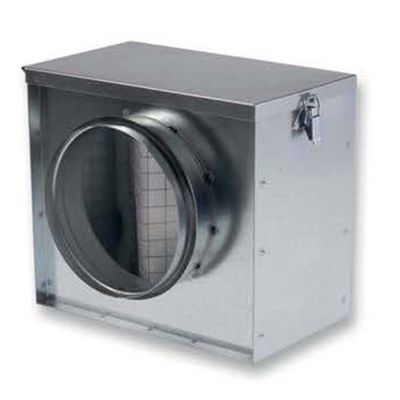
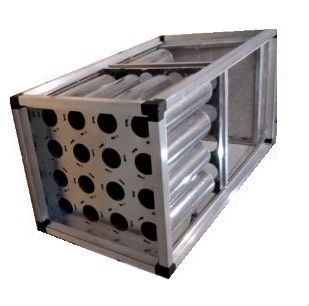
- Filter boxes — complete solutions for direct duct mounting
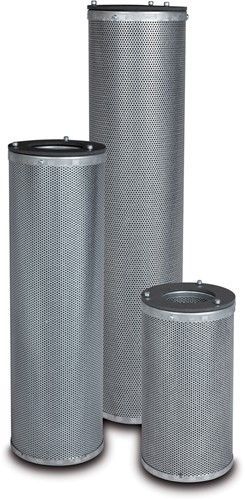
- Activated carbon filters — for gas and odour removal (VOCs, NO₂)
Not sure which filter you need? Describe your installation — airflow, building type, outdoor air intake location — and we'll recommend the correct filter combination, sized for your system.
☎ +40 722 667 238
✉ ioannina.ventilatie@gmail.com
→ View all available air filters
→ Filter boxes for ductwork
→ Activated carbon filters


Post comment