








 Solutions KIT
 Sales
Sales

















 My account
 View cart
 EC vs. AC Motors for Industrial Fans: What to Choose in 2026 and How Much You Save
A complete guide for building managers, HVAC designers and technical managers who want to cut energy bills without compromising performance
Why the Motor Type of Your Industrial Fan Matters
Industrial and commercial fans operate 8, 12, sometimes 24 hours a day. Their energy consumption is not an abstract figure on a technical datasheet — it is a real monthly bill that rises year after year with electricity prices. The difference between a fan with a classic AC motor and one with an EC motor (Electronically Commutated) can mean savings of 40–70% of the energy consumed by the ventilation system, which at an average installation translates to thousands of lei per year.
But it is not only about cost. EC motors also offer more precise control, lower noise, longer service life and native compatibility with automation and BMS systems. This combination has transformed them from a premium option into the de facto standard for any modern HVAC project.
This article explains the real differences between the two technologies, when the investment is justified and what EC motor models are available on ventilation.ro.
What Is an EC Motor and How Does It Differ from an AC Motor
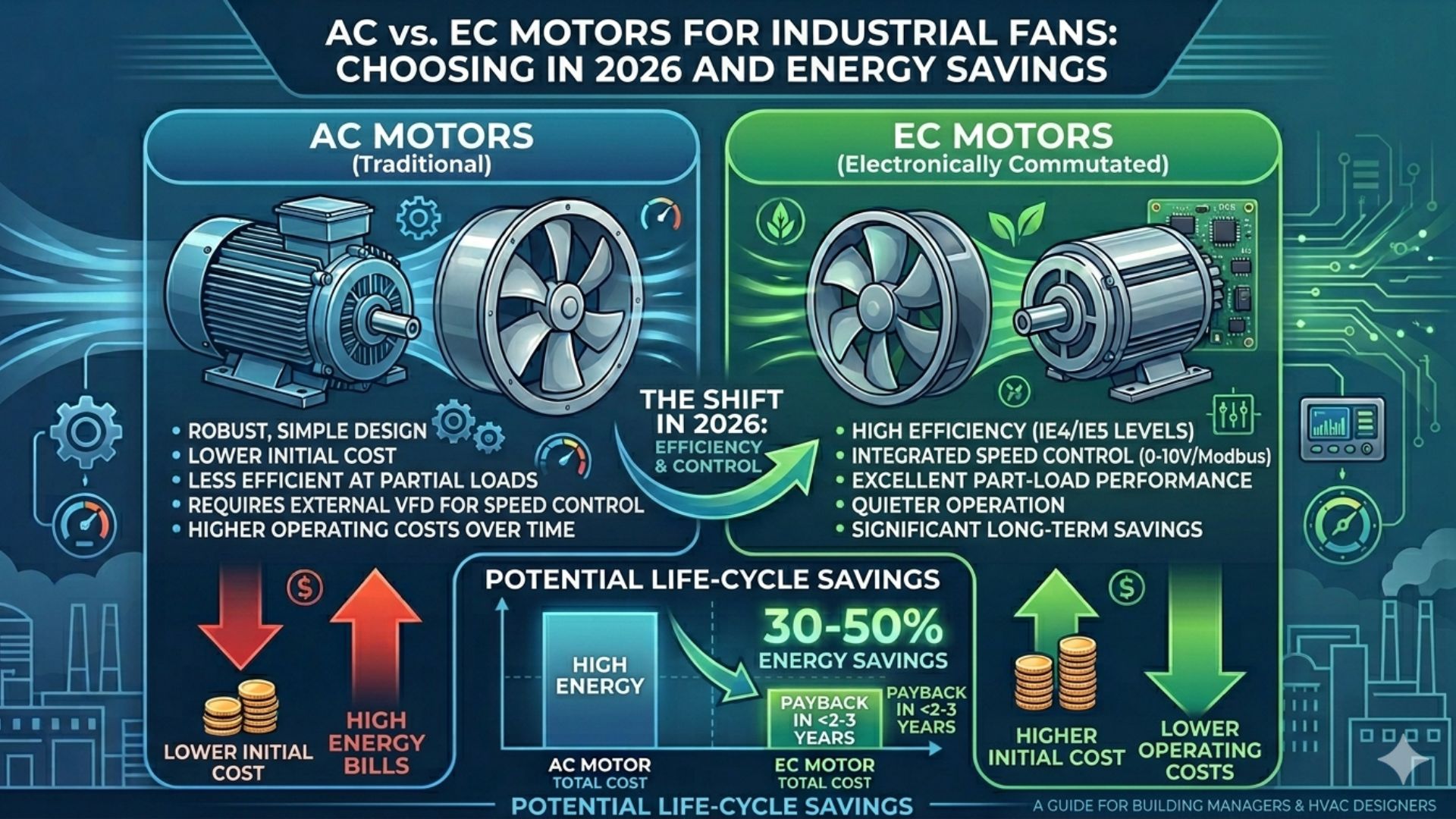
The classic AC (alternating current) motor is the traditional technology, present in industrial fans for decades. It operates at fixed or stepped speeds, determined by the network frequency (50 Hz in Europe). If the system does not need maximum airflow — which happens the vast majority of the time — the AC motor still consumes nearly the same amount, wasting energy as heat and mechanical vibration.
The EC motor (Electronically Commutated) is a permanent magnet DC motor, controlled by an electronic driver integrated directly into the casing. This driver converts alternating current from the network into direct current and permanently regulates the motor speed according to the actual system demand.
The main advantages of EC motors are: reduced energy consumption, high operating efficiency, reduced noise level, no maintenance required, reduced electromagnetic interference (EMI). Fan speed control can be achieved digitally via Modbus RTU or analogue (0–10V signal).
In practice, an EC motor behaves like an intelligent variable-speed motor that consumes exactly what is needed — no more.
Technical Comparison: EC vs. AC at Key Parameters
| Parameter | Classic AC motor | EC motor |
|---|---|---|
| Energy efficiency | IE2–IE3 (70–88%) | IE4–IE5 (up to 93–95%) |
| Speed control | Fixed steps or external drive | Continuous 0–100%, integrated |
| Partial load consumption | High (poor proportionality) | Dramatically reduced (cubic law) |
| Noise | Moderate–high at fixed speed | Reduced, varies with speed |
| Maintenance | Bearings, brushes (some models) | Brushless, extended-life bearings |
| BMS compatibility | Requires external drive | Native (0-10V, Modbus RS485) |
| Initial cost | Low | 20–40% higher |
| Investment payback | — | 1–3 years (depending on use) |
The Cubic Law — Why Speed Control Matters So Much
This is the fundamental rule of fluid dynamics applied to fans: power consumed varies with the cube of speed. In concrete terms:
- At 100% speed → 100% consumption
- At 80% speed → 51% consumption (0.8³ = 0.512)
- At 60% speed → 22% consumption (0.6³ = 0.216)
An AC fan operating at 80% of capacity still consumes ~90% of its rated energy. The same fan with an EC motor consumes only ~51%. Over a year of operation at 16 hours/day, the difference amounts to thousands of lei.
When EC Motor Investment Is Justified
EC motors are recommended as a priority in:
Variable air volume (VAV) general ventilation systems: Offices, shopping centres, hospitals where the number of people and air demand vary throughout the day. An EC system regulated by CO2 or occupancy sensors can reduce consumption by 50–60% versus a fixed-speed AC system.
Rooftop centrifugal fans for commercial buildings: Operating 24/7, so any percentage reduction in consumption has a massive annual impact.
Fans incorporated in air handling units (AHU): Where motor efficiency adds directly to the overall energy performance indicator of the entire unit (SFP — Specific Fan Power).
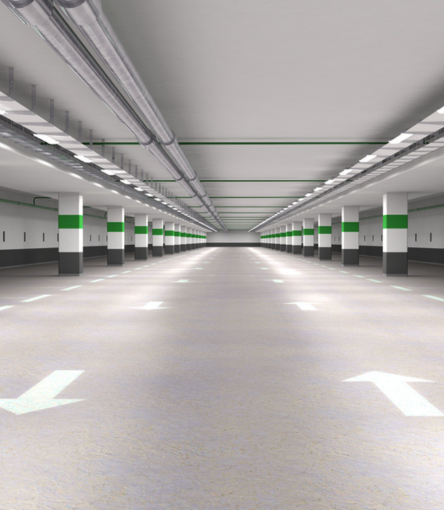
Underground car parks with CO sensors: The fan operates at minimum speed 90% of the time and jumps to maximum only when sensors detect elevated CO concentrations. An EC motor allows this transition to be fluid and energy-efficient.
EC Motor Products Available on ventilation.ro
ventilation.ro offers over 180 products with EC motors, covering all main constructional types:
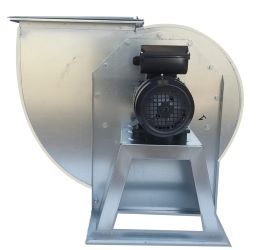
1. Centrifugal incorporated fans with EC motor — RDP EC series
RDP E0-0315 — 2.3 kW, 230V single-phase
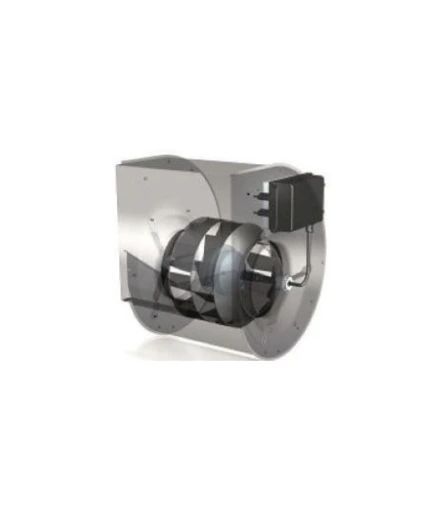
Double-inlet centrifugal fan with direct drive. Aluminium rotor with 11 backward-swept welded blades, mounted directly on a brushless motor with permanent magnets. High-efficiency driver with integrated active PFC (Power Factor Correction) and thermal protection, mounted directly on the casing in "plug and play" configuration — no additional configuration required. Continuous speed regulation via 0–10V analogue signal or Modbus RS485 interface. Maintenance-free!
Indicative price: ~6,996–7,187 RON incl. VAT.
RDP E0-0400 — 5.9 kW, 400V three-phase
Same constructional concept, 5.5 kW driver with active PFC, continuous 0–10V or Modbus RS485 regulation. 400V three-phase power supply, ideal for medium-to-large industrial applications.
Indicative price: ~8,759 RON incl. VAT.
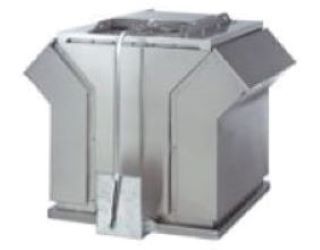
2. Centrifugal rooftop fans with EC motor — RDA EC series
RDA 21-1822-EC-SE — centrifugal rooftop fan with integrated pressure differential
Fitted with digital pressure differential ERA-0500-SE (0–500 Pa), simplified parameterisation menu, day/night operation, 0–10V analogue interface and continuous monitoring. Efficiency class per EU 1253/2014 requirements for ventilation equipment.
3. Axial fans with IE5 motor — the supreme efficiency class
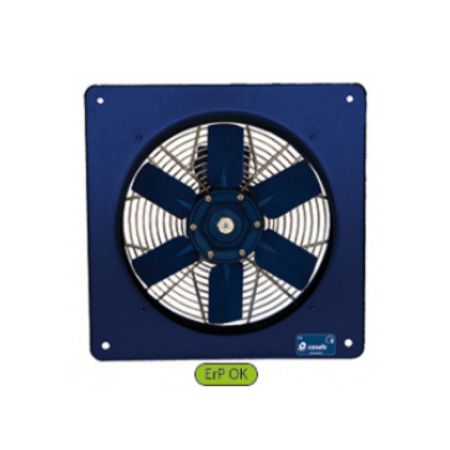
The EC motor range on ventilation.ro includes wall-mounted axial fans with IE5 motors — the highest level of energy efficiency currently available. EC Technology motor with integrated electronics, Class F, IP55 protection, available both single-phase (220–277V) and three-phase (380–480V), with alarm relay and Modbus RTU protocol on three-phase models.
→ Browse the complete EC motor range on ventilation.ro
Calculating Real Savings: A Practical Example
5.5 kW centrifugal fan, 16 hours/day operation, 300 days/year, energy price 1.2 RON/kWh:
AC fan at fixed speed: 5.5 kW × 16h × 300 = 26,400 kWh/year → 31,680 RON/year
EC fan at average 70% speed: Effective power: 5.5 × 0.7³ = ~1.9 kW 1.9 kW × 16h × 300 = 9,120 kWh/year → 10,944 RON/year
Annual saving: ~20,736 RON — investment payback in less than 2 years versus the price difference.
EU Regulations Compliance: Why IE1 and IE2 Motors Are Disappearing
European Regulation EU 640/2009 and its subsequent updates have progressively eliminated low-efficiency motors from the European market. From 2023, motors of medium and large power must reach minimum class IE3, and the European trend is towards IE4–IE5. ventilation.ro has already updated its catalogue — older IE2 models are marked "DISCONTINUED" and replaced with IE3 versions (e.g. CF 2 HP 300 T4 IE3). Investing in an EC IE4/IE5 fan today means guaranteed compliance for at least 15–20 years.
Contact the ventilation.ro team at +40 722 667 238 for a real-savings calculation for your specific installation.


Post comment