








 Solutions KIT
 Sales
Sales










 My account
 View cart
Heat Recovery Units for New Homes: What They Are, How Much They Cost and How to Choose in 2026
The complete guide for property owners building or renovating who want to breathe clean air without paying huge heating bills
The Problem Few People Anticipate When Building a New Home
You are building a new home or renovating. You choose quality double-glazed windows, high-performance external insulation, airtight joinery. You do everything right. And precisely because of this, you will have a problem that old houses with draughts never had: the absence of natural air exchange.
Well-insulated and airtight homes are energy-efficient, but quickly become environments with stale air, elevated humidity, condensation on windows, mould in corners and CO2 concentrations that cause drowsiness and reduced concentration. Opening a window in winter temporarily solves the problem but throws away the heat you just paid for.
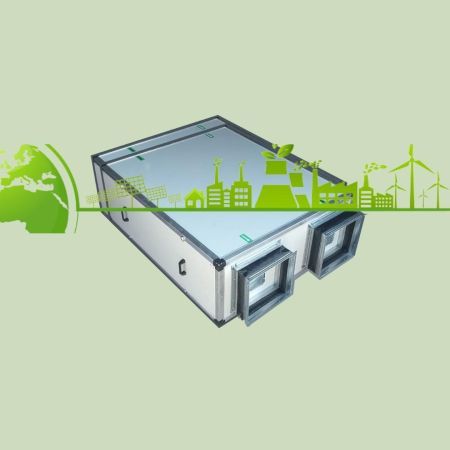
The solution is a heat recovery ventilation (HRV) system — the equipment that introduces fresh, filtered air and extracts stale air, simultaneously recovering 70–90% of the heat in the extracted air. ventilation.ro offers both the residential and commercial ranges of heat recovery units, with options for any type of dwelling.
How a Heat Recovery Unit Works
A heat recovery ventilation system operates on the principle of air exchange between the interior and exterior of the building. The core idea: it extracts polluted air from inside and replaces it with fresh outdoor air. The innovative part: during this process, the system recovers heat from the air being released to the outside and transfers it to the incoming air.
The two airstreams — extracted and introduced — pass through a heat exchanger without mixing. The warm stale indoor air transfers its heat to the cold incoming outdoor air, which thus enters already pre-warmed. In winter, recovery efficiency can reach 85–90%, meaning that if it is -10°C outside and 22°C inside, the fresh incoming air can reach 18–20°C before any additional heating.
In summer, the process works in reverse — warm outdoor air transfers heat to the cool indoor air, reducing the load on the air conditioning system.
Types of HRV Systems: Centralised vs. Decentralised
Centralised system (central HRV)
A single central unit, usually mounted in a loft, technical space or plant room, connected to all rooms via a ductwork network. Introduces fresh air into bedrooms and living rooms and extracts stale air from bathrooms, the kitchen and hallway.
Advantages: single unit to maintain, uniform distribution in all rooms, noise concentrated in the plant room, maximum efficiency (80–90% recovery).
Disadvantages: requires specialist design and installation, ductwork must be included during the construction phase, higher installation cost (11,500–25,000 RON fully installed).
Recommended for: new homes during construction, major renovations with structural work.
Decentralised system (individual room units)
Independent units mounted directly in the exterior wall of each room. Each unit provides air exchange for that room, without ductwork.
Advantages: simple installation (a hole in the wall of ~100–160 mm), no structural modifications required, ideal for renovations or flats.
Disadvantages: requires more units (one per main room), each unit makes a small amount of noise in its room, slightly lower recovery efficiency than the centralised system.
Recommended for: flats, renovations without major works, existing houses.
Products Available on ventilation.ro
ventilation.ro offers heat recovery units in two distinct categories, accessible at ventilation.ro/category/330:
Residential range
Compact systems for single-family dwellings and flats, with airflows up to 400 m³/h, discreet mounting and quiet operation. Solutions in this range are designed for houses and flats with 2–5 rooms.
Commercial range
Higher-capacity units for restaurants, offices, commercial spaces and buildings with special air quality requirements. Airflows from several hundred to over 1,000 m³/h, with advanced filtration and automatic control options.
Common features of ventilation.ro heat recovery units:
- Cross-flow or counter-flow heat exchangers
- Low-energy consumption motors (EC models available)
- Air filters included (F7/G4 classes or equivalent)
- Integrated control with automatic operation
How Much Does a Complete Heat Recovery System Cost?
| System type | Equipment cost | Installation cost | Total indicative |
|---|---|---|---|
| Decentralised (1 room) | 800–2,500 RON/unit | 200–500 RON/unit | 1,000–3,000 RON |
| Decentralised (4-room house) | 4,000–10,000 RON | 1,000–2,000 RON | 5,000–12,000 RON |
| Centralised (3-room flat) | 4,000–7,000 RON | 3,000–5,000 RON | 7,000–12,000 RON |
| Centralised (150 m² house) | 7,000–12,000 RON | 5,000–10,000 RON | 12,000–22,000 RON |
| Centralised (250 m² house) | 10,000–18,000 RON | 7,000–12,000 RON | 17,000–30,000 RON |
Operating costs are extremely low: a decentralised system with 4 units consumes on average 0.3 kWh/day, i.e. under 130 RON/year at current energy prices.
How to Correctly Size an HRV System
Basic airflow rule: minimum 30 m³/h per person and minimum 0.5 air changes per hour for the total dwelling volume.
ventilation.ro provides an airflow calculation guide directly on the site, useful for both designers and property owners.
Conclusion
Investing in a heat recovery ventilation system is no longer a luxury reserved for passive houses or premium projects. It is a financially rational decision — recoverable in 3–5 years through heating savings — and an investment in the health of occupants.
Browse the complete range of residential and commercial heat recovery units on ventilation.ro or contact the team at +40 722 667 238 for a solution sized for your home.


Post comment