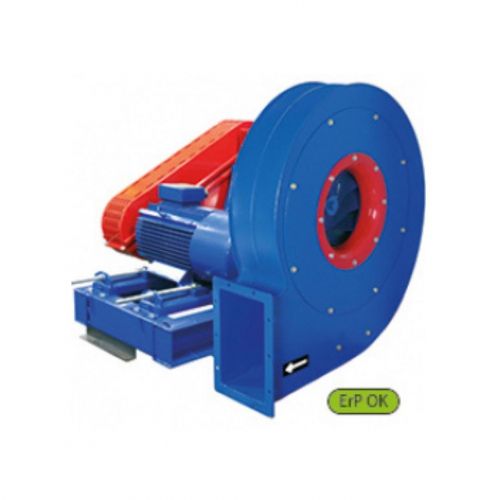
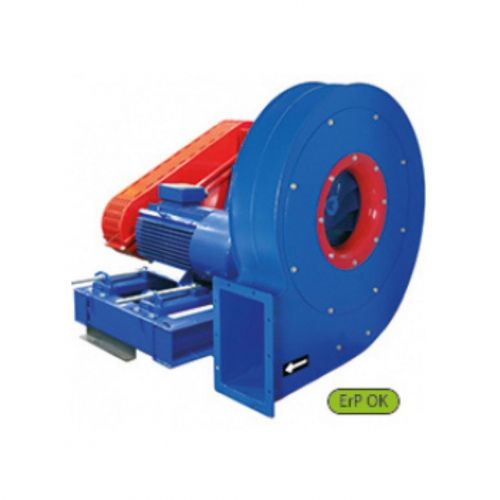
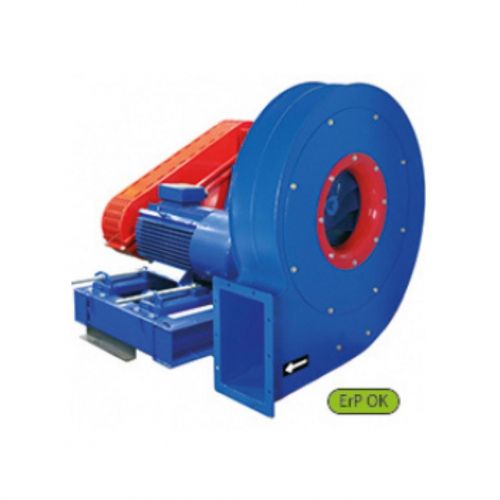
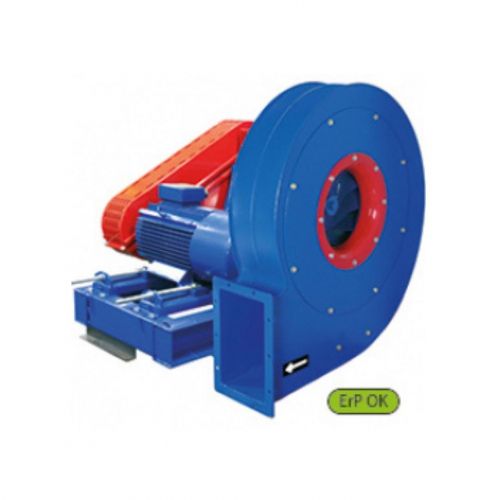
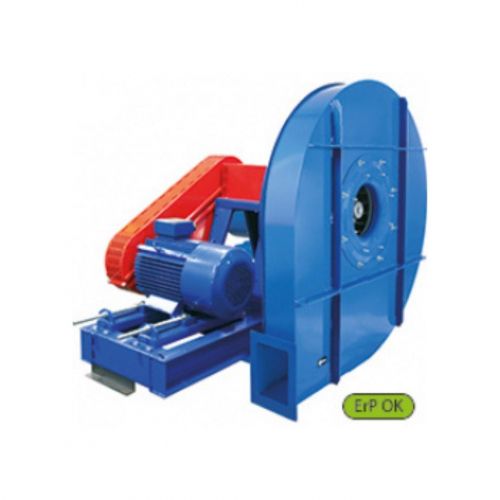
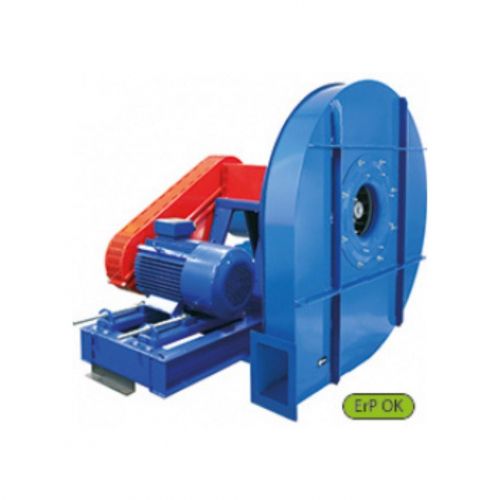
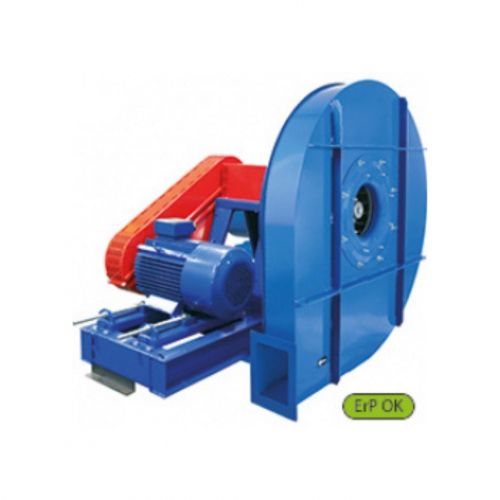
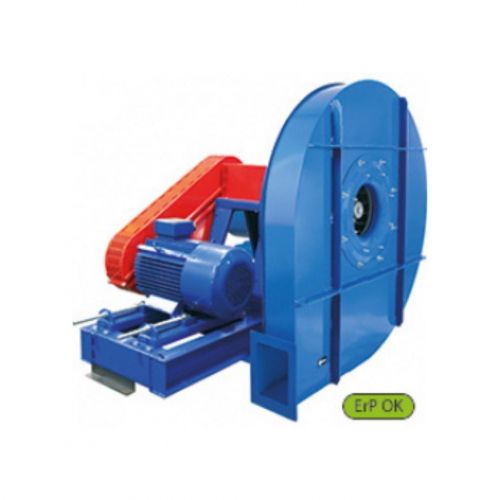
Belt-drive centrifugal fans — maximum flexibility for demanding industrial applications
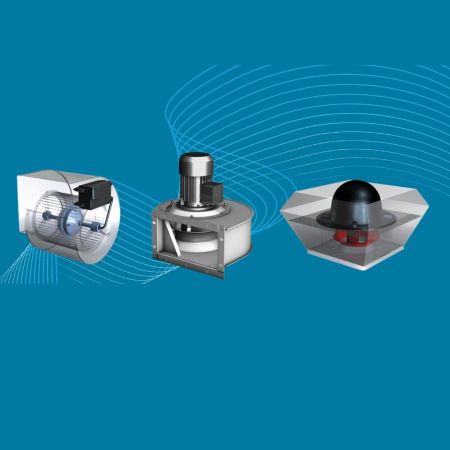
Belt-drive centrifugal fans are built on the same principle as belt-driven axial fans: the electric motor is separated from the rotor and transmits motion via V-belt and pulleys, without direct contact with the airstream. This separation simultaneously addresses two challenges of intensive industrial ventilation: resistance to elevated temperatures and flexibility in airflow adjustment.
For centrifugal fans, the benefits of belt drive are even more relevant than for axial models, since centrifugal fans are frequently used in complex installations where operating conditions can change. Mechanical speed adjustment by modifying the ratio between the drive and driven pulleys allows airflow to be adjusted to different values from the original design — useful when the installation expands, when air demand changes or when filters are replaced with ones of different resistance. No electronic intervention, no variable frequency drive cost.
Thermal resistance is the second advantage: the motor positioned externally, in the ambient airstream, operates at normal temperatures even when the air moving through the rotor reaches 60–120°C. Used in industrial dryers (timber, ceramics, textiles, food), chemical industry with moderately elevated temperature processes, hot air ventilation plants from technological processes and extraction installations from zones with high thermal output.
The larger footprint compared to direct-drive equivalents is offset by superior versatility and durability under demanding industrial conditions. Easy access to the motor and drive elements simplifies scheduled preventive maintenance.
How to choose: calculate the required airflow and static pressure, then determine the optimal rotor speed for the operating point on the performance curve. The pulley transmission ratio is calculated based on the available motor speed and required rotor speed. Check belt length and available centre-distance in the installation space.
👉 Direct-drive medium-pressure centrifugal fans — for standard installations 👉 Belt-drive axial fans — the same solution for axial applications
-
Price excl. tax:
€9.69120
Price inc. tax:
€11.72635
-
Price excl. tax:
€6.87360
Price inc. tax:
€8.31706
-
Price excl. tax:
€7.87500
Price inc. tax:
€9.52875
-
Price excl. tax:
€11.30910
Price inc. tax:
€13.68401
-
Price excl. tax:
€5.60090
Price inc. tax:
€6.77709
-
Price excl. tax:
€6.50840
Price inc. tax:
€7.87516
-
Price excl. tax:
€6.92100
Price inc. tax:
€8.37441
-
Price excl. tax:
€9.07710
Price inc. tax:
€10.98329



 Sales
Sales






















 My account
 View cart