What a multi-leaf volume control damper does — and where it fits
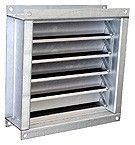
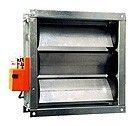
The volume control damper (VCD) — commonly called a damper in HVAC terminology — is an essential element of any ductwork distribution system. Its function: precise control of the air quantity passing through a duct section, enabling hydraulic balancing of the distribution network and zone-by-zone airflow adjustment.
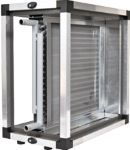
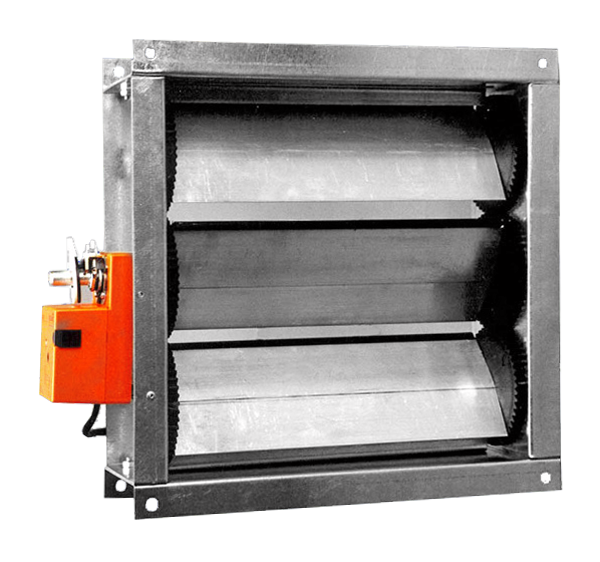
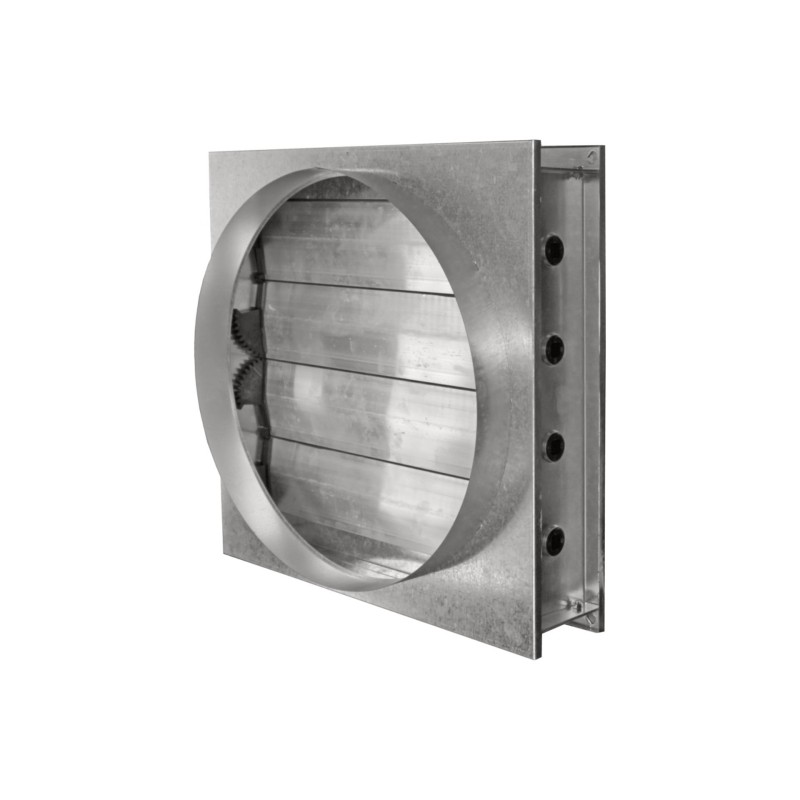
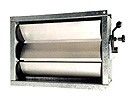
Opposite-rotation blades are the constructive feature distinguishing DA-type volume control dampers from parallel-blade dampers:
Parallel blades: all blades rotate in the same direction → form an undulating airflow path → higher turbulence → aerodynamic noise.
Opposite-rotation blades: adjacent blades rotate in opposite directions → form converging/diverging air channels → more uniform flow → reduced aerodynamic noise, lower pressure drop at the same airflow.
Typical applications:
Hydraulic balancing — in multi-branch ductwork networks, total airflow distributes unequally without regulation. DA dampers are installed on each branch and manually adjusted at commissioning to achieve designed airflows.
Zone control — in multi-zone ventilation systems (office, conference room, server room), DA dampers enable ventilation activation or shutdown per zone without stopping the whole system.
VAV systems — combined with the analogue 24V actuator, the DA damper becomes a VAV (Variable Air Volume) element continuously regulating airflow based on the 0–10V signal from the BMS controller.
Maintenance isolation — DA dampers with ON/OFF actuator allow circuit isolation for maintenance without shutting down the whole system.
Available variants
DA standard — manual regulation Blade angle adjusted manually via the adjustment knob on the damper shaft. Suitable for commissioning adjustments that do not change subsequently. Cost-effective, no electrical components.
DA-ON/OFF 220V — binary electric actuator 220V actuator opens or closes the damper fully on electrical command. Suitable for: zone-based ventilation on/off systems, simple relay-based automation, smoke control where the damper must open/close on fire alarm command.
DA-ANALOGUE 24V — analogue electric actuator 24V analogue actuator receives 0–10V or 4–20mA command signal and positions blades proportionally from fully closed (0V) to fully open (10V). Suitable for: VAV variable airflow systems, BMS (Building Management System) integration, automatic airflow control based on CO₂, occupancy or time schedule.
TECHNICAL SPECIFICATIONS EN:
| Specification |
Value |
| Model |
DA 500×250 mm |
| Type |
Multi-leaf volume control damper |
| Dimensions |
500 × 250 mm |
| Application |
Rectangular air ducts |
| Frame |
Galvanised sheet steel |
| Blades |
Aerodynamically shaped aluminium |
| Blade type |
Opposite rotation (counter-rotating) |
| Blade drive |
Plastic gears — inside frame |
| Blade seals |
Rubber |
| Leakage class |
Class 2 — EN 1751:1998 |
| Standard regulation |
Manual |
| Option 1 |
DA-ON/OFF 220V — binary electric actuator |
| Option 2 |
DA-ANALOGUE 24V — 0–10V analogue actuator |
| Multiple connection |
Yes — 2 dampers via connection elements |
| Blade orientation |
Parallel to first dimension (500 mm) |
| Standard |
EN 1751:1998 |
FAQ
What does Class 2 leakage mean in EN 1751? EN 1751:1998 defines air leakage classes for terminal devices and dampers. Class 2 permits maximum leakage of 3 l/s×m² at 100 Pa pressure differential — sufficient for general HVAC installations. Class 3 (stricter) is required for cleanrooms or spaces with special pressure requirements.
How do I select the correct damper size? The nominal dimensions must match the internal cross-section of the duct. DA 500×250 mm fits in a rectangular duct with 500×250 mm internal cross-section. Verify that dimensions refer to the duct's internal dimensions, not external.
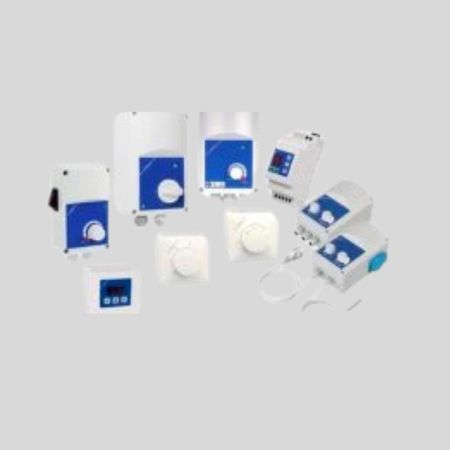
Can the DA damper be controlled from a standard room thermostat? The DA-ON/OFF 220V variant connects directly to any 220V electrical contact, including room thermostats with 220V output. The DA-ANALOGUE 24V variant requires a 0–10V or 4–20mA command signal — supplied by Sentera speed controllers or BMS controllers.
Can blades be locked at any intermediate position? Yes — the manual variant allows mechanical locking of blades at any desired angle by locking the adjustment shaft. The analogue actuator variant automatically maintains the commanded angle.
👉 Rectangular ductwork and accessories 👉 Ventilation grilles 👉 HVAC sensors for VAV control 👉 Industrial ventilation selection guide 2026
📞 +40 722 667 239 — free consultancy for volume control damper selection and sizing



 Sales
Sales



















 My account
 View cart

 DA_EN
DA_EN
 AGG iso_en_large


