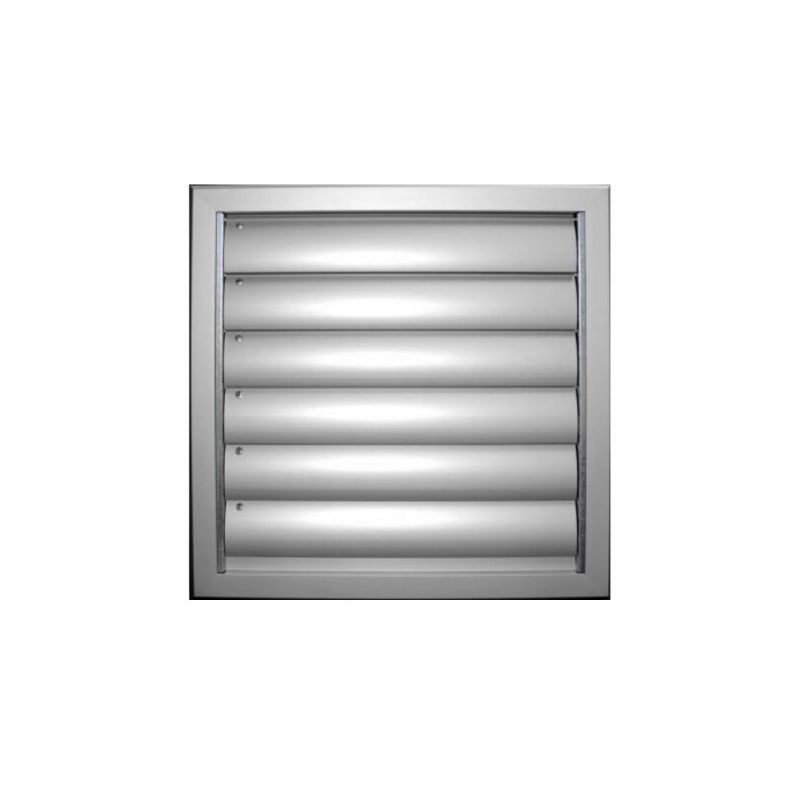
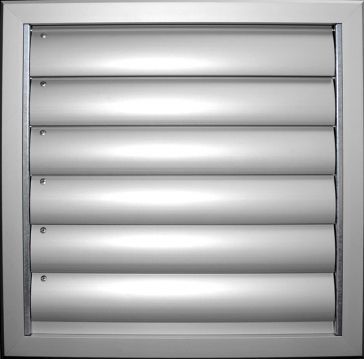
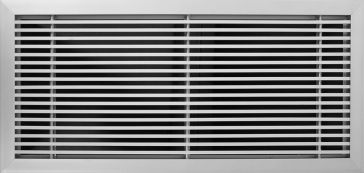
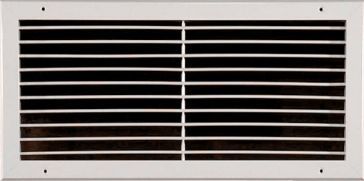
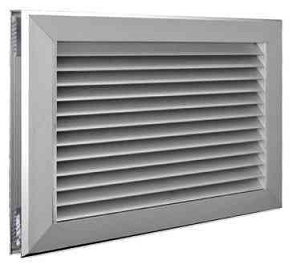
250x250 mm Gravity Wall Grille, Anodised Aluminium
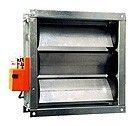
When the fan starts, the extracted air pushes the louvres and the grille opens by itself. When the fan stops, the louvres fall back under their own weight and close the wall opening.
No motor, no power supply, nothing to adjust or maintain.
Why aluminium and not plastic
A fair question, so here's a straight answer.
Plastic gravity grilles cost a fifth as much. They do the same job — for the first year. The difference shows up afterwards.
What happens to plastic on an exterior wall:
- Sun makes it brittle. After two or three summers, thin louvres crack at the first knock or hailstorm.
- Heat warps it. The louvres no longer close tightly, and cold air comes in all year.
- It discolours. White turns yellow, and on a white façade it shows.
- Frost makes it fragile — precisely in winter, when it most needs to close properly.
Anodised aluminium has none of these problems. The louvres keep their shape, so they close as well in year ten as on day one.
The simple arithmetic: a plastic grille replaced three times costs more than one aluminium grille fitted once. And each replacement means someone up a ladder, redoing the wall seal.
What size do I need?
Choose by duct diameter, not room size:
| Duct / fan |
Recommended grille |
| Ø100 mm (standard bathroom, WC) |
250x250 mm ← this one |
| Ø125 mm (large bathroom, kitchen) |
250x250 or 300x300 mm |
| Ø150 mm (kitchen, plant room) |
300x300 mm or larger |
Rule: the grille must be larger than the duct, never smaller. An undersized grille throttles airflow and creates noise.
Check your fan can open the louvres
The louvres lift through air force alone — no spring, no motor helping them.
With modest-pressure bathroom fans this matters. Louvres may only partly open if the fan is undersized, the duct run is long or has many bends, or the flexible duct was left concertinaed.
The effect is invisible: louvres sit half open, airflow drops, and the bathroom stays damp after a shower — even though the fan runs.
Ten-second check: switch the fan on and look at the grille from outside. The louvres should lift fully and visibly.
Installation: louvres horizontal, always
Being square, it fits the wall four ways — but only one works.
The louvres close under their own weight, so they must be horizontal. Fitted rotated, they become vertical and the mechanism stops working.
Test before fixing: push the louvres with a finger. If they open and fall back by themselves, it's correct.
Specifications
| Feature |
Value |
| Size |
250 x 250 mm |
| Material |
Anodised aluminium |
| Louvres |
Moving, rubber sealed, bridge system |
| Operation |
Gravity — no motor, no power |
| Mounting |
Wall, louvres horizontal |
| Use |
Extract only |
| RAL painting |
To order, any colour |
FAQ
Is it worth the difference over plastic? If it's somewhere easy to reach and you don't mind replacing it every couple of years — maybe not. If it's on a façade, at height, or you'd rather not think about it again — yes. Anodised aluminium keeps its shape and colour for 10–15 years.
Can it be used for fresh air intake? No. It works on the pressure of air leaving, so extract only.
Does it have an insect mesh? No separate mesh — the closed louvres block access.
Who fits it? Any installer, or you. Fixed with wall plugs at the end of the duct and sealed around. Just keep the louvres horizontal.


 Sales
Sales









 My account
 View cart