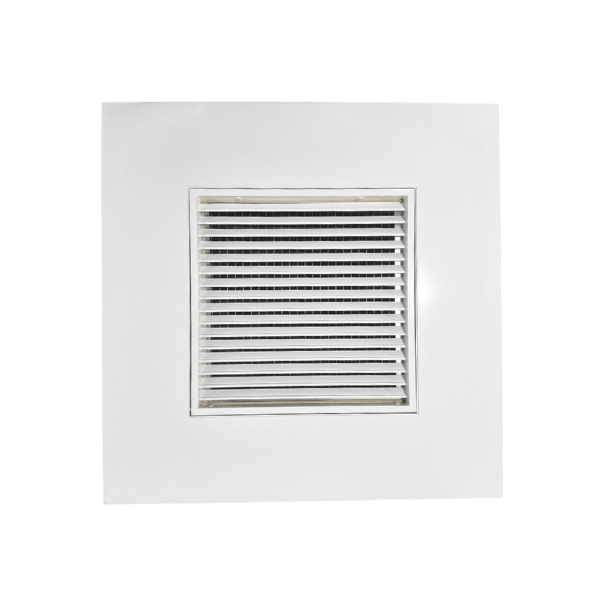
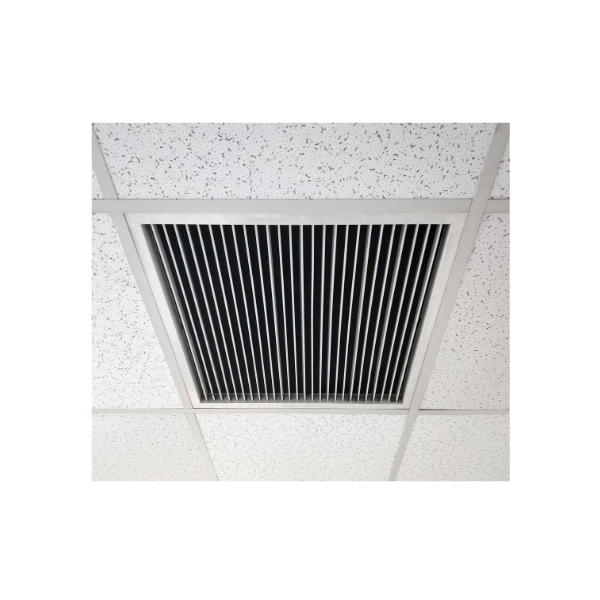
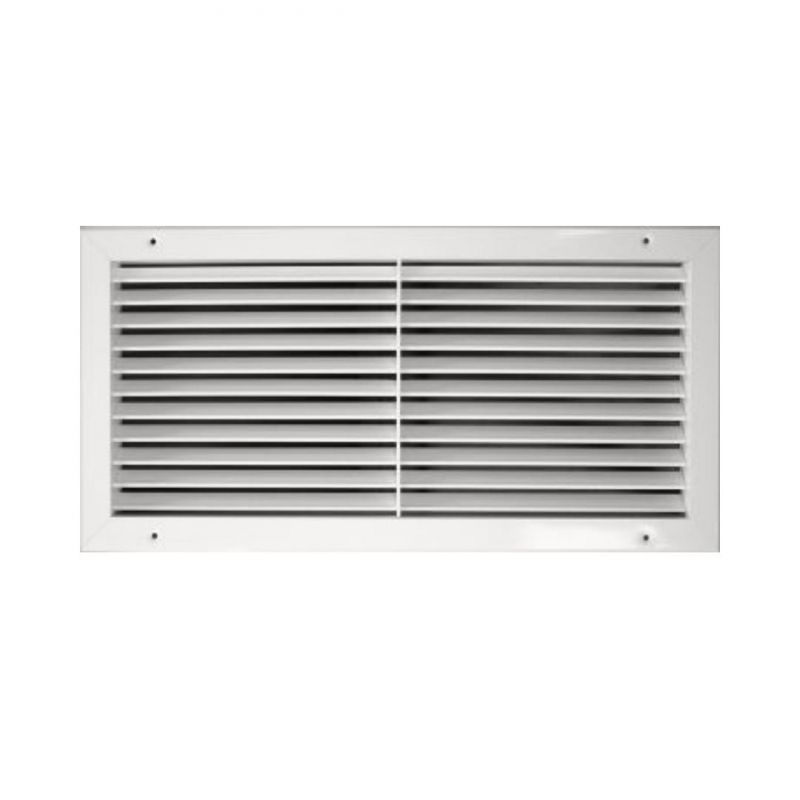
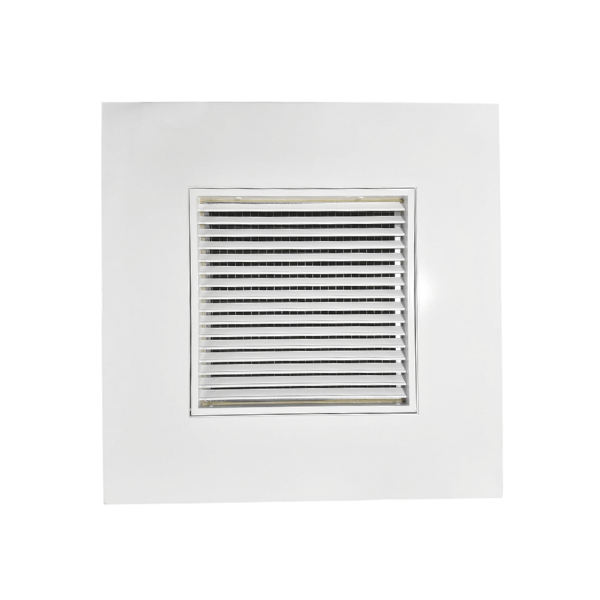
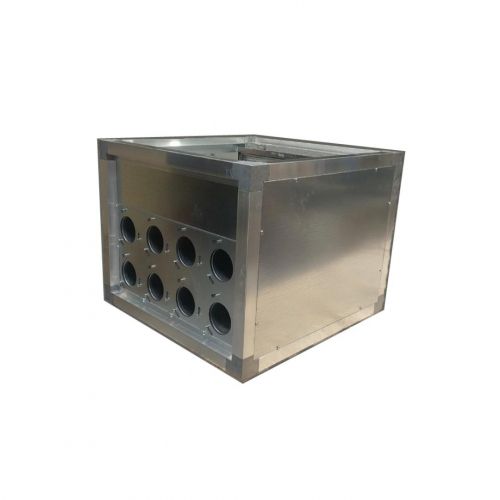
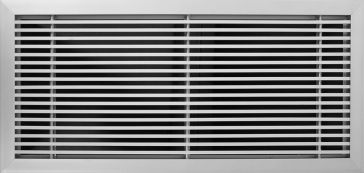
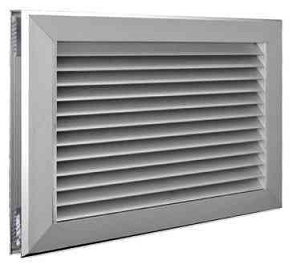
TEP-E-FA Return Air Grille with Filter, in a 595x595 mm SPQ Plate, RAL 9010
This product combines three options from the TEP range.
| Code |
What it means |
What it does |
| TEP |
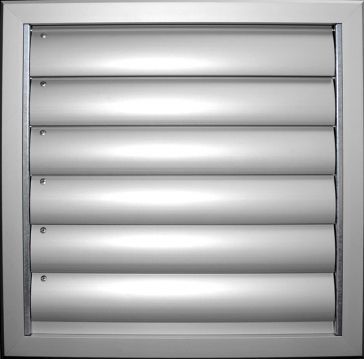
Return air grille, fixed blades at 45° |
draws stale air from the room |
| E |
Accessible (removable front) |
filter access without removing the grille |
| FA |
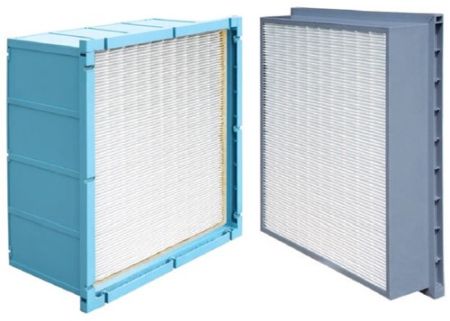
Integrated air filter |
stops dust before the ductwork |
| SPQ |
595x595 mm metal plate |
drops into a suspended ceiling grid |
The grille itself is 350x350 mm; the SPQ plate it sits in is 595x595 mm.
SPQ: why the 595x595 mm plate matters
Standard suspended ceilings use the 600x600 mm module. A 595x595 mm plate sits exactly where a tile would, with the clearance needed for the metal grid.
The practical consequence: nothing gets cut. Lift out a ceiling tile, drop in the plate with the grille. No trim frame, no plasterboard cutting, no making good afterwards.
By comparison, a grille fitted directly into a false ceiling requires an exact cut-out, a fixing frame, grid adjustment and often re-finishing around it. In an office with 20 extract points, the labour difference is significant.
RAL 9010 (white) painting completes the logic: it is the standard ceiling-tile colour, so the plate blends in with no further work.
The E + FA combination: a filter you change from below
This is the advantage that doesn't show in the specifications.
A filter fitted in a ceiling grille must be changed periodically — otherwise it clogs, extract airflow drops, and the system goes out of balance without anyone noticing.
On an ordinary filtered grille, changing it means removing the grille or the plate from the ceiling. In a working office that means a ladder, dust over desks and interrupted work.
The E (accessible) version solves it: the front opens from below, the filter comes out and is replaced, and it closes. The plate stays in the ceiling. A few minutes, one ladder, one person.
In buildings with many extract points, that difference is measured in hours of labour per maintenance cycle.
Why filter on extract
A fair question: if the air is leaving, why filter it?
The reason isn't the quality of the extracted air — it's protecting the installation. Everything that rises from the room passes through the extract grille: dust, textile fibres, particles from whatever happens in the space. These settle in the ductwork, where they can no longer be cleaned — especially on runs concealed above a false ceiling.
The grille filter stops coarse particles at the inlet. The ductwork stays clean for the life of the system, and the extract fan doesn't build up deposits on its impeller.
Where it is used
Open-plan and office buildings with suspended ceilings · Retail spaces, showrooms, shops · Consulting rooms, clinics, laboratories · Conference and training rooms · Hotels — common areas, corridors, plant rooms · Any space with a modular 600x600 mm ceiling
Specifications
| Feature |
Value |
| Type |
Return air grille with filter, in ceiling-grid plate |
| Grille size |
350 x 350 mm |
| Plate size (SPQ) |
595 x 595 mm — for 600x600 ceiling grids |
| Blades |
One row, fixed at 45° |
| Configuration |
E (accessible) + FA (filter) + SPQ (in plate) |
| Material |
Anodised aluminium |
| Finish |
Electrostatically painted RAL 9010 (white) |
| Mounting |
In a suspended ceiling, replacing a standard tile |
| Use |
Extract / return air |
FAQ
Will it fit my suspended ceiling? If the ceiling module is 600x600 mm — yes. The 595x595 mm plate sits where a standard tile would, with the clearance needed for the grid. Measure an existing tile before ordering.
Can the blades be adjusted? No — they are fixed at 45°. This is a return grille, where air direction doesn't matter. For adjustable blades you need a supply grille.
How do I change the filter? From below, on a ladder. The front opens, the filter comes out and is replaced, and it closes — without removing the plate from the ceiling. That is what the "E" in the code does.
How often should the filter be changed? It depends on the space: in an office, once or twice a year; in dusty or high-traffic spaces, more often. Check it at every scheduled maintenance visit.
Why filter on extract? To protect the ductwork and the fan. Dust that passes the grille settles in the ducts, where it can no longer be cleaned — especially on concealed runs.



 Sales
Sales















 My account
 View cart