





 Solutions KIT
 Sales
Sales








 My account
 View cart
Greenhouse Ventilation: How to Maintain the Right Temperature and Humidity Year-Round
Correct ventilation in a greenhouse makes the difference between a good harvest and a compromised one. Find out which equipment to use, how to calculate the required airflow and how to automate the entire system.
A well-built greenhouse can produce vegetables, flowers or seedlings all year round — but only if the air inside is managed correctly. Excessively high temperatures on summer days, excessive humidity that encourages fungal diseases, or lack of CO₂ during peak photosynthesis hours are problems that arise directly from insufficient or poorly designed ventilation.
Unlike a home or commercial space, a greenhouse has specific and often contradictory requirements: you want to retain warmth in winter but evacuate excess heat in summer; you want enough humidity for plants but not so much that mould appears. Ventilation is the tool through which you balance all these factors.
Why Ventilation Is Critical in a Greenhouse
Temperature control
The greenhouse effect — heat accumulation through solar transmission — is beneficial in winter and dangerous in summer. Under glass or polycarbonate, temperatures can rise by 20–30°C above outdoor levels within a few hours of sunshine. Most crops suffer at temperatures above 30–32°C: pollination is reduced, growth slows, and at extreme temperatures plants wilt irreversibly.
Well-sized mechanical or natural ventilation keeps the temperature within the optimal range for the crop, regardless of outdoor conditions.
Humidity control
Plants transpire constantly — a process that releases water vapour into the air. In a closed greenhouse without ventilation, relative humidity can quickly reach 90–100%, creating ideal conditions for fungal diseases: downy mildew, grey mould (Botrytis), powdery mildew. These diseases can compromise an entire harvest within days.
Ventilation reduces humidity by replacing saturated air with fresh air from outside and by creating an air current that reduces the moisture layer on leaves and fruit.
CO₂ supply
Photosynthesis consumes CO₂. Normal concentration in outdoor air is approximately 420 ppm. In a closed greenhouse, during peak photosynthesis hours (morning and midday), plants can reduce the local CO₂ concentration to below 200 ppm — a level at which photosynthesis slows dramatically. Ventilation brings in fresh air and restores the concentration, supporting optimal growth.
Stem strengthening
A lesser-known benefit: the gentle air current that passes through the greenhouse stimulates mechanical movement of stems, which triggers the production of structural fibres. Plants grown without any air movement are more fragile and break more easily during transplanting or in wind.
Types of Greenhouse Ventilation
1. Natural ventilation — through roof vents and side walls
The simplest and cheapest form of ventilation: openings in the roof and side walls that allow hot air to exit at the top and cool air to enter at the bottom, through natural convection.
Advantages: zero operating cost, no moving parts to fail.
Limitations: works well only when there is a sufficient temperature difference and adequate wind. On sunny, calm days — exactly when ventilation need is greatest — natural convection may be completely insufficient. It does not allow precise control and does not operate automatically without actuators.
Design rule: the area of ventilation openings should be a minimum of 15–20% of the greenhouse floor area. A 100 m² greenhouse needs at least 15–20 m² of total openings (roof + walls).
2. Mechanical ventilation — with fans
Mechanical ventilation takes control when natural convection is insufficient — or completely replaces natural ventilation in large greenhouses or those with advanced automation.
How it works: extraction fans mounted on the end wall of the greenhouse draw warm air out of the interior, creating a slight negative pressure. Fresh air enters through openings on the opposite wall, crossing the entire greenhouse from one end to the other — a uniform, controllable airflow.
This configuration (fans on one wall, air inlet on the opposite wall) is called cross-flow ventilation and is the standard in modern greenhouse growing.
3. Combined ventilation
The most effective greenhouses use both systems: roof vents for passive ventilation under normal conditions and mechanical fans that start automatically when temperature or humidity exceeds set thresholds. This approach reduces energy consumption compared to continuous mechanical ventilation and provides redundancy in case of equipment failure.
What Equipment to Use
Axial fans — the standard choice for greenhouses
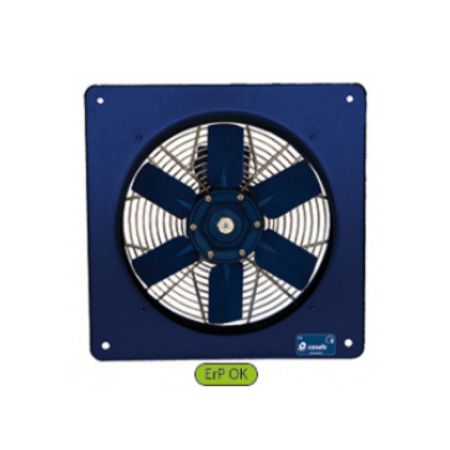
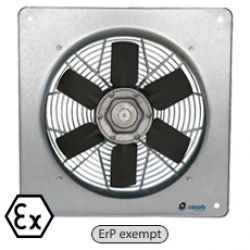
Axial fans are the standard equipment for greenhouse ventilation of any size. The reason is simple: air exits directly outside, without ductwork, so the required static pressure is low — exactly the strength of axial fans. They deliver high airflow at reasonable cost and energy consumption.
What to look for in an axial fan for a greenhouse:
- Airflow — must be sufficient to exchange all the air in the greenhouse 40–60 times per hour in summer conditions. The exact calculation is below.
- Moisture protection — minimum IP54; greenhouses are humid environments, and a motor without adequate protection will fail prematurely.
- Automatic back-draught shutters — essential to prevent cold air (or wind) from entering at night or in winter when the fan is not running.
- Corrosion resistance — high humidity and chemicals used in phytosanitary treatments are aggressive. Fans with corrosion-resistant casings and rotors last significantly longer.
- Speed control — the ability to reduce speed (and consumption) at night or on cooler days is an important advantage.
👉 Explore axial fans available — includes models suitable for humid environments and agricultural applications.
Portable fans — for internal air circulation
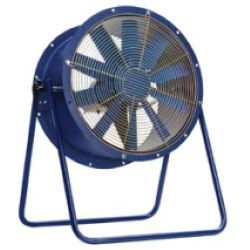
In addition to extraction fans, larger greenhouses benefit from portable or suspended fans that circulate air between crop rows. These don't extract air outside — they agitate the air inside, eliminating stagnant areas of high humidity and equalising temperature across the height of the greenhouse.
They are particularly useful in tall greenhouses (over 3 m) where warm air stratifies at the top and cool air remains at the bottom, creating unequal conditions for crops.
👉 See portable fans available in stock.
Speed controllers and automation
A fan running at fixed speed, simply on or off, is a basic solution. An automated system is an intelligent solution.
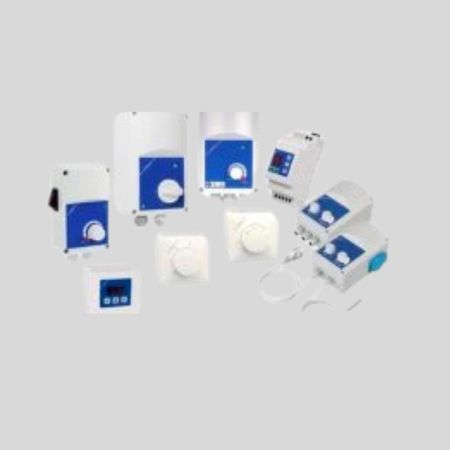
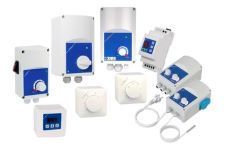
Speed controllers allow continuous adjustment of airflow based on conditions inside the greenhouse. Connected to temperature and humidity sensors, they start the fan at low power when conditions are at the acceptable limit and progressively increase speed if temperature or humidity rises. The result: better conditions for plants and significantly reduced energy consumption compared to continuous full-speed operation.
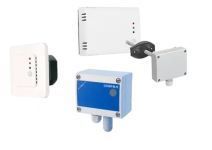
Multifunctional HVAC sensors simultaneously measure temperature, humidity and, in advanced variants, CO₂ concentration. They are the brain of an automated greenhouse ventilation system.
👉 Explore speed controllers and HVAC sensors for ventilation automation.
How to Calculate the Required Airflow for a Greenhouse
Correct airflow calculation is the step that makes the difference between functional and insufficient ventilation.
Basic formula:
Required airflow (m³/h) = Greenhouse volume (m³) × air changes per hour
Recommended number of air changes:
- Spring–autumn, normal days: 20–30 air changes/hour
- Summer, sunny days: 40–60 air changes/hour (sometimes more for sensitive crops)
- Night / winter: 5–10 air changes/hour (to remove moisture)
Practical example:
A greenhouse 20 m long × 8 m wide × 3.5 m average height:
- Volume = 20 × 8 × 3.5 = 560 m³
- Required airflow in summer = 560 × 50 = 28,000 m³/h
If you use an axial fan with an airflow of 7,000 m³/h, you need 4 fans to cover the summer requirement.
Important note: The manufacturer's specified airflow is measured at zero static pressure. In practice, shutters, protective grilles and even the distance to the air inlet reduce real airflow by 15–25%. Add this margin to your calculation.
Fan Positioning — Where to Mount Them
Extraction wall: extraction fans are mounted on the end wall of the greenhouse, in the upper section (20–30 cm below the eaves). Hot air rises naturally and is efficiently evacuated from the upper zone.
Inlet wall: on the opposite wall, fresh air openings must have a total area at least equal to the combined area of the fans, ideally with an insect protection screen and the ability to close at night or in winter.
Side distribution: in wide greenhouses (over 10 m), a single cross-flow may be insufficient — air doesn't reach the centre uniformly. Additional fans on side walls or internal circulation fans mounted between crop rows are recommended.
Avoid obstructions: do not mount fans where tall crops or structural elements obstruct airflow. A fan with partial obstruction in front loses a significant proportion of its airflow.
Common Mistakes in Greenhouse Ventilation
Undersizing for summer. The most frequently encountered issue. Calculations are done for average or spring conditions, not for the hottest days of July and August. A greenhouse that overheats for even a few days can completely compromise the harvest.
No speed adjustment capability. Fixed-speed fans with no controller run at full power even when not needed — wasted energy, unnecessary wear and sometimes air currents too strong for young plants.
Insufficient air inlet. A powerful fan with an inadequate air inlet creates high negative pressure and a real airflow much lower than calculated. The inlet area must be at least equal to the total fan area.
Ignoring humid nights. At night, temperatures drop and relative humidity frequently reaches 85–100% in unventilated greenhouses. A reduced night ventilation programme (5–10 air changes per hour) prevents fungal diseases without excessively cooling the space.
Insufficient insect protection. Air openings without insect screens are an open door for aphids, thrips and other pests. The screen must have fine mesh (under 0.5 mm for thrips), but should not reduce airflow excessively — check the pressure drop before fitting it.
Conclusion
Greenhouse ventilation is not a detail — it is one of the variables that directly determines the productivity and health of crops. A well-sized system, with correctly positioned axial fans, speed controllers and temperature and humidity sensors, can operate automatically and efficiently year-round, without constant manual intervention.
The investment in quality equipment pays back quickly: a single harvest saved from overheating or a fungal attack caused by excess humidity typically justifies the cost of the entire ventilation system.
Equip Your Greenhouse with Quality Fans and Control Systems
At ventilation.ro you'll find axial fans for extraction, portable fans for internal circulation, speed controllers and HVAC sensors suitable for greenhouses of any size.
📞 Call for technical advice: +40 722 667 239 — we'll help you calculate the required airflow and choose the right equipment for your specific greenhouse type and size.
Useful categories:


Post comment