










 Solutions KIT
 Sales
Sales


















 My account
 View cart
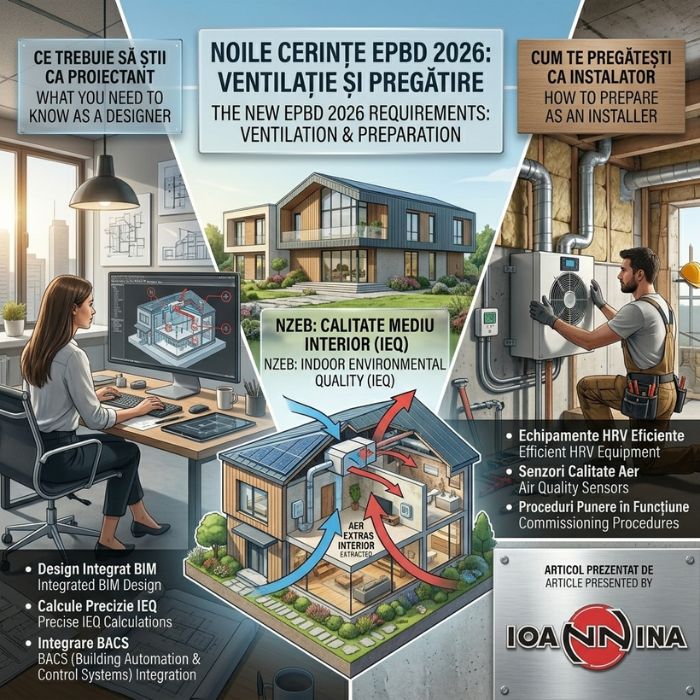 The New EPBD 2026 Require
men
ts: What They Mean for Ventilation and How to Prepare as a Designer or Installer
Why EPBD 2026 is the Most Important Document for the HVAC Industry in the Last Decade
If you are a building services designer, HVAC installer or technical manager of a property portfolio in Romania, there is a European document you need to know in detail: Directive EU 2024/1275 — the new version of the EPBD (Energy Performance of Buildings Directive), which entered into force on 28 May 2024 and must be transposed into the national legislation of each member state by 29 May 2026.
This is not a minor update. It is the most ambitious legislative reform in the history of European construction: it introduces mandatory Zero Emission Buildings (ZEB) from 2028 for public buildings and 2030 for all new buildings, establishes minimum energy performance standards for existing buildings (which will require the renovation of at least 16% of the worst-performing residential buildings by 2030), and places indoor air quality (IEQ) on the same footing as energy efficiency.
For ventilation designers and installers, EPBD 2026 creates both significant challenges and real opportunities — the market for energy renovation works and efficient HVAC systems will expand dramatically in Europe and Romania in the period 2026–2030.
The EPBD 2024 Timeline: What Happens and When
| Date | Requirement / Event |
|---|---|
| 28 May 2024 | Directive EU 2024/1275 enters into force |
| 1 January 2025 | Elimination of subsidies for new fossil fuel boilers |
| 29 May 2026 | Transposition deadline into member states' national legislation |
| 31 December 2026 | Member states submit national building renovation plans |
| 1 January 2028 | New public buildings must be ZEB (Zero Emission Buildings) |
| 1 January 2030 | All new buildings must be ZEB |
| 2030 | Minimum 16% of worst-performing non-residential buildings renovated |
| 2033 | Minimum 26% of worst-performing non-residential buildings renovated |
| 2050 | Fully decarbonised European building stock |
Reality for Romania: the May 2026 transposition deadline means designers and installers must be prepared now for requirements that will become mandatory in less than a year. Projects started in 2025 and completed in 2026–2028 will fall directly under the new regulations.
The 6 EPBD Requirements with Direct Impact on Ventilation
1. Zero Emission Buildings (ZEB) — Ventilation Becomes a First-Rank Component
The central concept of EPBD 2024 is ZEB — Zero Emission Building: a building with very high energy performance, without on-site fossil fuel emissions, powered primarily from renewable sources. From 2028 (public buildings) and 2030 (all new buildings), this becomes the mandatory standard, replacing nZEB.
The difference from nZEB: while nZEB allows fossil fuel combustion as long as total consumption is offset by renewables, ZEB completely prohibits on-site fossil fuel use. This means ventilation systems must operate exclusively on electricity — with maximum-efficiency EC motors — and the SFP indicator becomes even more critical in building energy performance calculations.
Practical impact for designers: in new projects from 2026+, any ventilation solution proposing conventional AC motors will be technically suboptimal. Fans with EC motors IE4/IE5 — compliant with EU 1253/2014 — become the de facto standard.
2. IEQ — Indoor Air Quality Becomes a Legal Requirement
EPBD 2024 introduces for the first time specific requirements regarding IEQ (Indoor Environmental Quality), recognising that an energy-efficient building with poor air quality is not truly high-performing.
Article 11 of the directive provides that member states must establish requirements whereby, from 29 May 2026, new residential buildings and major renovations be equipped with systems that monitor and control indoor air quality, including:
- CO₂ sensors for air quality indication
- Variable Air Volume (VAV) ventilation systems that automatically adjust fresh air supply based on occupancy
- Relative humidity monitoring to prevent mould
- Adequate filtration (minimum F7 in urban areas with high pollution)
Practical impact for installers: it is no longer sufficient to install a fan or heat recovery unit and set it at a fixed airflow. IEQ-compliant systems require CO₂ sensors, speed controllers and integration with the building automation system (BMS or home automation).
3. SFP — Specific Fan Power in Energy Calculations
SFP (Specific Fan Power) — the electrical power consumed by the fan per unit of airflow (W/m³/h or Pa·s/m³) — becomes the reference parameter for evaluating ventilation systems in energy performance calculations.
Regulation EU 1253/2014 (ErP for ventilation units) has already established maximum SFP limits for residential and non-residential ventilation units, but EPBD 2024 consolidates and extends these requirements, linking SFP directly to the building's primary energy indicator.
Indicative SFP values for ventilation systems: below 0.45 W/m³/h for simple residential systems; below 0.30 W/m³/h for well-designed heat recovery systems — values achievable only with high-efficiency EC motors.
Practical impact: incorporated fans with EC motor from the RDP or PFP range on ventilation.ro, with IE4/IE5 efficiency and active PFC driver, are the solutions enabling achievement of the required SFP values.
4. SRI — Smart Readiness Indicator: Buildings Become Intelligent
SRI (Smart Readiness Indicator) is a rating system evaluating a building's capacity to use smart technology to optimise its energy operation. EPBD 2024 expands SRI applicability and links renovation financing to achieving a minimum SRI score.
Ventilation's relevance to SRI: a ventilation system contributes to the SRI score through:
- Automatic airflow adjustment based on sensors (CO₂, occupancy, temperature) — major contribution
- BMS integration via digital protocols (Modbus RTU, BACnet) — major contribution
- Heat recovery with efficiency >70% — significant contribution
- Time-based programming (day/night, occupied/unoccupied) — moderate contribution
Practical impact: designers who propose ventilation systems with EC motor, CO₂ sensors and BMS control add valuable SRI points to the building — which can be decisive for obtaining PNRR funding or preferential green credit rates.
5. Mandatory Renovation of Existing Buildings — A Huge Market for HVAC
The greatest economic impact of EPBD 2024 on the HVAC industry comes from a less-discussed direction: Minimum Energy Performance Standards (MEPS) for existing buildings.
The directive requires member states to establish performance thresholds below which existing buildings must be renovated:
- 16% of worst-performing non-residential buildings renovated by 2030
- 26% of worst-performing non-residential buildings renovated by 2033
- Reduction of primary energy consumption for residential buildings by 16% by 2030 and 20–22% by 2035
What this means for Romania concretely: millions of flats in Communist-era residential blocks (energy classes E, F, G) will face renovation pressure in the 2026–2035 period. Every serious renovation will require modernisation of the ventilation system — including installation of heat recovery units where none previously existed.
Opportunity for HVAC installers: demand for heat recovery ventilation systems for renovated flats will grow exponentially. Decentralised units (wall mounting, single Ø 125–160 mm hole) will be the preferred solution for renovations without major structural works.
6. Renovation Passport and Renewed Energy Performance Certificate
EPBD 2024 introduces the renovation passport — a document describing the optimal renovation trajectory for a specific building, phased over time, with indication of required investments and estimated savings. Member states must implement the renovation passport scheme by 29 May 2026.
Energy performance certificates must be issued on a uniform A–G scale, with Class A reserved exclusively for ZEB buildings. Class G will identify the worst-performing 15% of the national building stock. EPCs with Class D or below have validity reduced to 5 years (versus 10 years previously).
Practical impact: designers issuing energy performance certificates will need to include specific ventilation improvement recommendations — including HRV system proposals — in documents issued after May 2026.
EC Fans — The Only Acceptable Standard from 2026
Regulation EU 640/2009 (electric motors) and EU 1253/2014 (ventilation units) have already created the framework for gradual phase-out of inefficient motors. EPBD 2024 consolidates and extends this framework:
- IE1 motors — banned in new applications since 2017
- IE2 motors — being phased out; IE2 models on ventilation.ro are already marked as "Discontinued"
- IE3 motors — current minimum standard for motors >0.75 kW
- EC motors (IE4/IE5) — recommended standard for new ventilation systems
Concrete advantages of EC motors for EPBD/nZEB/ZEB compliance:
- Efficiency 93–95% versus 70–85% for AC equivalents
- Continuous adjustment 0–100% without losses — optimal SFP at any airflow
- Native BMS compatibility (0–10V, Modbus RTU/RS485) — essential for IEQ and SRI
- IE4/IE5 efficiency class — exceeding any current or future requirement
ventilation.ro products compliant with EPBD/nZEB/ZEB:
The EC motor range on ventilation.ro — 174 products — covers all necessary constructional types:
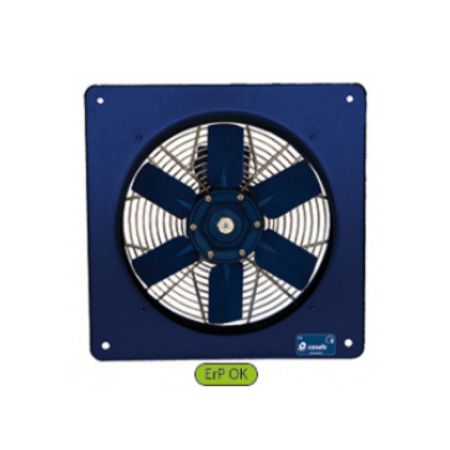
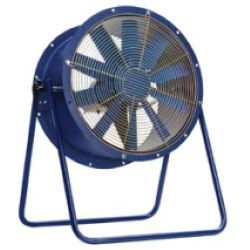
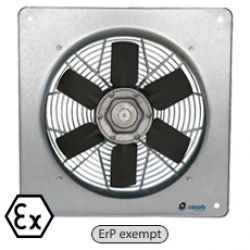
- Axial EC fans (IE4/IE5) for halls and commercial spaces
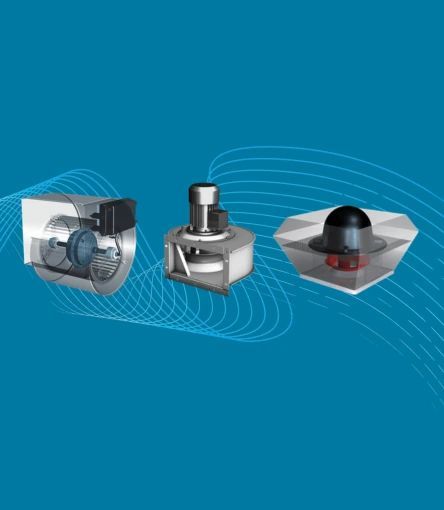
- RDP EC incorporated fans (DWDI, brushless, active PFC) for AHU and centralised systems
- PFP plug fans for plenum chambers — with integrated IMV airflow measurement device
- EC rooftop fans (RDA series) with integrated digital pressure differential
- Inline EC fans for residential and semi-commercial systems
👉 Explore the complete EC motor range on ventilation.ro
Checklist for Designers and Installers — EPBD 2026 Compliance
☑ Checks for new projects (from May 2026)
- Does the ventilation system use exclusively EC motors (IE4/IE5)? — mandatory for ZEB 2028/2030
- Does the system SFP fall within EU 1253/2014 limits? — verified through equipment technical datasheets
- Is an IEQ monitoring system provided (CO₂ sensors, humidity)? — EPBD Article 11 requirement
- Does ventilation integrate with the building BMS (0–10V or Modbus)? — contribution to SRI score
- Does the heat recovery unit achieve ≥ 75% efficiency? — recommended by RTC 4–2022
- Does the nZEB calculation include ventilation SFP in the primary energy indicator?
☑ Checks for major renovations (from May 2026)
- Is the existing ventilation system evaluated against modern solutions?
- If new windows or additional insulation is being installed, is an HRV system also provided?
- Are decentralised units evaluated as an alternative to centralised systems for flats?
- Does the renovation passport (where applicable) include ventilation upgrade recommendations?
☑ Required products and documentation
- Do fan technical datasheets include SFP explicitly calculated or specified?
- Do CE declarations of conformity mention EU 1253/2014 or EU 640/2009?
- Are IE efficiency classes explicitly mentioned on datasheets and product labels?
Business Opportunities in the EPBD 2026 Era
The energy renovation market — estimate for Romania
Romania's building sector consumes approximately 40% of national primary energy — identical to the European average. The residential building stock is predominantly energy classes D, E, F and G — exactly those targeted by EPBD MEPS requirements.
The PNRR — Renovation Wave programme allocates significant European funds for energy renovation of public and residential buildings, contingent on achieving minimum energy performance thresholds. Designers and installers capable of proposing EPBD-compliant solutions — including HRV ventilation systems with EC motor and IEQ sensors — will be in pole position for these contracts.
The competitive advantage of the EPBD-ready designer/installer
Designers who understand EPBD 2024 requirements can offer genuine added value to their clients:
- Projects achieving Energy Class A certificate on first permit application, not after multiple iterations
- High SRI score unlocking preferential financing
- Technically documented ventilation systems for the renovation passport
- Demonstrable and correctly calculated energy savings
ventilation.ro Products Recommended for EPBD 2026 Compliance
Heat recovery units — HRV compliant
Efficiency ≥ 75%, EC motors, F7 filters, BMS compatible:
👉 Residential range 👉 Commercial range
EC incorporated fans — optimal SFP
Brushless IE4/IE5 motor, active PFC, 0–10V/Modbus control:
👉 RDP EC — DWDI backward curved 👉 PFP — Backward curved Plug Fan
HVAC sensors — for IEQ and SRI
CO₂, temperature, humidity, air quality:
👉 Multifunctional HVAC sensors
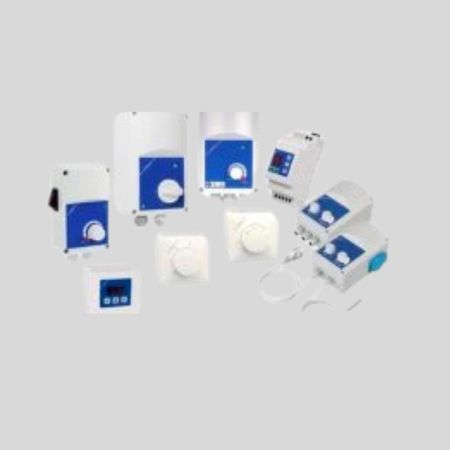
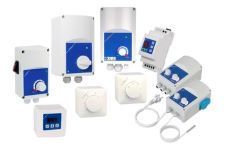
Speed controllers — for VAV systems
Variable airflow control compatible with CO₂ sensors:
Conclusion
EPBD 2024/1275 changes the rules of the game for the entire construction and installation industry in Europe. The May 2026 transposition deadline is not a distant date — it is close, and projects starting today will be completed under the new legislation.
The vectors of change for ventilation are clear: EC motors instead of AC, HRV heat recovery units instead of simple ventilation, IEQ sensors instead of fixed airflow, BMS integration instead of manual switching. These are not trends or premium options — they are the mandatory direction of the market.
ventilation.ro offers the complete range of EPBD-compliant equipment — from residential and commercial HRV heat recovery units, to EC incorporated fans with optimal SFP, to air quality sensors and speed controllers for VAV systems. Contact our team at +40 722 667 238 for technical consultancy tailored to your projects.
Article by the ventilation.ro team — IOANNINA IMPEX SRL. Information is based on Directive EU 2024/1275 (EPBD), EU 1253/2014 (ErP ventilation), EU 640/2009 (motors), MC001/2022 and RTC 4–2022.


Post comment