







 Solutions KIT
 Sales
Sales










 My account
 View cart
 Heat Recovery Ventilation for New Homes in 2026 — What MVHR Is, Why It Is Mandatory and What It Costs
If you are building or buying a new home in 2026, you will increasingly hear the terms "heat recovery unit" or "MVHR" from your designer or builder. This is not an optional extra — it is a legal requirement that applies to all new buildings in Romania, with direct implications for your energy consumption and the quality of the air you breathe. This guide explains what it is, why it is mandatory, what it costs and how to choose correctly.
What is a heat recovery unit and what is MVHR
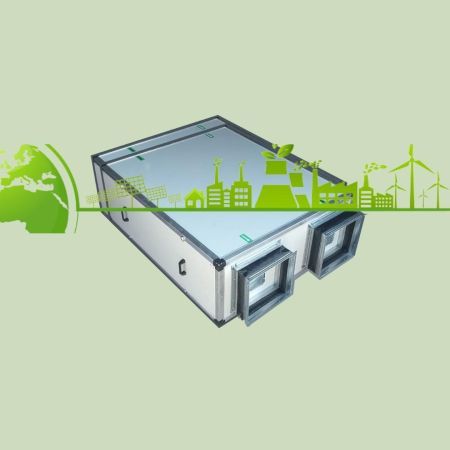
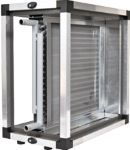
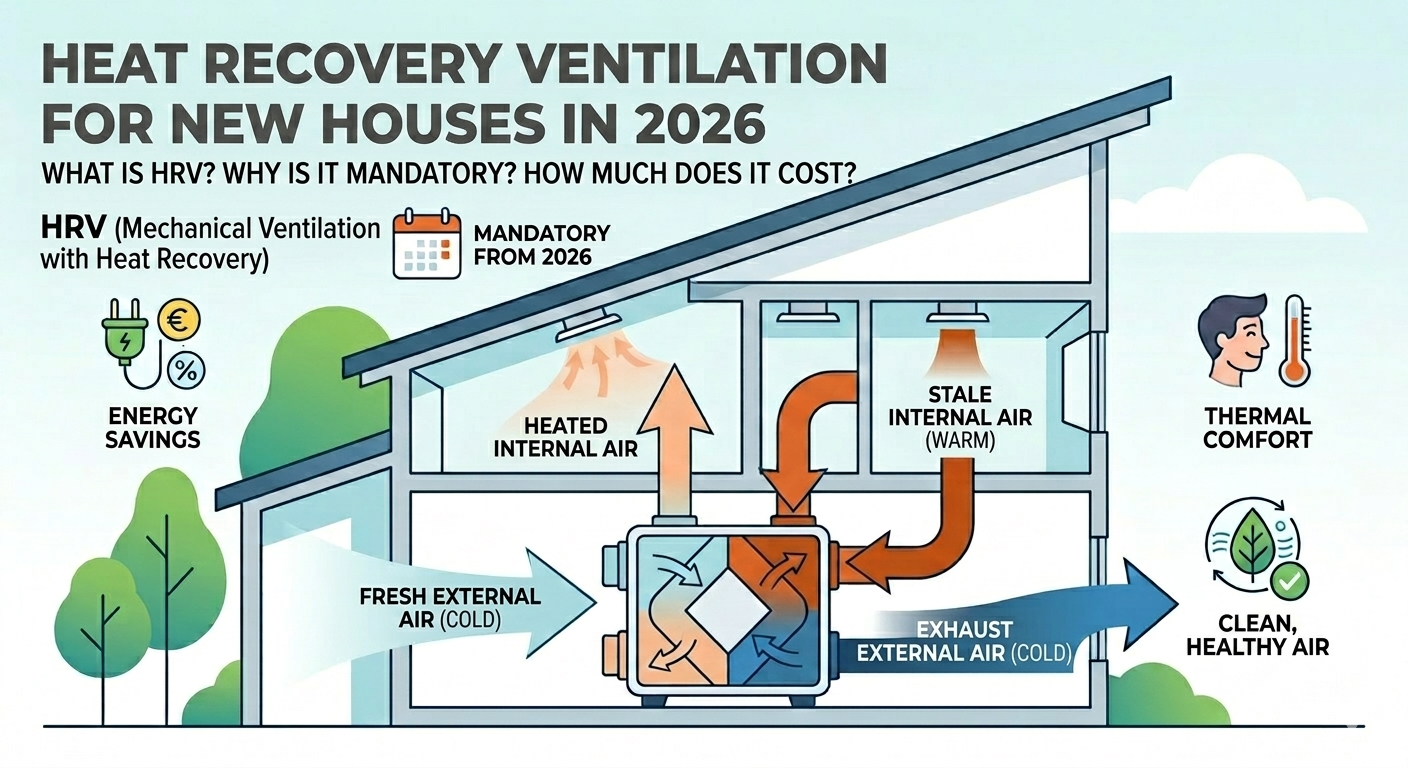
MVHR (Mechanical Ventilation with Heat Recovery) is a ventilation system that continuously supplies fresh air from outside and extracts stale air from inside, without losing the heat (or coolness) from your home. At its heart is the heat exchanger — a thermal transfer device through which both air streams pass simultaneously without mixing, transferring temperature from the extracted air to the incoming fresh air.
The practical result: in summer you can ventilate without introducing outside heat, in winter you introduce fresh air without losing indoor heat. A heat recovery unit with 85% efficiency means that 85% of the thermal energy in the extracted air is transferred to the incoming fresh air — significantly reducing your heating bill.
The difference from a simple extractor fan: an extractor fan removes stale air but does not supply controlled fresh air and loses all conditioned air. An MVHR unit makes the complete exchange and recovers the energy. The annual difference on your energy bill can exceed 150–200 euros for an average home.
Why it is mandatory in new homes — the nZEB requirement
Short answer: since 2023, all new residential buildings in Romania must comply with the nZEB (Nearly Zero Energy Building) standard, under Law 372/2005 (updated) and the MDLPA Order. One of the nZEB requirements is mechanical ventilation with heat recovery at a minimum efficiency of 75%.
This means in practice that any new home with a building permit from 2023 onwards must include an MVHR system in its design. If your designer or builder has not informed you of this requirement, there is a risk that the project will not pass verification or that the completion certificate will be challenged.
What happens if MVHR is not installed:
- The project does not receive nZEB-compliant energy certification
- At building completion, the non-conformity may block finalisation of the file
- The completed dwelling is more expensive to operate (higher energy bills)
- Indoor air quality is compromised — modern well-insulated homes no longer allow natural ventilation through infiltration
Single-room unit vs. central system with ductwork — the difference you must understand before buying
This is the most common confusion and has a direct impact on price. There are two completely different categories of equipment, both commonly called "heat recovery units":
Single-room units (wall-mounted, no ductwork)
Mounted directly on the exterior wall of one single room. Supply fresh air and extract stale air through the same wall sleeve, with an internal heat exchanger. No ductwork required. Airflows: 100–550 m³/h.
From the catalogue: Vent-Axia HR 300 (300 m³/h), Vent-Axia HR 500D (550 m³/h)
Suited for: renovation (adding ventilation to an existing room), individual bedroom, bathroom or a room without existing ventilation. Not the right solution for a new nZEB home — a 3–4 bedroom home would need 3–4 separate units (one per room), each with its own wall hole, with individual controls and no coordination between rooms.
Indicative price: 200–400 euros per unit, plus installation.
Central systems with ductwork (centralised system for the whole house)
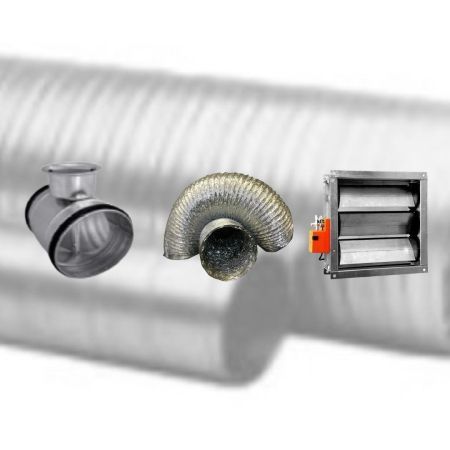
A single central unit serves the entire house through a duct network. Supplies fresh air to bedrooms and living rooms, extracts stale air from bathrooms, kitchen and WCs. Airflows: 200–6,000 m³/h.
From the Casals CHR range:
- CHR 800 — 800 m³/h, for homes up to 120 m²
- CHR 1500 — 1,500 m³/h, homes 120–200 m²
- CHR 2000 — 2,000 m³/h, homes 200–300 m² or commercial spaces
- CHR 3000 — 3,000 m³/h, commercial spaces and offices
This is the correct solution for new nZEB homes. A single unit serves the whole house, provides controlled air exchange in all rooms, can be regulated automatically based on air quality (CO₂, humidity) and meets nZEB requirements.
Indicative price for complete system (unit + ductwork + installation) for a 120–150 m² home: 2,000–4,500 euros, depending on installation complexity and distances.
What it costs — realistic comparison for a 150 m² home
| Solution | Equipment | Estimated installation | Indicative total |
|---|---|---|---|
| 4 single-room units | ~1,200 EUR | ~700 EUR | ~1,900 EUR |
| CHR 800 + ductwork | ~850 EUR | ~1,500–2,000 EUR | ~2,400–2,900 EUR |
| CHR 1500 + ductwork | ~1,300 EUR | ~1,500–2,000 EUR | ~2,800–3,300 EUR |
Recommendation: for a new home of 120–180 m², the CHR 800 or CHR 1500 central system with ductwork is the optimal solution — more efficient, quieter, easier to regulate automatically and better evaluated in nZEB energy certification.
What efficiency is required — the nZEB requirement
nZEB requires a minimum heat recovery efficiency of 75%. In practice, quality equipment achieves 80–90%.
What 85% efficiency means concretely: if it is -10°C outside and +20°C inside (a 30°C difference), the incoming fresh air will be pre-heated to approximately +15°C before entering the house. The energy saved compared to a system without recovery is calculable: for a 150 m² home, the difference can represent 80–150 euros annually on the heating bill, meaning the equipment investment is recovered in 8–12 years — without counting the benefits for indoor air quality.
What to choose based on your situation
You are building a new home (permit from 2023 onwards): You mandatorily need an MVHR system with a central unit and ductwork for nZEB compliance. Discuss with your mechanical designer from the design phase — integrating ductwork in a suspended ceiling or structure is significantly simpler and less expensive during construction than after.
You are renovating an existing home: Single-room units (Vent-Axia HR 300/HR 500D) are the quick solution with no major structural intervention — one hole per wall per room, no ductwork. Not nZEB-compliant but significantly improves indoor air quality.
You are buying a new apartment: Check whether the developer has included MVHR in the design — it is mandatory for permits from 2023. If not included, either the apartment was permitted earlier or there is a non-conformity worth clarifying.
You have a commercial space or office: The commercial CHR range (800–6,000 m³/h) covers all sizes of office spaces, hotels and small commercial centres.
👉 Vent-Axia residential range — wall-mounted heat recovery units 👉 Casals CHR commercial range — central duct systems
Frequently asked questions
How many m³/h do I need for my home? Simple rule: 30 m³/h per person in a bedroom, 60 m³/h in the kitchen, 40 m³/h in a bathroom. A 4-person home with 2 bedrooms + kitchen + 2 bathrooms: 120 + 120 + 80 = 320 m³/h minimum. CHR 800 covers this comfortably.
👉 Airflow calculator for your home
How much noise does it produce? CHR units and Vent-Axia units are designed for residential applications — noise level is below 30 dB(A) at normal airflow, imperceptible in a bedroom.
Does it need maintenance? Filters are replaced or cleaned every 6–12 months (depending on local air quality). The heat exchanger has no moving parts and requires no specific maintenance over its normal service life of 15–20 years.
Does it integrate with home automation? Yes — CHR units are available with a digital controller and can be integrated with CO₂ and humidity sensors for automatic airflow regulation based on air quality.
Why choose ventilation.ro
Direct importer of Vent-Axia (UK) and Casals (Spain) in Romania:
- Complete range for all applications — from HR 300 single-room units for renovation to CHR 3000 units for commercial buildings
- Complete technical documentation — data sheets, energy certificates, CE declarations directly usable in the nZEB authorisation file
- Free consultancy for airflow calculation and model selection for your home
- Local stock — delivery without import lead times
- Fixed-price quotations for projects, builders and installers
📞 +40 722 667 238 — we calculate the airflow required for your home free of charge 🌐 Heat recovery units — complete range
Related articles: I5-2022 standard — guide for designers · Airflow calculator · Residential fans


Post comment