










 Solutions KIT
 Sales
Sales












 My account
 View cart
Restaurant and Professional Kitchen Ventilation 2026 — Norms, Minimum Airflow and Equipment Guide
Summer puts maximum pressure on any professional kitchen. At 35°C outside, a kitchen without adequate ventilation reaches 45–50°C — temperatures at which staff cannot work efficiently, accident risk increases and food quality deteriorates. Add to this the mandatory insect protection requirement imposed by food safety authorities, and the pressure on a restaurant's ventilation system is at its peak exactly during the busiest season.
This guide explains what airflow is required, what the regulations say, which equipment solves the problem completely and how to quickly calculate what you need for your kitchen and dining room.
Why restaurant ventilation is more complex than any other space
A restaurant has three zones with completely different requirements that must be treated separately:
The kitchen — the most demanding space in the entire building. Sources of heat, steam, grease and odours are concentrated and intense. A single commercial grill produces heat equivalent to several air conditioning units. Insufficient ventilation means unbearable temperatures for staff, grease deposited in ducts (fire risk) and odours migrating to the dining room.
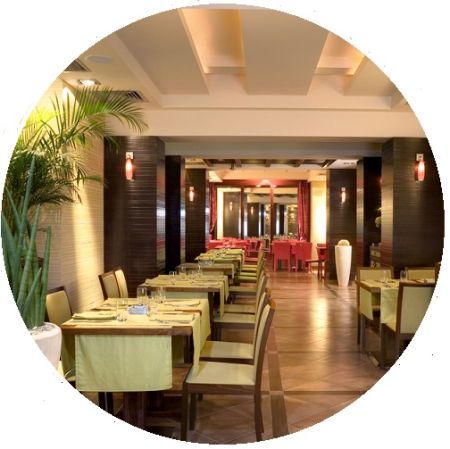
The dining room — customer comfort requirements: pleasant temperature, fresh air free of kitchen odours, no direct air draughts on tables. Slight negative pressure relative to the kitchen to prevent odours migrating from kitchen to dining room.
The entrance — in summer, insect barriers are mandatory under food safety regulations. A permanently open door at a busy restaurant means guaranteed insects — the only equipment that solves this without blocking customer access is an air curtain.
What the regulations say — concrete obligations
Insect protection — mandatory under food safety norms
EU Regulation (EC) No 852/2004 on the hygiene of foodstuffs imposes that any establishment handling, processing or serving food must have effective insect protection at all entrances.
Practical consequence: at any food safety inspection, inspectors check for insect protection at both the kitchen entrance and the main restaurant entrance. Absence is grounds for a warning and, on repeated inspection, a fine and suspension of activity.
Accepted solutions: insect screen (blocks customer access or requires double door) or air curtain — which satisfies the requirement without creating operational obstacles. The air curtain is the standard solution chosen by the HoReCa industry precisely because it creates no barriers to operations.
Workplace temperature — health and safety regulations
Health and safety regulations require that temperatures in workplaces are maintained at values that do not endanger employee health. In professional kitchens with intense heat sources, adequate mechanical ventilation is the only realistic method of meeting this obligation.
Required airflow — quick calculation
Air changes per hour method
Indicative airflow rates per technical norms for food service premises:
| Space | Air changes / hour | Notes |
|---|---|---|
| Professional kitchen | 15–25 ACH | 20 ACH for standard kitchen |
| Fast food / intense grill | 25–40 ACH | Large heat source |
| Dining room | 10–15 ACH | Customer comfort |
| Bar / café | 8–12 ACH | No intense heat sources |
| Food storage | 4–6 ACH | Product quality maintenance |
| Dishwashing area | 15–20 ACH | Intense steam vapours |
| Toilets | 8–10 ACH | Odour extraction |
Calculation formula: Required airflow (m³/h) = Floor area (m²) × Ceiling height (m) × Air changes per hour
Example: Kitchen 30 m² × 3 m height × 20 ACH = 1,800 m³/h
Complete example — medium-capacity restaurant
Restaurant with 60 covers, kitchen 30 m², dining room 80 m², 3m ceiling:
| Space | Volume | ACH | Required airflow |
|---|---|---|---|
| Kitchen 30 m² | 90 m³ | 20 | 1,800 m³/h |
| Dining room 80 m² | 240 m³ | 12 | 2,880 m³/h |
| Dishwashing 10 m² | 30 m³ | 18 | 540 m³/h |
| Total extract | ~5,220 m³/h |
Fresh air supply should cover approximately 80–90% of extracted airflow — the difference is provided by controlled infiltration (slight negative pressure in kitchen relative to dining room, preventing odour migration).
Equipment — what solves which problem
1. Hood extract fan — kitchen extraction
The most important piece of equipment. Extracts air laden with steam, grease and heat directly at source — before it distributes throughout the kitchen.
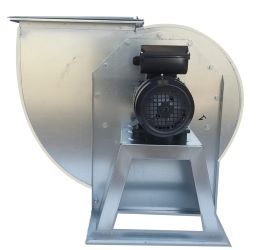
CF HP range — centrifugal fans with external motor designed specifically for professional kitchen hoods. The external motor means grease-laden air does not pass through the motor — much longer service life and simpler maintenance.
| Model | Power | Approximate airflow | Discharge connection |
|---|---|---|---|
| CF 1 HP | 0.75 kW | 800–1,200 m³/h | Ø250mm |
| CF 1.5 HP | 1.1 kW | 1,000–1,600 m³/h | Ø250mm |
| CF 2 HP | 1.5 kW | 1,400–2,200 m³/h | Ø300mm |
| CF 3 HP | 2.2 kW | 2,000–3,000 m³/h | Ø350mm |
| CF 4 HP | 3.0 kW | 2,800–4,000 m³/h | Ø350mm |
| CF 5.5 HP | 4.0 kW | 3,500–5,500 m³/h | Ø350mm |
| CF 7.5 HP | 5.5 kW | 5,000–7,500 m³/h | Ø450mm |
Selection rule: calculate required airflow for your kitchen (formula above), add 20% reserve and select the next model up.
👉 CF HP range — professional hood fans
2. HP discharge reducers — connecting to ductwork
Each CF HP fan requires a transition reducer from the fan's rectangular discharge to the circular extract duct. Without the correct reducer — pressure losses, aerodynamic noise and air leakage at the connection.
| Reducer | Compatible with | Duct outlet |
|---|---|---|
| HP 200 | CF 1 HP | Ø200mm |
| HP 250 | CF 1 HP, CF 1.5 HP | Ø250mm |
| HP 300 | CF 2 HP | Ø300mm |
| HP 350 | CF 3 HP, CF 4 HP, CF 5.5 HP | Ø350mm |
| HP 450 | CF 7.5 HP | Ø450mm |
👉 HP 200–450 discharge reducers — in stock
3. Air curtain at entrance — insect protection and thermal barrier
In summer, the air curtain at the restaurant entrance performs two functions simultaneously:
Insect barrier — satisfies food safety requirements without blocking customer access. Air velocity of 6–8 m/s at floor level is sufficient to prevent insects from crossing.
Thermal insulation — reduces warm outdoor air entering the air-conditioned dining room by 60–80%. For a restaurant operating 12 hours/day in summer, energy savings can exceed the curtain cost within a single season.
Correct sizing:
- Curtain width must equal or exceed the door width
- A 1,200mm door requires a minimum 1,200mm curtain
- A 2,400mm entrance requires two 1,200mm curtains side by side or a 2,000mm unit + 400mm covered laterally
👉 Casals air curtains — complete range
Common mistakes in restaurant ventilation
Mistake 1 — Undersizing the hood extract fan. Most frequent. The owner chooses a smaller fan to save money — and ends up with a 45°C kitchen, grease in ducts within 6 months and exhausted staff. Better oversized by 30% than undersized by 10%.
Mistake 2 — Air curtain narrower than the door. A 1,000mm curtain on a 1,200mm door leaves 200mm open — that is exactly where insects enter. The investment is wasted.
Mistake 3 — No periodic duct cleaning. Grease deposits in ducts ignite at 250–300°C — easily reached near a grill or oven. Clean ducts every 6 months for intensive operations, 12 months for moderate.
Mistake 4 — Positive pressure in kitchen relative to dining room. If supply airflow in the kitchen exceeds extract, kitchen becomes positive pressure and odours migrate to dining room. Correct: extract slightly exceeds supply in kitchen — controlled negative pressure.
Mistake 5 — No reserve capacity for summer. A fan sized to the limit at 20°C outside will be insufficient at 35°C. Add 20–25% reserve to the initial calculation.
Why ventilation.ro for your restaurant equipment
- Local stock — CF HP fans and air curtains available immediately, 24–48h delivery
- Complete range — CF 1 HP to CF 7.5 HP with all compatible HP reducers
- Free consultancy — tell us your kitchen area and cooking type, we calculate the required airflow
- Documentation for food safety authorisation if required
📞 +40 722 667 238 — Call with your kitchen dimensions and number of restaurant covers 💬 WhatsApp — send your kitchen plan and we respond with a complete recommendation
👉 Casals CF HP professional hood fans 👉 Air curtains — complete range 👉 HP 200–450 discharge reducers 👉 Air curtain complete guide
Frequently asked questions
Does an air curtain replace an insect screen in food safety documentation? Yes — air curtains are accepted by food safety authorities as an insect protection method under EU food hygiene regulations. In fact, the preferred solution over insect screens precisely because it does not block customer access.
How many air changes per hour for a kitchen with an intense grill? Kitchens with intense grilling require 25–40 air changes per hour versus 15–20 for a kitchen with steam or oven cooking. The grill produces large quantities of smoke, grease vapours and heat that must be evacuated rapidly.
Can the same fan be used in winter and summer? Yes — CF HP fans operate continuously regardless of season. In summer they work harder due to higher temperatures but are dimensioned for this load.
What happens if I don't clean the ducts? Grease deposits in ducts are flammable and constitute the primary cause of restaurant fires. Fire safety norms require periodic cleaning. Recommended interval: 6 months for intensive operations, 12 months for moderate.
Related articles: Air curtain complete guide 2026 · CF HP professional hood fans guide · Commercial space ventilation


Post comment