









 Solutions KIT
 Sales
Sales


















 My account
 View cart
Demand Controlled Ventilation (DCV): How Sensors Cut Your System's Energy Use
Buildings are over-ventilated — sometimes by as much as six times the required minimum rate.
The cause isn't negligence, it's how systems are designed: the installation is sized for peak occupancy and then runs at that airflow permanently. A meeting room for 20 people receives air for 20 people whether two people are sitting in it or nobody at all.
Every cubic metre of fresh air introduced in winter has to be heated. In summer, cooled. Demand controlled ventilation — DCV — removes exactly this waste.
What demand controlled ventilation is
Short answer: DCV is a strategy where fresh air volume is continuously adjusted to the actual occupancy of a space, measured by sensors. Unlike constant air volume (CAV) systems, which run permanently at design airflow, DCV ventilates as much as needed, when it's needed.
The difference, side by side:
| CAV — constant volume | DCV — on demand | |
|---|---|---|
| Airflow | fixed, sized for peak occupancy | variable, follows real occupancy |
| Empty room | ventilates the same | drops to minimum airflow |
| Full room | ventilates correctly | ventilates correctly |
| Fan energy | constant | proportional to demand |
| Thermally treated air | full airflow, permanently | only what's necessary |
The stake isn't just fan energy. Most of the saving comes from the air that no longer has to be heated or cooled.
What it actually saves
Figures from technical literature and case studies:
- 17.8% average energy saving, measured by the US Department of Energy across all climate zones
- 10–30% of conditioning energy in buildings with variable occupancy
- 13–20% daily savings in field studies
- 27% annual reduction in HVAC consumption — a university campus in Denmark, using CO₂ sensors with adaptive algorithms
- In some modelling, heating energy reductions exceeded 40% for office buildings
The range is wide because savings depend on one thing: how much occupancy varies. In a space occupied constantly at full capacity, DCV has nothing to save. In a meeting room used three hours a day, the saving is substantial.
Why CO₂ and not something else
Because people are the source of fresh air demand, and CO₂ is their most direct signal.
A person exhales air at 3,000–5,000 ppm CO₂, while outdoor air is typically 400–700 ppm. In an occupied room, concentration rises predictably, in proportion to the number of people and the fresh air rate.
A CO₂ sensor doesn't measure "stale air" — it measures how many people are in the room, indirectly but reliably. It is the best occupancy indicator available, better than a presence sensor, because it distinguishes between one person and twenty.
Which threshold to use
| Reference | Threshold |
|---|---|
| ASHRAE 62 | indoor CO₂ below 700 ppm above outdoor |
| Common practice | 1,000 ppm as an absolute ceiling |
| California Title 24 | below 600 ppm above outdoor, sensor accuracy ±75 ppm |
At 1,000 ppm, roughly 20% of occupants perceive the air as unacceptable. Above that, documented effects on concentration and decision-making begin to appear.
Which sensors are used
CO₂ is the most important, but not the only one. A well-designed DCV system combines several parameters:
CO₂ — human occupancy. The primary signal in offices, classrooms, meeting rooms, cinemas and retail. 👉 CO₂ level sensors
Humidity — moisture load. Essential in bathrooms, kitchens, laundries, pools and production areas. The fan responds to rising humidity, not to a fixed schedule. 👉 Temperature and humidity sensors
Air quality / VOC — pollutants unrelated to people. Paints, solvents, new furniture, cleaning products. CO₂ doesn't detect them. 👉 Air quality sensors
Toxic gases CO / NO₂ — car parks and workshops. Here ventilation isn't about comfort but safety: the system starts when a threshold is exceeded. 👉 CO / NO₂ sensors
Differential pressure — filter condition and system balance. Signals filter clogging before airflow visibly drops. 👉 Pressure sensors
The overlooked part: a sensor alone saves nothing
This is where most DCV projects stall, and the consequence is expensive.
A sensor measures and transmits a signal. That's all. For a saving to exist, something must act on that signal — meaning the fan must be able to change speed.
A conventional AC motor connected directly to the mains runs at one speed. You can fit ten sensors: it will consume the same. The only way to reduce airflow would be to throttle the system with dampers — but then the energy consumed stays roughly the same, it's simply lost as resistance.
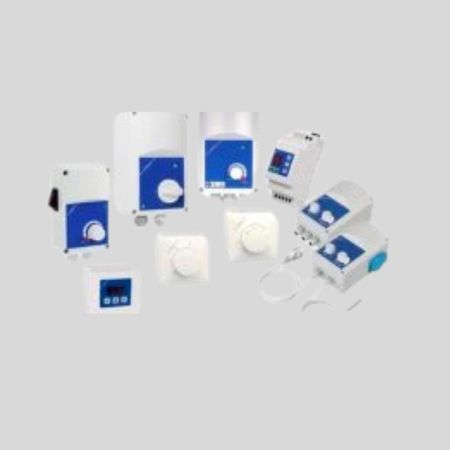
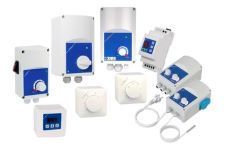
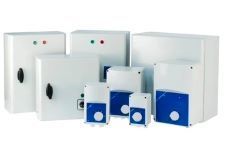
👉 EC motor fans · Frequency inverters · Speed controllers
Where DCV pays back fastest
The rule is simple: the more occupancy varies, the greater the saving.
Fast payback:
- Meeting and conference rooms — occupied a few hours a day, ventilated for ten
- Classrooms and lecture halls — intense but scheduled occupancy
- Cinemas and auditoriums — full or empty, nothing in between
- Gyms and sports halls — extreme variation in occupancy and metabolic load
- Restaurants — short peaks, long hours of low occupancy
- Open-plan offices — real occupancy often below 60% of capacity
- Underground car parks — CO/NO₂-driven ventilation is mandatory anyway
Slow or no payback:
- Spaces occupied constantly at full capacity
- Systems already running intermittently on a strict schedule
- Very small spaces, where the sensor cost isn't justified
What the Romanian technical framework says — and where the gap is
Normative I5-2022 is the standard in force in Romania for the design, execution and operation of ventilation and air conditioning systems. It starts from the right principle: indoor air quality is ensured by ventilating according to the room's use and its occupancy level.
It even provides the tools — Annex 4 gives floor area per person for determining occupancy, and Annex 7 gives recommended air change rates by building use.
Where the gap appears: the normative sizes the installation for design occupancy. It says nothing about what happens in operation, when the room is half full or empty. In practice, the system stays at design airflow.
The result: a correctly designed and correctly executed installation that wastes energy every day. DCV closes exactly this gap — it doesn't change the sizing, it changes how the system runs.
The nZEB paradox
In older buildings, part of the fresh air entered uncontrolled — through gaps, imperfect joinery and leaks. It wasn't energy-efficient, but it provided accidental ventilation that masked problems.
In nZEB buildings, the envelope is far tighter and this mechanism disappears entirely.
The consequence is twofold and seemingly contradictory:
- Mechanical ventilation becomes mandatory, not optional — without it come damp, condensation, mould and stale air
- But it also becomes the largest remaining source of energy loss, in a building where every other loss has been eliminated
In other words: the better the building performs, the more it matters how you control the ventilation. In an nZEB building, a system permanently running at full airflow can single-handedly compromise the performance you paid for in envelope, glazing and heat pump.
The full framework applicable in Romania: Law 372/2005 on the energy performance of buildings · Normative I5-2022 · Methodology MC001/2022 · Directive (EU) 2024/1275.
The regulatory context: EPBD 2024
This isn't only about cost.
Directive (EU) 2024/1275 on the energy performance of buildings imposes the zero-emission building standard for new construction:
- from 2028 — for new public buildings
- from 2030 — for all new buildings
These buildings have very low energy needs, largely covered by renewable sources. At that level, a ventilation system running permanently at maximum airflow becomes incompatible with the target. DCV is one of the strategies explicitly promoted by the directive.
For new projects or major renovations, the question is no longer whether it's worth it, but how to implement it correctly.
The calculation in money: a worked example
Percentages are useful, but decisions are made in currency. Below, a transparent calculation with every assumption stated.
The example
| Parameter | Value |
|---|---|
| Space type | open-plan office |
| Design occupancy | 100 people |
| Design airflow | 3,000 m³/h (30 m³/h per person) |
| Operating schedule | 10 h/day × 250 days = 2,500 h/year |
| Fan power at full airflow | 1.5 kW |
| Average real occupancy | 60% of capacity |
| Heating season | 180 days × 10 h = 1,800 h |
| Average winter temperature difference | 15 K |
Saving 1 — fan electricity
With DCV, average airflow drops to around 65% of design. Fan power falls roughly with the cube of speed:
0.65³ ≈ 0.27 → the fan draws about 27% of its power
1.5 kW − 0.41 kW = 1.09 kW saved, over 2,500 h/year ≈ 2,700 kWh/year
Saving 2 — air that no longer needs heating
This is the larger part, and the one most calculations omit.
With 35% less air introduced — 1,050 m³/h that no longer needs heating:
Q = 1,050 m³/h × 1.2 kg/m³ × 1.005 kJ/kg·K × 15 K ≈ 5.3 kW thermal
5.3 kW × 1,800 h ≈ 9,500 kWh thermal/year
The bottom line
At typical Romanian energy prices, the two savings together come to roughly 6,500 lei per year for a space of this size. Against a typical DCV investment — sensors for three or four zones, plus the speed control solution — payback is usually within the first or second year. In summer, cooling savings add to this.
⚠️ The figures above are a worked example, not a quotation. The real result depends on operating hours, actual occupancy, your energy tariffs and the system configuration. Send us your real data and we'll run the calculation on your case — free of charge.
Five mistakes that cancel out the saving
1. Sensor in the wrong place. A CO₂ sensor next to a supply diffuser reads fresh air and permanently reports low values — the system will never increase airflow. Correct position: in the occupied zone, at breathing height, away from direct draughts and doors.
2. A fan that can't modulate.
3. Setpoint too low. A 600 ppm setpoint in an area with 450 ppm outdoor air keeps the system at near-maximum airflow permanently. The entire saving is lost, with no gain in air quality.
4. No minimum airflow. Ventilation shouldn't drop to zero when a space is empty: pollutants remain from materials, furniture and finishes, which CO₂ doesn't detect. Set a base minimum airflow below which the system won't go.
5. Uncalibrated sensors. A sensor drifting by 200 ppm falsifies the whole algorithm. Check periodically — quality NDIR sensors drift little, but not zero.
Where we start the conversation
As a direct importer of Casals Ventilación and Nicotra Gebhardt, we supply the full chain a DCV system needs: the sensors, the control elements and the fans that can modulate.
What to send us:
- space type and floor area
- peak occupancy and estimated average
- what's already installed: fan, motor type, whether a BMS exists
What you get: a sensor proposal, the speed control solution and an estimate of the saving versus constant-volume operation. Free of charge.
📞 +40 722 667 238 💬 WhatsApp — send us your system details
FAQ
What saving can I realistically expect? In buildings with variable occupancy, between 10% and 30% of conditioning energy. The average measured across diverse climate zones is around 18%. In a constantly occupied space, the saving tends towards zero.
How many sensors do I need? One per zone with a distinct occupancy pattern. A meeting room, an open-plan area and a reception are three different zones, even on the same floor and the same system.
Is it worth it on an existing system? It depends on the fan.
Can I use a presence sensor instead of CO₂? For switching lights, yes. For ventilation, no: a presence sensor can't distinguish between one person and twenty, so it can't size the airflow.
What CO₂ setpoint should I use? Common practice is 1,000 ppm as an absolute ceiling, or 700 ppm above outdoor concentration per ASHRAE 62. The exact value depends on the room's use.
What happens when the room is empty? The system drops to a base minimum airflow, not to zero — for pollutants from materials and finishes, which CO₂ doesn't indicate.
Related reading: EC vs AC motors — what you save


Post comment