










 Solutions KIT
 Sales
Sales












 My account
 View cart
A shiny stainless steel hood extracts nothing without the right fan behind it. If steam, smoke or frying smells build up in your kitchen, the problem is almost always the airflow, the ductwork or the fan, not the hood.
In this guide you will learn, in a few minutes:
- how much airflow your hood needs, with a free calculator;
- what a correct system looks like, on a diagram, and what type of fan works in a commercial kitchen;
- what a complete system costs, with two examples based on real prices;
- the most common mistakes and how to avoid them.
Why kitchen ventilation matters
Poor ventilation shows quickly in the kitchen, in the dining room and during inspections.
- Hard working conditions. Heat and steam stay in the room. Staff tire faster, and in summer the kitchen becomes hard to bear.
- Grease everywhere. Grease vapour that the hood doesn't capture settles on walls, ceilings and equipment. Cleaning takes longer, and grease in the ductwork raises the fire risk.
- Smells in the dining room and next door. Frying smells reach your guests and, through ducts or windows, the neighbours. Neighbour complaints are one of the most common problems for restaurants in residential areas.
- Problems with inspections. Kitchen ventilation is checked during licensing and during food safety and fire safety inspections.
The good news: for a small or medium kitchen, the solution isn't complicated. You need correctly calculated airflow, the right fan and properly installed ductwork.
What a correct system looks like
A hood system that works has six parts. If one is missing or wrongly chosen, the hood pulls weakly, however powerful the fan.
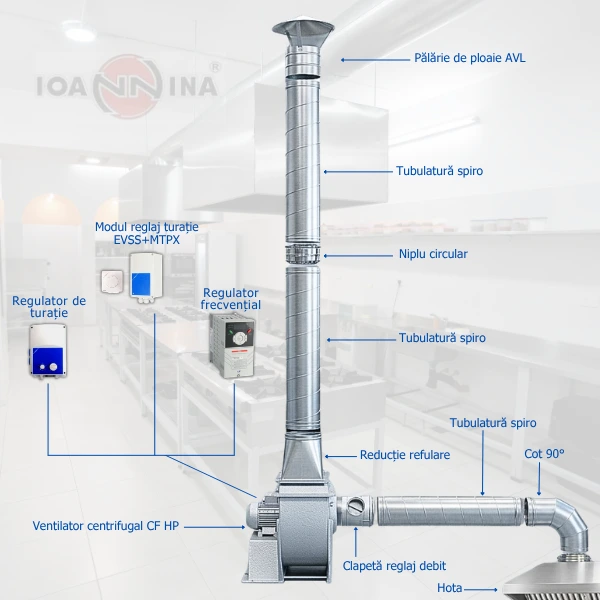
- The hood. Its lower edge sits about 2.1 m above the floor, and no lower than 2.0 m. The hood overhangs the appliances by at least 30 cm at the sides and front. Above combi steamers, on the door side, the overhang is at least 60 cm.
- The grease filters. Above fryers, griddles and grills, use only flame-resistant grease separators, class F-1, according to EN 16282-6. Wire mesh filters on their own are not enough.
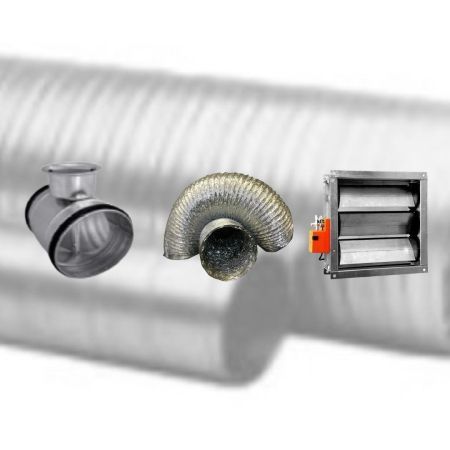
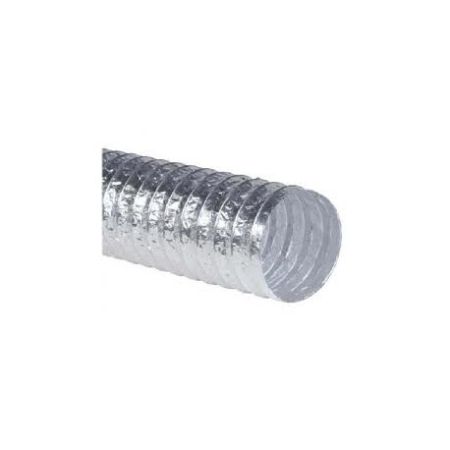
- The ductwork. The same diameter along the whole route, as few elbows as possible, with a damper for balancing.
- The fan. Centrifugal, as close to the end of the route as possible. The ductwork after the fan is under positive pressure, so its joints are sealed well with aluminium tape to stop smells escaping. If it sits indoors, it goes in a sound-insulated box.
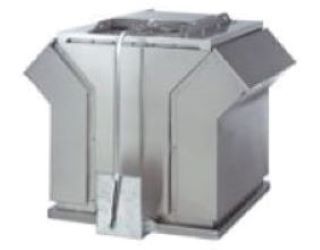
- The discharge. Above the roof, with a rain cap, away from the neighbours' windows and air intakes.
- The make-up air. Fresh air enters the kitchen away from the cooking appliances, so it doesn't disturb the hood's capture.
The rules on hood height, overhang and filters come from the accident prevention guide for commercial kitchens of the German BGN association, which is based on VDI 2052 and EN 16282.
Step 1: calculate the airflow your hood needs
Airflow depends on two things: the length of the hood and how “heavy” the cooking under it is. A gas char-grill produces far more heat and smoke than an electric oven, so it needs more air per metre of hood.
Q [m³/h] = L [m] × q [m³/h per metre] × 1.3
- L = hood length; if several hoods share one fan, add up their lengths;
- q = airflow per metre of hood, from the table below, based on the heaviest-duty appliance under the hood;
- 1.3 = a 30% margin for filters, ductwork and a standard hood that hasn't been lab-tested.
| Cooking duty | Typical appliances | q, wall canopy | q, island canopy |
|---|---|---|---|
| Light | electric ovens, boiling, bain-marie | 780 m³/h per metre | 1,560 m³/h per metre |
| Medium | fryers, griddles, gas ranges | 1,170 m³/h per metre | 1,950 m³/h per metre |
| Heavy | gas char-grills, wok ranges | 1,560 m³/h per metre | 2,340 m³/h per metre |
| Extra heavy | charcoal or wood-fired grills | 2,150 m³/h per metre | 2,730 m³/h per metre |
The q values are the maximum exhaust rates allowed for efficient hoods (based on ASHRAE Standard 154), converted from cfm per foot to m³/h per metre.
Example. A restaurant with fryers and gas ranges has a 3 m wall canopy. Q = 3 × 1,170 × 1.3 = 4,563 m³/h, so the 5,000 m³/h kit.
| Example kitchen | Hood | Duty | Recommended airflow | Matching kit |
|---|---|---|---|---|
| Bistro with fryer and range | wall, 1.5 m | medium | ~2,300 m³/h | 2,700 m³/h kit |
| Pizzeria with electric oven | wall, 2.0 m | light | ~2,000 m³/h | 2,700 m³/h kit |
| Restaurant with fryers and ranges | wall, 3.0 m | medium | ~4,600 m³/h | 5,000 m³/h kit |
| Canteen | wall, 3.5 m | medium | ~5,300 m³/h | 6,000 m³/h kit |
| Steakhouse with gas char-grill | wall, 3.0 m | heavy | ~6,100 m³/h | 8,000 m³/h kit |
| Hotel with two hoods | wall, 2 × 2.5 m | medium | ~7,600 m³/h | 8,000 m³/h kit |
The calculator below does the maths for you. Choose the hood type, length and appliances, and it shows the airflow, the matching kit and the fan price. One click sends us the result on WhatsApp, and you get a complete quote.
What the standards say. In Europe, requirements for commercial kitchen ventilation are set by EN 16282-1, which includes a method for calculating airflow rates. The new edition, EN 16282-1:2026, was published in July 2026 and replaces the 2017 edition. The standard's method starts from the heat released by each appliance and is complex, so it is usually applied by the system designer. The calculation above is a good estimate for choosing equipment; for permits, airflow is set in the building services design, according to the Romanian regulation I5-2022.
On a long route or one with many elbows, also check the pressure loss with our duct pressure loss calculator.
Step 2: choose the right hood fan
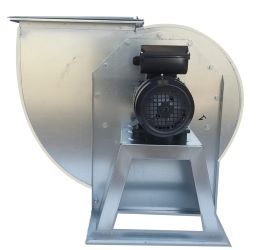
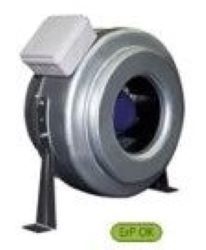
For a commercial kitchen hood, the safe choice is a medium-pressure centrifugal fan with a grease-resistant impeller.
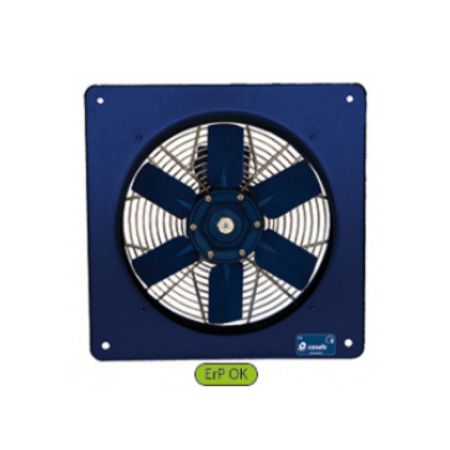
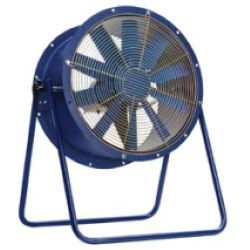
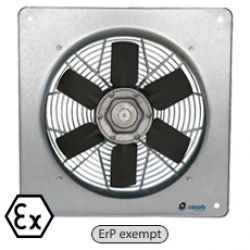
Why centrifugal, not axial. The air passes through grease filters, the hood, elbows and metres of ductwork. All of these add resistance. A wall-mounted axial fan loses much of its airflow in these conditions. A centrifugal fan keeps its airflow even on long duct runs.
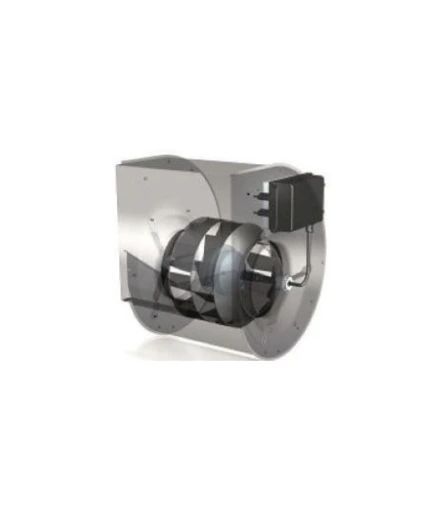
The impeller matters. Impellers with few, spoon-shaped blades don't clog easily with grease and are simple to clean. An impeller with many closely spaced blades can clog within a few months in a kitchen that does a lot of frying.
Stainless steel or galvanised.
- Stainless steel: recommended when the air carries grease and steam, which means most commercial kitchens. It resists corrosion and is easy to clean.
- Galvanised: a cheaper option for hot air extraction, kitchens with light cooking, or plant rooms.
Single-phase or three-phase. If you only have a 230 V supply, choose the single-phase motor with a speed controller. If you have a three-phase supply, a three-phase motor with a variable frequency drive gives the finest control and the lowest energy use.
Speed control isn't a luxury. A kitchen doesn't cook at full capacity all day. With a speed controller, the fan runs hard only at peak times. Fan power falls roughly with the cube of speed, so at 80% speed it uses about half the energy. You also lose less heated or cooled air from the dining room.
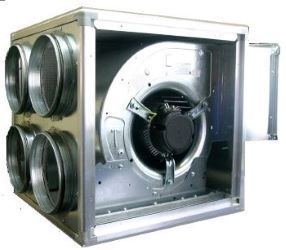
A sound-insulated box keeps the neighbours happy. When the fan is installed inside the building or near other people's windows, a sound-insulated plenum box greatly reduces the noise transmitted.
Don't forget make-up air. All the air extracted through the hood has to come back into the kitchen. Without a fresh air supply, the kitchen goes into negative pressure: the hood pulls weakly, doors are hard to close and smells come in from other rooms.
Step 3: a complete system in a single order
So you don't have to source the fan, ducting, elbows and controller separately, we offer configurable kits for the whole hood fan range, from 2,700 to 14,500 m³/h. Choose the kit by the airflow calculated in step 1, then the fan (galvanised, stainless steel or in a sound-insulated box, single-phase or three-phase) and exactly the parts you need. All parts in a kit share the same diameter and fit together.
| Kit | Motor | Ducting | Supply | Wall canopy, max. length (medium / heavy duty) | Fan from (incl. VAT) |
|---|---|---|---|---|---|
| 2,700 m³/h kit | 0.37 kW (0.5 HP) | Ø200 mm | single- or three-phase | 1.7 m / 1.3 m | 1,760 lei |
| 5,000 m³/h kit | 0.75 kW (1 HP) | Ø250 mm | single- or three-phase | 3.2 m / 2.4 m | 2,230 lei |
| 6,000 m³/h kit | 1.1 kW (1.5 HP) | Ø250 mm | single- or three-phase | 3.9 m / 2.9 m | 2,758 lei |
| 8,000 m³/h kit | 1.5 kW (2 HP) | Ø300 mm | single- or three-phase | 5.2 m / 3.9 m | 3,455 lei |
| 9,000 m³/h kit | 2.2 kW (3 HP) | Ø350 mm | single- or three-phase | 5.9 m / 4.4 m | 4,724 lei |
| 11,000 m³/h kit | 3 kW (4 HP) | Ø350 mm | three-phase | 7.2 m / 5.4 m | 5,006 lei |
| 13,000 m³/h kit | 4 kW (5.5 HP) | Ø350 mm | three-phase | 8.5 m / 6.4 m | 6,159 lei |
| 14,500 m³/h kit | 5.5 kW (7.5 HP) | Ø450 mm | three-phase | 9.5 m / 7.1 m | 10,378 lei |
The “from” price is for the galvanised three-phase fan, without accessories. Stainless steel and sound-insulated box versions cost more. The maximum hood lengths are calculated with the method in step 1. For kitchens with several hoods, the kit airflow must cover the sum of the airflow of all hoods connected to it.
Example 1: bistro with a 1.5 m hood, budget under 5,000 lei
About 6 m of duct to the outside, two elbows, 230 V supply.
| Component | Qty |
|---|---|
| Centrifugal fan CF 0.5 HP 200 M4, galvanised, single-phase | 1 |
| Circular duct Ø200, 3 m | 2 |
| Galvanised 90° elbow, Ø200 | 2 |
| Circular nipple Ø200 | 3 |
| Discharge reducer | 1 |
| Circular damper Ø200 | 1 |
| Rain cap Ø200 | 1 |
| 75 mm aluminium tape and perforated mounting strap | 1 + 1 |
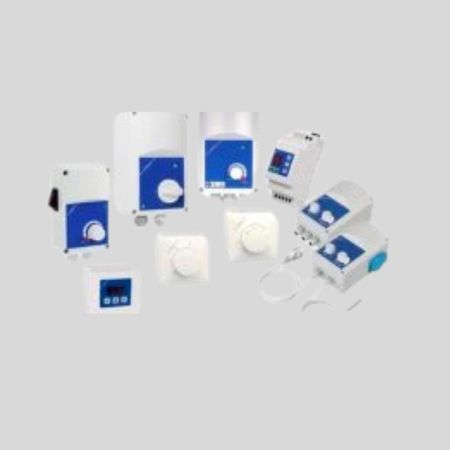
| Analogue speed controller EVSS-1-30-DM | 1 |
| TOTAL: ~3,800 lei + VAT |
Example 2: restaurant with fryers and ranges, 3 m hood, under 9,500 lei
About 9 m of duct with three elbows, three-phase supply, fan installed indoors.
| Component | Qty |
|---|---|
| Centrifugal fan CF INOX 1 HP 250 T4, stainless steel, three-phase | 1 |
| Circular duct Ø250, 3 m | 3 |
| 90° elbow, Ø250 | 3 |
| Circular nipple Ø250 | 4 |
| Discharge reducer | 1 |
| Circular damper Ø250 | 1 |
| Rain cap Ø250 | 1 |
| 75 mm aluminium tape and perforated mounting strap | 1 + 1 |
| Variable frequency drive, 0.75 kW | 1 |
| Sound-insulated plenum box BOX HP 1 | 1 |
| TOTAL: ~7,500 lei + VAT |
Prices are indicative, excluding delivery and installation. The hood and grease filters are not included. Your configuration may differ: on each kit page you choose exactly how many parts you need.
7 mistakes that ruin kitchen ventilation
- Choosing the fan by catalogue airflow alone. Catalogue airflow is measured with no resistance. After the hood, filters and ductwork, real airflow can be much lower.
- An axial fan on a long duct run. On routes with elbows and long ducting, a wall-mounted axial fan extracts almost nothing. Choose a centrifugal fan.
- Ducting that is too narrow. A diameter that is too small raises air velocity, noise and pressure loss. Keep the fan's diameter along the whole route.
- A hood that is too small or mounted too high. A hood that doesn't overhang the appliances by at least 30 cm lets steam escape around it, however powerful the fan.
- The wrong filters above fryers and grills. These need flame-resistant class F-1 grease separators. Wire mesh filters on their own are not safe.
- No speed control and no make-up air. The fan runs at full speed all day, and the kitchen goes into negative pressure, so the hood pulls more weakly.
- Discharging next to the neighbours' windows. Exhaust air must be led away from windows and air intakes, ideally above the roof. On smells, see also why neighbours' smells come in through ventilation.
Frequently asked questions
How much does restaurant kitchen ventilation cost? For a small kitchen, the ventilation equipment (fan, ducting, accessories and controller) starts at around 5,000 lei including VAT. For a larger kitchen, with a stainless steel fan, a variable frequency drive and a sound-insulated box, the budget is around 9,500 lei. The hood, filters and installation are extra.
Can I install the kit myself? The parts join simply, with nipples and aluminium tape. The electrical connection of the fan and the controller must be done by a licensed electrician.
Which standards apply? At European level, commercial kitchen ventilation is covered by the EN 16282 series of standards, including grease filters (part 6). In Romania, the system is designed according to regulation I5-2022. For permits you need a building services design; we provide the datasheets and certificates for the equipment.
What if I have several hoods or a very large kitchen? The kit range goes up to 14,500 m³/h, so it also covers hotel kitchens and large canteens. Add up the airflow of all hoods connected to the same fan and choose the next kit above the total. For systems with long branches or even higher airflow, we'll make a dedicated selection for you, free of charge.
Is the fan noisy? Every fan makes some noise, but you can reduce it a lot: with speed control, with correctly sized ducting and, when the fan is indoors, with a sound-insulated plenum box.
Why choose stainless steel if galvanised is cheaper? Air in a commercial kitchen carries grease and moisture. Stainless steel lasts longer and is easier to clean, so in kitchens with frying and grilling the price difference pays for itself over time.
Not sure what you need? We'll help, free of charge
Send us the hood dimensions, a list of the cooking equipment and the approximate length of the route to the outside. We'll recommend the right kit and the exact parts list, with prices, usually the same day.
- Phone: +40 722 667 238
- WhatsApp: +40 790 721 172 (you can also send a photo of the hood)
- Kits: 2,700 m³/h ventilation kit · 5,000 m³/h ventilation kit


Post comment