












 Solutions KIT
 Sales
Sales















 My account
 View cart
Your Neighbour's Cooking Smell Is Coming Through Your Ventilation. Here's Why — and How to Stop It for Good
You're cooking something. But it smells like your neighbour's fried fish from three floors up.
Or you're in the bathroom and you can clearly smell someone else's dinner — without any idea where it's coming from.
If this has happened to you, you've probably already spoken to the building manager. Asked them to check the ventilation shaft. Filed a complaint with the residents' association. And the problem stayed — because everyone gave you the same answer: "the shaft is fine."
They're right. And it still doesn't solve anything. Here's why.
Why your neighbour's smell comes to you — and not the other way around
The ventilation shaft in an apartment block is a shared vertical channel. Every apartment on the same stack is connected to it — bathroom, kitchen, sometimes the hallway. Stale air from each flat should rise up the shaft and exit through the roof.
Should. The problem starts when the airflow reverses.
Instead of rising toward the roof, air from the shaft flows downward and enters through any unprotected grille or connection — including yours. This happens for a few specific reasons:
The upstairs neighbour has installed an oversized fan. It actively pulls air from the shared shaft, creating a pressure drop that draws air from lower floors rather than from the roof. Whatever they evacuate ends up travelling toward you.
The shaft is partially blocked above your floor. Accumulated deposits, a stuck damper in a neighbouring flat, an unauthorised modification — any of these can block upward airflow and reverse the pressure at lower floors.
Your non-return damper is broken or missing. This is the most common cause. Every connection from your flat to the shared shaft should have a damper that opens when you evacuate air and closes shut when you don't. If it's missing, worn out or stuck open, your flat and the shaft communicate freely — in both directions, at all times.
The 30-second test that tells you exactly what's wrong
Light a lighter and hold it a few centimetres from the ventilation grille in your bathroom. Bathroom door — closed. No other fans running.
- Flame leans toward the grille — normal airflow, your air is leaving correctly
- Flame stands straight — zero draught, the shaft isn't working
- Flame leans away from the grille — reversed airflow, your neighbours' air is coming in
If the flame leans away from the grille — confirmed. You don't need the building manager anymore. You need a technical fix.
Why a standard damper isn't always enough
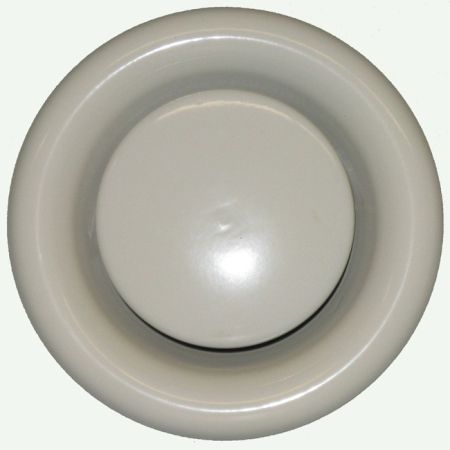
The first instinct is to fit a non-return damper on the grille. That's correct — and it's the first thing to do. A flap or disc that opens when you push air out and closes under gravity when you stop.
The problem: cheap gravity dampers don't seal perfectly. They leave a small gap through which smells migrate even when "closed". And if the upstairs neighbour's fan is powerful enough, it can force the damper to stay open against its own weight.
The complete solution isn't just a damper — it's a fan that creates positive pressure on your duct run, combined with a back-draught damper on the discharge.
When the fan is running, your air leaves under positive pressure — your neighbour's smell cannot enter against that flow. When the fan stops, the damper closes under gravity and seals the shaft.
Neighbour's smell stays with the neighbour.
The Casals BT3 range — the right solution for every configuration
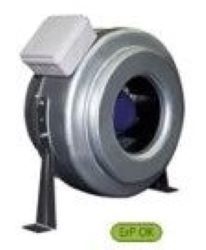
Casals BT3 centrifugal inline fans are designed specifically for duct installation in false ceilings and service ducts — exactly the configuration found in Romanian apartment blocks. External rotor motor, galvanised steel housing, permanently lubricated bearings rated 40,000 hours (~14 years at 8h/day), automatic thermal protection with self-reset.
Two variants — each for a different type of use:
BT3 standard — for residential use
Single-phase asynchronous motor 230V · IP44 · Maximum air temperature 50°C
Suitable for bathrooms and residential kitchens with intermittent operation — switched manually, on a timer or wired to the bathroom light. When you start the shower or begin cooking, the fan starts.
Available in 7 diameters: Ø100 / Ø125 / Ø150 / Ø160 / Ø200 / Ø250 / Ø315mm
Choose the diameter that matches your existing ductwork:
| Diameter | Typical application | Link |
|---|---|---|
| Ø100mm | Small bathroom, WC, short duct run | BT3 100 |
| Ø125mm | Standard apartment bathroom | BT3 125 |
| Ø150mm | Large bathroom, kitchen, medium duct run | BT3 150 / Complete kit |
| Ø200mm | Office, hotel room, small commercial space | BT3 200 |
| Ø250mm | Restaurant, clinic, medium commercial space | BT3 250 |
| Ø315mm | Professional kitchen, large commercial space | BT3 315 |
BT3 EEC — for continuous operation and commercial spaces
EC motor (electronically commutated) · Fully sealed housing · Indoor OR outdoor installation
The BT3 EEC uses a direct current electronically commutated motor — a different technology from the asynchronous motor of the standard BT3. Energy consumption is 35% lower at the same airflow. The EC motor maintains high efficiency at any speed, not only at rated speed — relevant if you use a speed controller or if the fan runs at partial speeds for extended periods.
The key constructive difference from the standard BT3: the BT3 EEC housing is made of polymer-coated steel, fully sealed — allowing installation both indoors and outdoors. If your duct run requires the fan to be exposed to the elements (balcony, building exterior), the BT3 EEC handles it. The standard BT3 does not.
Centralised control — EC motors can be integrated into unified fan networks with centralised control. If you manage multiple spaces (hotel, office building, apartment block), all BT3 EEC units can be controlled from a single point.
Designed specifically for: banks, supermarkets, restaurants, hotels, private swimming pools.
Available in the same 7 diameters: Ø100 / Ø125 / Ø150 / Ø160 / Ø200 / Ø250 / Ø315mm
| Diameter | Link |
|---|---|
| Ø100mm EEC | BT3 100 EEC |
| Ø125–315mm EEC | Contact us for availability |
BT3 standard or BT3 EEC — the decision in 3 questions
1. Will the fan run for more than 4–6 hours a day? Yes → BT3 EEC. The 35% lower consumption pays back the price difference in 2–3 years. No → BT3 standard is sufficient.
2. Will the installation be partly or fully outdoors? Yes → BT3 EEC required (fully sealed housing for outdoor use). No → either variant works.
3. Do you need to control multiple ventilation points centrally? Yes → BT3 EEC (EC motors networkable for centralised control). No → BT3 standard does the job.
What doesn't solve the problem — so you don't waste money
Complaining to the building manager — the manager can confirm that the shaft is structurally clear. But reversed airflow caused by a neighbour's fan or by pressure differences has no administrative solution. Each owner is responsible for their own connection point.
Sealing the grille — blocks smells coming in but also blocks your bathroom ventilation. Mould appears within weeks.
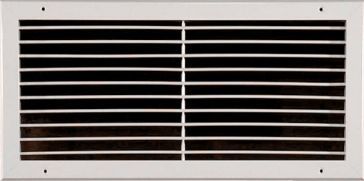
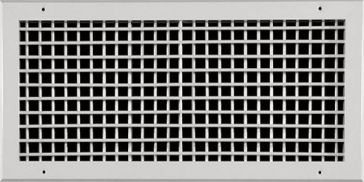
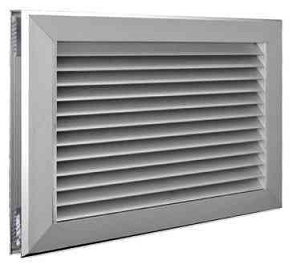
A new decorative grille — if there's no functional non-return damper and no fan behind it, any new grille has exactly the same effect: zero.
Nuisance smell legislation — in Romania, odour laws apply exclusively to commercial operators, not to individuals cooking in their flat. You cannot fine a neighbour for cooking smells. The solution is technical, not legal.
In short — what to do, in order
- The lighter test at every ventilation grille — 30 seconds, right now
- Flame leans away from grille → check the non-return damper — is it there? does it close fully?
- Damper missing or defective → replace it (a few euros, 15 minutes)
- Damper is fine but problem persists → add a BT3 inline fan with a back-draught damper on discharge
- Continuous operation or outdoor installation → BT3 EEC
If you don't know your duct diameter or the length of the run, call us — we'll tell you exactly which model fits in the same conversation.
📞 +40 722 667 238 — Monday to Friday, 9:00–18:00 ✉ ioannina.ventilatie@gmail.com 🌐 Full BT3 and BT3 EEC range at ventilation.ro
Further reading:
- Mould in the bathroom and flat — the real cause and the definitive solution
- Ventilation systems for commercial spaces — complete guide
ventilation.ro — Ioannina Impex SRL | Authorised Casals importer in Romania


Post comment