









 Solutions KIT
 Sales
Sales







 My account
 View cart
Indoor Pool Ventilation: How to Combat Humidity and Corrosion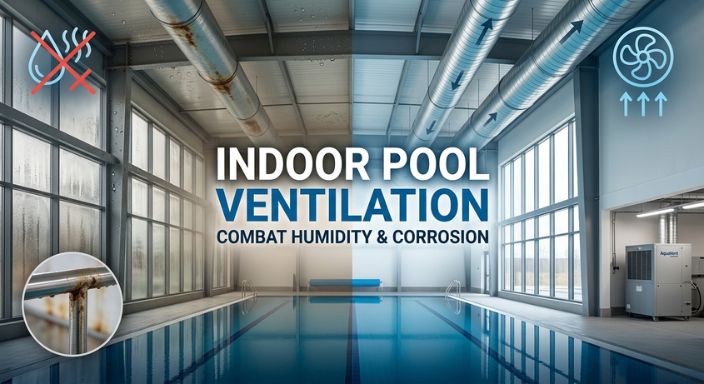
An indoor pool without proper ventilation will destroy the building structure within a few years. Find out what specific equipment to use, how to calculate airflow and why corrosion is the greatest threat.
An indoor swimming pool is one of the most demanding applications for a ventilation system. The level of humidity, elevated water temperature, chlorine and ammonia vapour — all combined in an enclosed space — create an environment that rapidly degrades any unprotected material and makes the air heavy, humid and irritating to skin and eyes.
Without a ventilation system designed specifically for pools, the consequences appear quickly and are costly: condensation on walls, ceilings and windows, structural damage through corrosion of reinforcement bars, persistent mould, deterioration of electrical and mechanical equipment, and a swimming environment that is uncomfortable or even unhealthy.
This article explains why indoor pools require special treatment, which parameters must be controlled and what ventilation equipment is suitable for this application — including concrete recommendations from the range available at ventilation.ro.
Why Indoor Pools Are a Category Apart
Evaporation — the primary source of moisture
An indoor pool constantly evaporates water into the surrounding air. The evaporation rate depends on water temperature, air temperature, relative humidity of the air and the surface area of the water. A pool measuring 10 × 5 m (50 m²) with water at 28°C can evaporate 3–6 kg of water per hour under normal use — and significantly more when swimmers are actively swimming, agitating the water surface.
All of this water ends up in the air of the pool hall. Without extraction and active control, relative humidity rapidly rises above 80–90%, at which point condensation appears on any cooler surface — windows, exterior walls, metal structures, ceilings.
Chlorine — aggressive to any unprotected metal
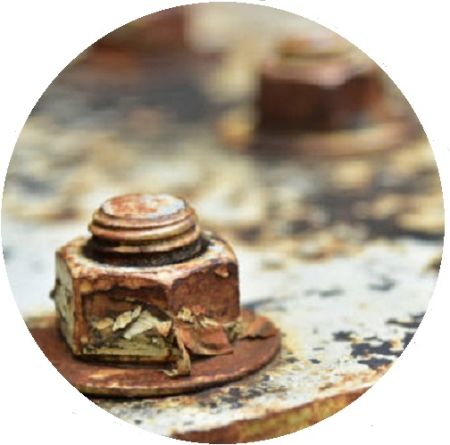
Pool water is treated with chlorine or chlorine-based compounds for disinfection. Chlorine partially evaporates into the air as gas and chloramine compounds — the substances responsible for the characteristic pool smell and for irritating the eyes and respiratory tract. These compounds are extremely corrosive to common metals: galvanised steel, unprotected aluminium, copper, iron.
A standard fan, designed for ordinary industrial or commercial applications, will show visible deterioration within 12–24 months in a pool hall. Corrosion starts at screws and joints, progresses to the rotor and casing, and ultimately leads to premature motor failure.
Condensation — the enemy of the building structure
Condensation on cold surfaces is perhaps the most costly effect of insufficient pool ventilation. Water condensed on concrete reinforcement bars, metal structural profiles and roof elements triggers a slow but irreversible degradation process: corroding reinforcement causes concrete to crack, mould attacks thermal insulation, timber swells and deforms.
Repairing structural damage caused by condensation in a pool hall is far more expensive than designing and installing a correct ventilation system from the outset.
The Parameters That Must Be Controlled
A ventilation system for an indoor pool must simultaneously maintain several parameters within optimal ranges:
Relative humidity of the air: 50–65% is the recommended range. Below 50% the air becomes dry and irritating; above 65% condensation appears on cold surfaces and corrosion accelerates.
Air temperature: 1–2°C above the water temperature, to limit evaporation and ensure thermal comfort. For example, water at 28°C → air at 29–30°C.
Surface temperatures: walls and windows must be kept above the dew point of the air in the hall — otherwise condensation is inevitable. This places specific requirements on the building's thermal insulation and warm air distribution.
Air quality: the concentration of chloramines in the air must be kept below comfort limits (below 0.5 mg/m³ of trichloramine). Fresh air ventilation dilutes these compounds and removes them to the outside.
Relative pressure in the hall: a slight positive pressure relative to adjacent spaces, to prevent moist, chlorine-laden air from migrating into corridors, changing rooms or other areas of the building.
Ventilation Solutions for Indoor Pools
1. Dehumidification — the number one priority
Before anything else, an indoor pool hall needs active dehumidification. Ventilation with outdoor air alone is insufficient in cold weather — outdoor air, although drier in absolute terms, is cold and must be heated, which is energetically costly. Dedicated pool dehumidifiers condense moisture from the air and drain it away, independently of outdoor conditions.
Mechanical ventilation with fresh air complements dehumidification, ensuring air quality — diluting chloramines and providing oxygen — rather than controlling humidity.
2. Corrosion-resistant fans — the only correct choice
This is the critical point of any pool ventilation project: equipment must be corrosion-resistant. Not merely moisture-resistant, not coated with paint — but built from materials that specifically resist chlorinated, high-humidity atmospheres.
Corrosion-resistant fans for pool applications have:
- Rotors made from technical plastics or fibreglass — immune to chlorine-induced corrosion
- Casings made from polypropylene, PVC or fibreglass — chemically stable in chlorine environments
- Motor protected to IP55 or IP65 — sealed against vapour and water droplets
- Stainless steel screws and fixings — the only fasteners that last long-term
Using a standard fan, or even a galvanised one, in a pool hall is a false economy — its lifespan will be 1–3 years, compared to 10–15 years for a corrosion-resistant unit.
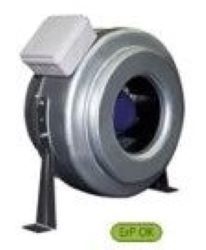
👉 At ventilation.ro you'll find a dedicated range of corrosion-resistant fans — designed for high-humidity environments with aggressive chemicals, suitable for pool halls, water treatment installations and chemical industry.
3. Centrifugal fans — for ducted systems
Indoor pool ventilation systems are almost always ducted systems: warm air is distributed through nozzles or grilles at floor or wall level (to heat surfaces and prevent condensation) and is extracted through grilles mounted high up, near the roof, where warm moist air accumulates.
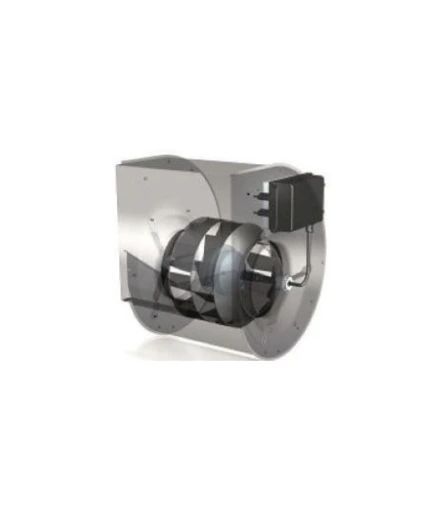
This configuration requires fans capable of generating the pressure needed to push air through the entire installation — the role of centrifugal fans. Here too, equipment must be corrosion-resistant or at least treated for resistance to humid, chlorinated environments.
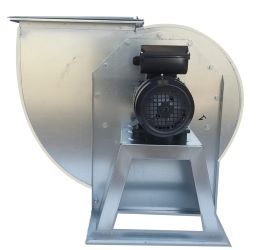
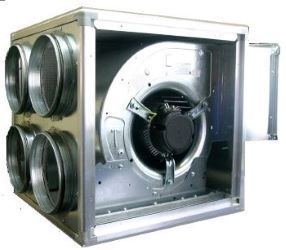
👉 Explore the range of centrifugal fans — available in standard and corrosion-resistant variants, for ducted ventilation systems.
4. Heat recovery units — energy efficiency in heavily ventilated halls
Indoor pools require high fresh air flow rates for chloramine dilution — which means a significant amount of heat is exhausted along with the stale air. Heat recovery ventilators (HRV units) transfer up to 75–85% of the heat from the outgoing air to the incoming fresh air, substantially reducing heating costs.
In a pool hall operating 12–16 hours per day, heat recovery can represent significant savings on thermal energy bills, quickly justifying the additional investment over simple ventilation.
Important note: heat recovery units for pools must also be corrosion-resistant — standard aluminium heat exchangers deteriorate rapidly when exposed to chlorine vapour. Select models with heat exchangers made from technical plastics or stainless steel.
👉 See the range of commercial heat recovery units available at ventilation.ro.
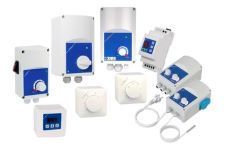
5. Controls and automation — sensors and speed controllers
A pool ventilation system running at fixed speed — simply on or off — is energy-inefficient and unable to respond to occupancy variations. A pool with 20 swimmers produces 5–6 times more evaporation than an empty pool.
Modern systems include:
Humidity and temperature sensors that monitor hall parameters in real time and transmit signals to speed controllers. When humidity rises, airflow automatically increases; when the hall is empty, the system operates at minimum.
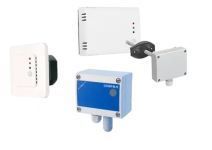
Multifunctional HVAC sensors that can simultaneously measure temperature, relative humidity and, in advanced variants, CO₂ concentration and volatile chemical compounds. They are the brain of a fully automated system.
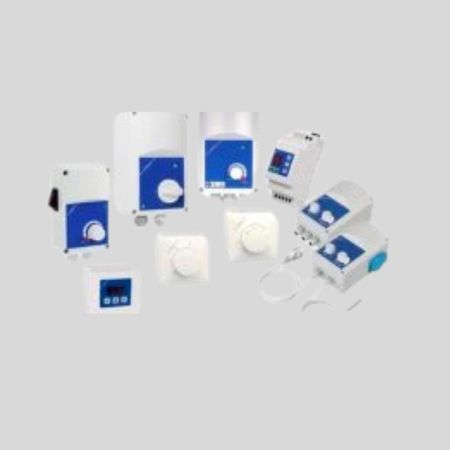
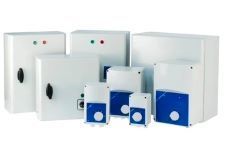
Speed controllers — linear or variable frequency — that continuously adjust fan speed based on sensor signals. Reducing speed by 20% reduces energy consumption by almost 50% (due to the cubic relationship between speed and consumption).
👉 At ventilation.ro you'll find multifunctional HVAC sensors, linear speed controllers and variable frequency drives — essential components for complete ventilation automation.
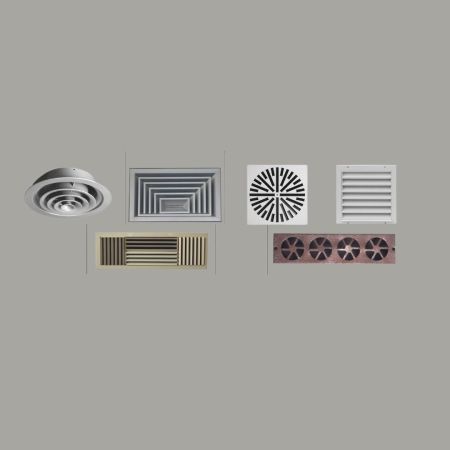
6. Corrosion-resistant grilles and diffusers
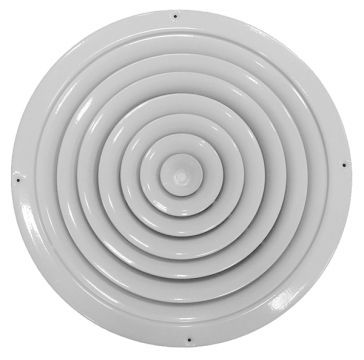
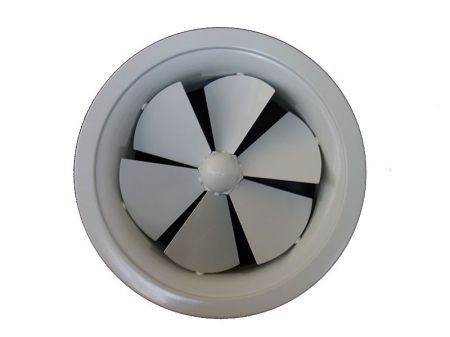
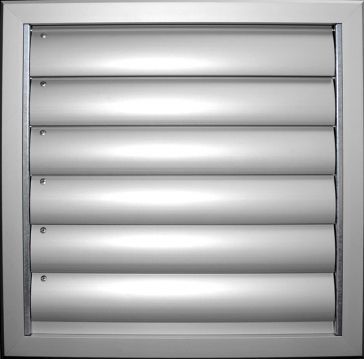
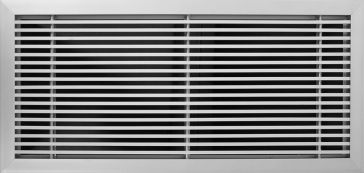
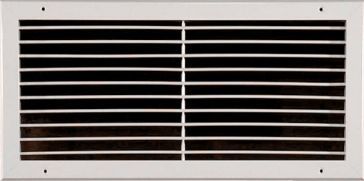
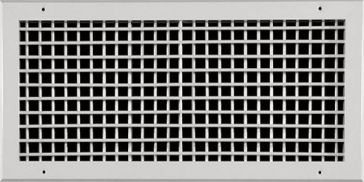
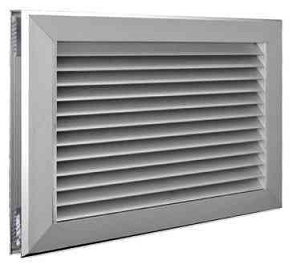
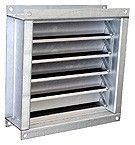
Ventilation grilles — both warm air distribution and extraction grilles — are permanently exposed to chlorinated, humid atmospheres. Standard anodised aluminium grilles resist better than galvanised steel, but in environments with high chlorine concentrations, grilles made from technical plastics or specially treated aluminium are more durable.
👉 Explore the range of anodised aluminium grilles available, including models for external and demanding applications.
How to Calculate the Required Airflow for a Pool Hall
Airflow calculation for pool ventilation is more complex than for standard commercial spaces, because it must account for the evaporation rate and chloramine dilution requirements, not just occupant numbers or room volume.
Simplified method:
The minimum fresh air flow rate recommended for a public indoor pool hall is 4–6 air changes per hour of the total hall volume, with a minimum of 2.5 l/s per m² of water surface area.
Practical example:
Pool measuring 25 × 10 m (250 m² water surface), in a hall approximately 5 m high:
- Hall volume ≈ 25 × 10 × 5 (hall width) × 5 m height = ~3,000 m³ (estimated)
- Minimum airflow = 3,000 × 5 = 15,000 m³/h for 5 air changes per hour
- Cross-check per water surface area = 250 m² × 2.5 l/s × 3,600 = 2,250 m³/h minimum fresh air
Total system airflow (recirculation + fresh air) will be significantly higher — up to 8–10 air changes per hour at maximum occupancy.
Recommendation: for any pool with a water surface area exceeding 50 m², ventilation system design should be carried out by an HVAC engineer with experience in pool applications. Calculations also involve the hall's thermal balance, dew point calculation on surfaces, and dehumidifier sizing.
Common Mistakes in Indoor Pool Ventilation
Using standard equipment instead of corrosion-resistant. The most costly long-term mistake. Ordinary fans — even industrial ones — deteriorate rapidly in a chlorine atmosphere.
Sizing for average rather than peak conditions. A pool with 30 active swimmers produces several times more evaporation than an empty pool. The system must be sized for maximum occupancy.
Incorrect warm air distribution. Warm air blown directly from above onto the pool surface accelerates evaporation. Correct distribution is at floor or wall level, with the jet directed towards cold surfaces — windows, exterior walls — to keep them above the dew point.
No positive pressure relative to adjacent spaces. Moist air and chloramines migrate into changing rooms, corridors and utility spaces if the hall pressure is equal to or lower than adjacent areas. A slight positive pressure (5–10 Pa) prevents this migration.
Ignoring the building's thermal insulation. Ventilation cannot compensate for a poorly insulated building. Cold surfaces will generate condensation regardless of how powerful the ventilation system is. Hall and window thermal insulation is a prerequisite for an effective ventilation system.
Conclusion
Ventilating an indoor pool is not a standard application — it is one of the most technically demanding, both in terms of engineering and material durability. High humidity, chlorine vapour and constant temperatures create an environment that rapidly destroys unsuitable equipment and degrades the building structure if parameters are not correctly controlled.
The right solution combines active dehumidification, corrosion-resistant fans, heat recovery for energy efficiency, and automation through sensors and speed controllers. The higher initial investment compared to standard ventilation pays back quickly through equipment durability, energy savings and avoidance of structural repair costs.
Equipment for Indoor Pool Ventilation — at ventilation.ro
At ventilation.ro you'll find the right ventilation equipment for indoor pools: corrosion-resistant fans, centrifugal fans, heat recovery units, HVAC sensors and speed controllers — all available in stock, with technical consultancy included.
📞 Contact us for system sizing: +40 722 667 238
Recommended categories for pool ventilation:
- Corrosion-resistant fans — essential for chlorine and high-humidity environments
- Centrifugal fans — for ducted systems with controlled distribution
- Commercial heat recovery units — energy efficiency in intensive ventilation
- Multifunctional HVAC sensors — humidity, temperature, CO₂ monitoring
- Linear speed controllers — continuous airflow adjustment
- Variable frequency drives — precise control and energy saving
- Anodised aluminium grilles — air distribution and extraction in humid halls
Article created by the ventilation.ro team — IOANNINA IMPEX SRL


Post comment