








 Solutions KIT
 Sales
Sales









 My account
 View cart
Air Curtain — Complete Guide: When Mandatory, How to Choose and What It Costs
Do you have a shop, restaurant, warehouse or office entrance and struggle in summer with insects, dust, hot air or draughts? Or have you received a notice from the health inspection that you are required to install an air curtain? This guide explains everything you need to know: how they work, when they are legally required, which type suits your situation, how to calculate dimensions correctly and what it truly costs — without paying extra for features you don't need.
What is an air curtain and how does it work
An air curtain is a unit mounted above or to the side of a door or opening that blows a high-velocity air stream along the full width of the entrance. This "invisible wall of air" separates two different environments — interior and exterior — without physically blocking the passage of people, goods or vehicles.
The 3 main effects:
Hygiene barrier — insects cannot penetrate against an air stream of 6–12 m/s. Fundamental for food businesses, pharmacies, hospitals, anywhere biological contamination must be prevented.
Thermal insulation — reduces air exchange between interior and exterior by 60–80% compared to an open door without a curtain. In summer it keeps cool air inside and heat outside; in winter the reverse. Quantifiable energy bill savings.
Dust and insect barrier for industrial buildings — in warehouses and industrial buildings with large doors permanently open for forklift traffic, the air curtain keeps out dust, insects and temperature differences without disrupting operational flow.
When is an air curtain legally required
EU and Romanian sanitary regulations require protection against insects at all entrances of units that process, store or sell food. An air curtain satisfies this requirement without obstructing passage.
Units explicitly covered:
- Restaurants, cafés, fast food, covered terraces
- Bakeries, pastry shops, confectioneries
- Butchers, fishmongers
- Supermarkets and food retail
- Food storage and catering facilities
- Pharmacies and medical units
Practical consequence: at any sanitary inspection, absence of insect protection at the entrance is grounds for a fine and — in persistent cases — suspension of activity. An air curtain at the entrance eliminates this vulnerability.
Types of air curtains — which for which situation
Type 1 — Electric air curtain (electric resistance heating)
Air drawn in by the fan passes through an electric resistance element that heats it, then blown across the entrance.
Best for: shops, restaurants, offices, commercial buildings where no hot water circuit is available nearby.
Note on operating cost: electric resistance consumes significant power at intensive use. Suitable for moderate-traffic entrances or seasonal use.
Type 2 — Hot water air curtain (hot water battery)
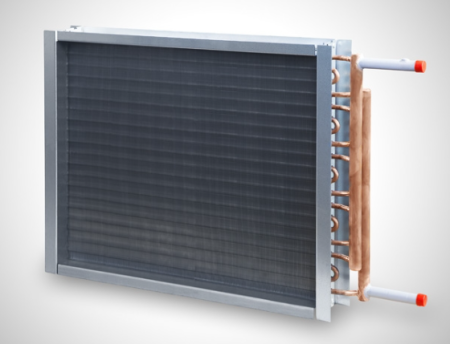
Air passes through a hot water battery connected to the building's heating circuit. Does not consume electric energy for heating — uses thermal energy already present in the installation.
Best for: industrial buildings, warehouses, supermarkets, large commercial surfaces with continuous operation. Most energy-efficient type for continuous winter use.
Type 3 — Industrial air curtain (no heating)
Blows air at high velocity with no heating element. Creates only the mechanical air barrier.
Best for: warehouses and industrial buildings where the temperature difference between inside and outside is small or irrelevant; applications where the primary function is insect/dust barrier, not thermal insulation; summer-only use.
Quick comparison table
| Criterion | Electric | Hot water | Industrial |
|---|---|---|---|
| Equipment cost | Medium | High | Low-Medium |
| Installation cost | Low | Medium-High | Low |
| Operating cost | High | Low | Minimal |
| Thermal insulation | Good | Excellent | Weak |
| Insect barrier | ✅ | ✅ | ✅ |
| Best for | Shops, restaurants | Warehouses, supermarkets | Depots, halls |
How to calculate the required width and air speed
The basic rule — width
The air curtain must be equal to or wider than the door or opening it protects.
A 1,000mm curtain on a 1,200mm door = 200mm uncovered = insects and air pass freely at the edges. The most common and costly mistake — a wider curtain or two adjacent units is required.
Standard widths available: 600mm · 800mm · 1,000mm · 1,200mm · 1,500mm · 2,000mm
For openings wider than 2,000mm — two units mounted side by side.
The basic rule — mounting height and air speed
Air velocity at floor level must be a minimum of 4–6 m/s for an effective insect barrier and at least 6–8 m/s for good thermal insulation.
The higher the curtain is mounted above the floor, the more the jet disperses and slows. Every manufacturer specifies a maximum recommended mounting height — never exceed it.
| Door height | Minimum source velocity |
|---|---|
| Up to 2.2 m | 6–8 m/s |
| 2.2–2.8 m | 8–10 m/s |
| 2.8–3.5 m | 10–14 m/s |
| Over 3.5 m | High-pressure industrial unit or side mounting |
Common mistakes — and how to avoid them
Mistake 1 — Curtain narrower than the door. Any uncovered edge negates the barrier effect. Measure the opening, add 10%, choose the next standard size up.
Mistake 2 — Mounting too high above the specification. Each unit has a maximum mounting height from the manufacturer — never exceed it or velocity at floor level drops below effectiveness.
Mistake 3 — Unheated curtain in continental Romanian climate. An unheated curtain blows cold air in winter — acceptable for industrial buildings but completely inappropriate for a restaurant or shop entrance where customers stand near the door.
Mistake 4 — Single curtain for a double door. A 2,400mm double door covered by a single 2,000mm curtain leaves 400mm open. Either buy a 2,400mm unit or mount two 1,200mm units side by side in continuity.
Mistake 5 — Insufficient space above the door. The curtain itself has height (50–250mm depending on model) and requires space for electrical connections. Measure available clearance above the door before ordering.
What an air curtain costs — real prices 2026
| Type | Width | Indicative cost |
|---|---|---|
| Electric 1kW (no heating) | 1,000mm | 130–200 EUR |
| Electric 2–3kW | 1,000mm | 200–350 EUR |
| Electric 6kW | 1,000–1,500mm | 350–600 EUR |
| Electric high power | 1,500–2,000mm | 600–1,200 EUR |
| Hot water | 1,000–2,000mm | 600–1,500 EUR |
| Industrial no heat | 1,500–2,000mm | 280–850 EUR |
Installation cost: 50–130 EUR for electric (electrician + mechanical mounting). 130–380 EUR for hot water (heating installer + electrician).
Energy saving: an air curtain at a medium-to-high-traffic shop entrance can reduce thermal losses through an open door by 60–80%. At a 20°C temperature difference and 8 hours/day operation, annual energy savings can exceed the curtain cost within 2–3 seasons.
Air curtain range available at ventilation.ro
ventilation.ro — direct importer of Casals (Spain) — offers the complete range of residential, commercial and industrial air curtains, available from local stock with 24–48h delivery.
Casals residential and commercial curtains — for shops, restaurants, offices and residential entrances. Widths 600–2,000mm, electric variants with and without heating, discreet design for any interior.
Casals industrial curtains — for warehouses, industrial buildings and large doors. High airflow, high velocity, robust construction for industrial environments.
👉 Air curtains — complete range
📞 +40 722 667 238 — tell us your door dimensions and space type and we recommend the right model in 2 minutes 💬 WhatsApp — immediate response
Frequently asked questions
Is an air curtain mandatory for a 40-seat restaurant? Yes — any food service establishment with an entrance that cannot be kept permanently closed must have insect protection. An air curtain is the standard solution that satisfies this requirement without obstructing customers. Check with your local food safety authority for jurisdiction-specific requirements.
Can an air curtain replace air conditioning? No — an air curtain reduces the loss of conditioned air through an open door but does not cool the space. It is complementary to air conditioning or ventilation, not a substitute.
What is the power consumption of a commercial air curtain? An unheated curtain consumes 60–200W (motor only) — negligible. A curtain with a 3kW electric resistance element consumes 3kW/h when the heating is active — but the resistance does not operate continuously; it modulates based on air temperature.
At what height is an air curtain mounted? Directly above the door frame, as close as possible to the top of the opening — not 50cm above the door. Any additional distance from the opening reduces barrier effectiveness. Maximum mounting height above floor level is specified by the manufacturer for each model.
How long does an air curtain last? Casals commercial air curtains are designed for continuous operation — estimated service life is 10–15 years under normal conditions, with periodic filter cleaning (every 3–6 months) and annual inspection of the heating element.
Related articles: Professional kitchen ventilation — norms, airflow and equipment · Ventilation for commercial spaces · CF HP professional hood fans — complete guide


Post comment