











 Solutions KIT
 Sales
Sales


















 My account
 View cart
Fan Speed Controllers in 2026 — Complete Guide: Linear, Stepped or Variable Frequency Drive?
You have chosen the right fan for your installation. Now comes the question that almost every installer and designer faces: which type of speed controller do you fit? The difference between a linear controller at €15 and a variable frequency drive at €150 is not just price — they are completely different pieces of equipment for different applications, incompatible with each other in certain situations. The wrong choice means at best wasted money, at worst a burnt motor. This guide explains everything you need to know before ordering.
Why the right controller choice matters
A fan speed controller reduces motor speed below its rated speed. The reasons for doing this are multiple: reduced noise at partial airflow, energy savings when maximum ventilation is not continuously required, adapting airflow to the variable needs of the ventilated space, or protecting the installation from overpressure.
The problem is that there are three fundamentally different technologies to achieve the same apparent result — and each works correctly only with certain motor types. Fitting an incompatible controller with the fan motor produces unstable operation, electromagnetic noise, overheating and ultimately motor burnout or controller failure.
The 3 controller types — essential differences
Type 1 — Linear (analogue electronic) controller
Operating principle: reduces the supply voltage fed to the motor using a triac — a semiconductor element that cuts a portion of the voltage supply waveform. The lower the voltage, the lower the motor speed.
Adjustment: continuous (stepless) — from the minimum speed adjustable via an internal trimmer to maximum speed. The potentiometer or rotary knob allows fine speed adjustment at any point in the available range.
Compatibility: exclusively with single-phase permanent capacitor motors (the most common type in residential and small commercial fans) and ERM (External Rotor Motor) fans. NOT compatible with three-phase motors, EC motors, motors with a separate starting capacitor, or inverter-driven motors.
Advantages: low cost, simple installation (inserted on the phase wire), small dimensions, available across a wide current range (1.5A–10A).
Disadvantages: generates harmonics in the supply network (can interfere with sensitive electronic equipment nearby if not filtered), lower energy efficiency than a VFD (energy cut from the voltage is partly dissipated as heat in the controller), not suitable for three-phase motors.
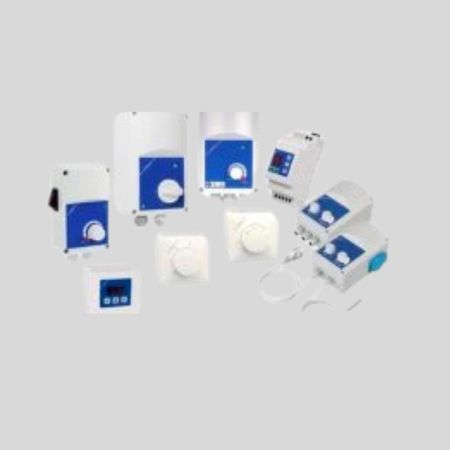
Available on ventilation.ro: 👉 ITR-9-15-DT — 1.5A 👉 ITR-9-30-DT — 3A 👉 ITR-9-50-DT — 5A 👉 ITR-9-60-DT — 6A 👉 ITR-9100-DT — 10A
Typical application: BT-3 inline fans, small single-phase centrifugal fans for offices or shops.
Type 2 — Stepped controller (speed switch)
Operating principle: switches between different motor windings or between tappings of an autotransformer — providing 3, 4 or 5 fixed speed levels rather than continuous adjustment.
Adjustment: discrete — you select speed 1 (minimum), speed 2, speed 3 etc. No intermediate positions are available.
Compatibility: with single-phase motors with speed tappings (motors with multiple windings, manufactured specifically for this type of control) and some three-phase motors with tappings (less common). It must be explicitly verified that the motor supports stepped control — not every single-phase motor has this feature.
Advantages: simpler and more robust than linear controllers (no active semiconductor elements), minimal harmonics in the supply network, suitable for motors that do not tolerate continuously reduced voltage.
Disadvantages: coarse adjustment (3–5 steps), no fine airflow optimisation, motor compatibility must be verified for the specific model.
Typical application: roof fans with multi-speed motors, large axial fans with speed tappings.
Type 3 — Variable Frequency Drive (VFD / inverter)
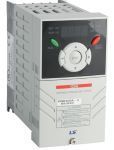
Operating principle: converts the supply voltage to direct current (rectifier), then regenerates an alternating voltage with electronically controlled frequency and amplitude (PWM inverter). Motor speed is proportional to frequency — at 25 Hz the motor runs at half its rated speed compared to 50 Hz.
Adjustment: continuous and precise, from 0 to 100% of rated speed, with full control of acceleration and deceleration ramps (programmable).
Compatibility: with three-phase asynchronous motors — the standard industrial solution. Special versions exist for single-phase motors but are more expensive and less common. NOT suitable for EC motors (which have their own integrated inverter).
Advantages: maximum energy efficiency (cubic power law — at 80% speed, power consumption falls to ~51% of nominal), precise control, comprehensive protections (overcurrent, overvoltage, motor overtemperature), BMS communication via Modbus/BACnet on advanced models, automatic control based on pressure, CO₂ or temperature sensors.
Disadvantages: significantly higher cost (5–15× compared to a linear controller), requires screened cable between VFD and motor (to prevent electromagnetic interference), requires EMC filter when installed in panels with sensitive equipment, initial configuration via parameters.
Typical application: medium and large three-phase centrifugal fans in industrial buildings, VAV (variable air volume) systems in commercial buildings and offices, systems with automatic control based on air quality sensors.
Quick comparison table
| Feature | Linear | Stepped | Variable Frequency Drive |
|---|---|---|---|
| Compatible motor type | Single-phase capacitor / ERM | Single-phase multi-speed | Three-phase asynchronous |
| Adjustment | Continuous | 3–5 fixed steps | Continuous and precise |
| Cost | Low (€15–50) | Low-medium | High (€150–1,500+) |
| Energy efficiency | Medium | Medium | Excellent |
| Supply harmonics | Moderate | Minimal | Requires EMC filter |
| Installation complexity | Minimal | Minimal | Medium-high |
| Motor protections | Limited | Limited | Comprehensive |
| EC motor compatible | ❌ No | ❌ No | ❌ No |
| Automatic BMS control | ❌ No | ❌ No | ✅ Yes (advanced models) |
Special case — EC motors need no external controller
EC (Electronically Commutated) motors — found in fans in the /en/category/364/ec-motor.html category on ventilation.ro — have an integrated electronic inverter inside the motor. Speed is controlled via:
- 0–10V signal (most common) — DC voltage supplied by an external controller, sensor or BMS
- PWM signal — digital signal with variable duty cycle
- External potentiometer — simple manual adjustment
- Digital communication (Modbus, BACnet) — on advanced models
What NOT to do: connect a linear controller or a variable frequency drive to an EC motor. A linear controller will damage the motor electronics. A VFD will conflict with the EC motor's internal inverter. EC motors are controlled exclusively via their specific control signal (0–10V or PWM).
How to choose the right controller — decision flowchart
Step 1 — Identify the fan motor type
Check the motor nameplate or technical data sheet:
Single-phase 230V → go to Step 2 Three-phase 400V → go to Step 3 EC motor (0–10V / PWM signal) → no external speed controller needed, use a 0–10V signal controller ERM (External Rotor Motor) → compatible linear controller
Step 2 — Single-phase motor
Do you need continuous fine adjustment?
- Yes → Linear controller (ITR-9 or equivalent). Controller current ≥ motor current.
- No, 3–5 fixed speeds are sufficient → Stepped controller (verify the motor has multiple speed tappings).
Motor current below 1.5A? → ITR-9-15-DT Motor current 1.5–3A? → ITR-9-30-DT Motor current 3–5A? → ITR-9-50-DT Motor current 5–6A? → ITR-9-60-DT Motor current 6–10A? → ITR-9100-DT
Step 3 — Three-phase motor
Motor power below 0.75 kW and limited budget? → Some three-phase stepped controllers are available — check specific compatibility.
Motor power 0.75 kW or above, or precise control required? → Variable frequency drive. VFD current ≥ motor rated current × 1.2 (safety factor).
Have a BMS or need automatic control based on sensors? → VFD with 0–10V input or Modbus communication.
Common mistakes — and how to avoid them
Mistake 1 — Linear controller on a three-phase motor
Linear controllers of the ITR type are designed exclusively for single-phase motors. Connecting a three-phase motor to a single-phase controller results in single-phase operation, overheating and motor burnout within hours or days. Always check the number of phases before ordering.
Mistake 2 — Controller current rating lower than motor current
If the motor draws 4A and you fit a 3A controller, the controller will operate permanently in overload — the internal fuse will blow within weeks or the controller will fail prematurely. Always choose the controller with the current rating immediately above the motor current.
Mistake 3 — Linear controller on an EC motor
An EC motor already has an integrated inverter and controls its own speed through the control signal. Connecting a linear controller to the EC motor supply can irreversibly damage the power electronics inside the motor — a failure not covered by warranty. Control EC motors exclusively via the 0–10V or PWM signal specified by the manufacturer.
Mistake 4 — Minimum speed set too low
Most fans have a minimum operating speed below which the motor will not start reliably or operates unstably (vibration, humming noise). The ITR-9 linear controller has the minimum speed trimmer factory preset to 45% of nominal voltage — a safe value for most motors. Reducing the minimum speed below the motor's threshold risks failed starting or unstable operation.
Mistake 5 — VFD without EMC filter in the panel
A VFD without an appropriate EMC filter generates significant electromagnetic interference that can affect other equipment in the same distribution panel or installation (PLCs, sensors, measuring instruments). Always install the EMC filter recommended by the VFD manufacturer.
Controllers and energy efficiency — real savings
The cubic power law for fans states that power consumption varies with the cube of the speed ratio:
P₂ = P₁ × (n₂/n₁)³
Concrete example for a 1.5 kW fan reduced to 80% speed:
- P₂ = 1,500 × (0.8)³ = 1,500 × 0.512 = 768 W (vs 1,500 W)
- Saving: 49% of consumption
- At 8h/day, 250 days/year: 1,464 kWh saved = ~€210/year at current tariffs
This saving is achieved in full with a variable frequency drive on a three-phase motor. With a linear controller, savings are lower (energy cut from the voltage does not disappear entirely — part is dissipated in the controller), but remain meaningful for residential and commercial applications.
Controllers and noise — the direct connection
Reducing speed by 20% reduces airflow by ~20% but cuts aerodynamic noise by ~5 dB(A) — a clearly perceptible reduction to the human ear (the ear perceives 3 dB as halving perceived noise). At 30% speed reduction: noise reduction of ~7–8 dB(A) — a major difference in the acoustic comfort of an office or hotel room.
For installations where noise is critical (hotel rooms, executive offices, conference rooms), the speed controller is not an optional accessory — it is a mandatory component of the design.
Frequently asked questions
Does the ITR-9 linear controller work at 110V? Yes — the Sentera ITR-9 series has automatic supply voltage detection (110–240V / 50–60Hz) with no manual configuration. It adapts automatically to the available voltage.
Can I control multiple fans with a single controller? Yes, provided the sum of all motor rated currents does not exceed the controller's maximum current. Example: 3 fans at 1A each → total 3A → ITR-9-30-DT (3A) or ITR-9-50-DT (5A) is appropriate.
How often does the controller need replacing? Quality linear controllers (ITR-9 Sentera) have a service life of 10–15 years under normal operating conditions. Factors that reduce service life: thermal overload (current too high relative to rating), elevated ambient temperature in the panel, excessive humidity. Controllers installed in well-ventilated panels without overload operate without issues for the full fan service life.
What is the difference between kickstart and soft start on the ITR-9? Kickstart (default): at start-up, the fan runs at 100% speed for 8–10 seconds, ensuring reliable starting of high-inertia motors, then returns to the speed set by the potentiometer. Soft start: the fan increases progressively from minimum to set speed in 8–10 seconds — recommended for installations where sudden starts cause vibration or mechanical stress.
Where to buy the right controller
ventilation.ro is direct importer of ITR-9 series — available in 5 current variants (1.5A / 3A / 5A / 6A / 10A), all with automatic 110–240V voltage detection, IP54, selectable kickstart and soft start, 2A unregulated output for valves or indicator lights. Local stock — 24–48h delivery with no import lead time.
👉 Linear speed controllers — complete range 👉 ITR-9-50-DT 5A — most popular model 👉 HVAC controls — controllers, sensors, automation 👉 EC motor fans with 0-10V control 👉 Airflow calculator — ventilation sizing
📞 +40 722 667 238 — not sure which controller you need? Call us and we'll tell you in 2 minutes.
Related articles: EC motors vs AC motors — what to choose in 2026 · How to choose the right fan for your home · Ventilation systems for commercial spaces


Post comment