











 Solutions KIT
 Sales
Sales



















 My account
 View cart
Server Room Ventilation in 2026 — Temperatures, Redundancy and Equipment
If you have a server room in your office and summer temperatures exceed 30°C outside, you have a problem that worsens every year. Servers generate heat constantly — 24 hours a day, 365 days a year. At 27°C supply air temperature, servers operate at the recommended limit. At 32°C, they operate in the risk zone. At 40°C, components begin to degrade rapidly or shut down automatically.
Yet the standard solution in many Romanian companies is a wall-mounted air conditioning unit installed 8 years ago, with no redundancy, no monitoring and no mechanical ventilation backup. It works fine — until it doesn't.
This guide explains what temperatures and humidity must be maintained, how to calculate required airflow, why redundancy is not optional, and which equipment from the Nicotra Gebhardt and Vent-Axia ranges available at ventilation.ro solves the problem correctly.
The global standard — ASHRAE TC 9.9
ASHRAE Technical Committee 9.9 publishes the world reference standard for server room and data center thermal environments. Every server manufacturer (Dell, HP, Lenovo, Cisco) uses it to specify equipment operating limits.
Temperature — exact values
According to ASHRAE TC 9.9 standards, the recommended inlet temperature range for Class A1 equipment is between 18°C and 27°C.
| Parameter | Recommended (24/7) | Allowable (short term) |
|---|---|---|
| Air inlet temperature | 18–27°C | 15–32°C |
| Dew point | 5.5–15°C | –12–17°C |
| Relative humidity | 20–80% | 8–80% |
Although the "Allowable" upper limit for Class A1 is 32°C, prolonged operation at this temperature risks shortening the equipment's lifespan.
Thermal load calculation — simple formula
Dissipated power (kW) = Sum of all IT equipment power consumption (kW)
(approximation: 90-95% of electrical consumption becomes heat)

Required airflow (m³/h) = (Dissipated power kW × 3,412) ÷ (ΔT × 0.31)
where ΔT = temperature difference between supply and return air (recommended 10–15°C)
Practical example: 3 servers × 500W + 2 switches × 100W + UPS = 2.0 kW thermal load Required airflow: (2.0 × 3,412) ÷ (10 × 0.31) = 2,200 m³/h
| Thermal load | Required airflow | Typical room |
|---|---|---|
| Under 1 kW | 500–1,000 m³/h | Small room, 1–2 racks |
| 1–3 kW | 1,000–3,000 m³/h | Medium room, 3–6 racks |
| 3–6 kW | 3,000–6,000 m³/h | Medium-large room, 6–12 racks |
| 6–15 kW | 6,000–15,000 m³/h | Large room / small data centre |
N+1 Redundancy — the golden rule of server room ventilation
N+1 redundancy means the ventilation system operates with N required fans + 1 reserve fan. If one fails, the others automatically take over.
A server room with a single fan: at fan failure, temperature rises approximately 8–12°C in 15–30 minutes. In a sealed room, you reach 40°C+ in under an hour. Servers shut down automatically at 45°C inlet. Downtime = direct loss.
One spare COPRA EC fan: €200–600 One hour of IT infrastructure downtime in a medium company: €500–5,000
The arithmetic is straightforward.
Recommended equipment — what to use for each room size
Small server room — under 15 m², 1–3 racks (under 3 kW)
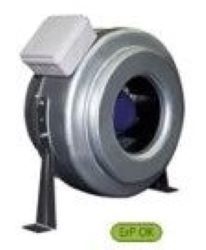
Vent-Axia ACM 150 or ACM 200 — inline mixed flow fan
EC motor, IP54, quiet (29 dB at ACM 150), 0-10V control. Ceiling-mounted, no complex ductwork.
Configuration for N+1: 2× ACM 150 or 2× ACM 200 — each covers the required airflow independently.
Medium server room — 15–40 m², 4–10 racks (3–10 kW)
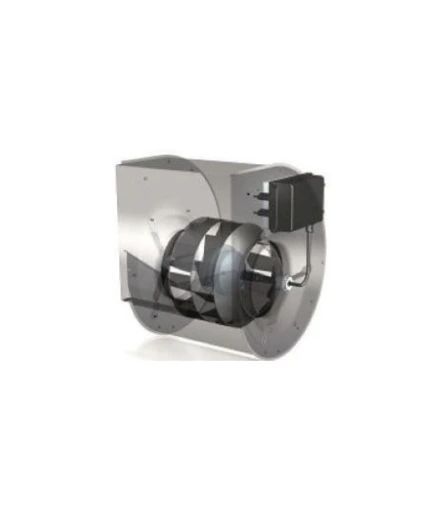
Nicotra Gebhardt PFP — compact EC plug fan
Compact plug fan with backward-curved blades and EC motor, no volute, mounted directly in room partition or ceiling plenum. No ductwork needed. Minimal pressure losses.
Nicotra Gebhardt COPRA — EC plenum fan for fan arrays
COPRA combines motor, impeller and integrated controller in an extremely compact system — the short motor does not restrict airflow, while the newly developed aerodynamic impeller design delivers maximum efficiency, especially at reduced operating speeds.
COPRA is perfectly suited to multiple wall configurations with several fans arranged side by side and above each other — both because of its compactness in axial length and its smallest possible diameters with high airflows.
Powered by an IE6 class motor, it offers up to 10% higher efficiency than traditional plug fans.
Integrated control: 3 digital inputs, Modbus capable, 0-10V, 4-20mA or PWM, onboard +10V and +20V outputs.
COPRA fan array — N+1 configuration example:
Required airflow: ~6,000 m³/h

Configuration: 4× COPRA (each 2,000 m³/h)
Normal: 3 fans active at 67% speed
Redundancy: 4th starts automatically if any fails
Bonus: at 67% speed, EC motor consumes ~30% of rated power
Large server room / small data centre — 40+ m² (over 10 kW)
Thermal loads above 10 kW require detailed airflow calculation, equipment placement design and integration with precision cooling. Contact ventilation.ro for dedicated consultancy.
Common mistakes in server room ventilation
Mistake 1 — Single fan without redundancy. Most frequent. Redundancy cost is 2–3× less than the first downtime incident cost.
Mistake 2 — Fan sized to exact minimum. At 35°C outside in summer, air density drops — fan delivers 10–15% less airflow than at 20°C. Add 25% reserve to initial calculation.
Mistake 3 — No temperature monitoring. Temperature must be monitored at server inlets, not in the middle of the room. Difference can be 5–8°C.
Mistake 4 — Incorrect airflow direction. Cold air must reach server inlets — hot air exhausts from rear of racks must be immediately extracted.
Mistake 5 — No free cooling in winter. EC variable speed allows minimum airflow at minimum consumption during cold months — temperature control without active cooling.
Full technical specifications summary
| Equipment | Airflow | Control | Application |
|---|---|---|---|
| Vent-Axia ACM 150 | 558 m³/h | 0-10V | Small server room, ceiling mount |
| Vent-Axia ACM 200 | 1,056 m³/h | 0-10V | Small-medium room |
| Nicotra PFP | up to 3,000 m³/h | 0-10V / PWM | Medium room, wall/ceiling plenum |
| Nicotra COPRA | 1,000–8,000 m³/h | 0-10V / Modbus / 4-20mA | Fan array, N+1 redundancy |
FAQ — EN
What is the maximum temperature for servers? The recommended inlet temperature range is 18°C to 27°C for continuous 24/7 operation. The allowable upper limit is 32°C but prolonged operation at this temperature risks shortening equipment lifespan.
Can mechanical ventilation replace air conditioning? In Romania, mechanical ventilation alone can maintain server room temperature below 27°C for 8–9 months per year (free cooling). In July–August when outdoor temperatures exceed 28–30°C, active cooling is needed as a complement.
What is the difference between COPRA and a standard axial fan? COPRA is a housing-free centrifugal plug fan with integrated EC motor and backward-curved impeller, designed for plenum and fan array mounting. A standard axial fan has much lower efficiency at typical server room static pressures (30–80 Pa) and lacks the integrated control needed for automatic redundancy.
How often does it need maintenance? EC motors in COPRA, PFP and ACM are brushless — no mechanical maintenance. Clean impellers annually. Check filters (if fitted on intake) every 6 months. Test redundancy failover manually every 6 months.
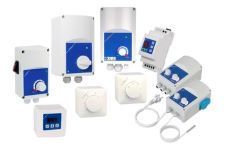
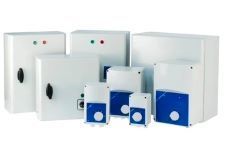
👉 Nicotra Gebhardt COPRA and PFP — incorporable fans 👉 Vent-Axia ACM 150/200/250 — inline fans 👉 Speed controllers 👉 Industrial ventilation guide 2026
📞 +40 722 667 238 — free consultancy for your server room configuration
Related articles: Industrial ventilation guide 2026 · EC vs AC motors — efficiency · Airflow calculation guide


Post comment