









 Solutions KIT
 Sales
Sales













 My account
 View cart
Attic Ventilation in 2026 — How to Solve Winter Condensation, Summer Heat and Year-Round Stale Air
The attic is the most difficult space to ventilate in any home. Unlike any other room, an attic has three completely different problems that must be solved simultaneously — and solving one can worsen the others if you don't understand the mechanism behind each.
Problem 1 — Summer: roof surface temperatures reach 60–70°C on tiles or sheet metal. Without active ventilation, the attic becomes uninhabitable in July-August. Air conditioning fights against an enormous radiator overhead.
Problem 2 — Winter: water vapour produced by people, plants and household activities rises to the highest point of the building — the attic. On contact with the cold surfaces of the roof, it condenses. Moisture accumulated in insulation and on the timber roof structure causes mould and rots wood within a few years.
Problem 3 — Year-round: an attic with small windows and no mechanical ventilation accumulates CO₂ and moisture. The air becomes stale, heavy, unsuitable for sleeping or working.
A simple fan partially solves problem 1. It does not solve 2 or 3. Air conditioning alone solves none. Correctly sized mechanical ventilation solves all three.
Why winter condensation slowly destroys an attic
In winter, warm indoor air contains large quantities of water vapour. This moist air rises naturally towards the attic. On contact with the cold roof structure or insulation layer, air temperature drops. At a certain point — the dew point — vapour condenses into liquid water.
Consequences of repeated condensation in the attic:
- Mould on timber roof structure — visible after 1–2 winter seasons without ventilation
- Wood rot — roof structure degrades within 5–10 years at constant moisture
- Loss of insulation capacity — wet mineral wool loses 30–50% of thermal resistance
- Persistent odours — mould produces spores that penetrate rooms below
Mechanical ventilation solves condensation by continuously evacuating moist air before it reaches dew point.
Airflow calculation — how much ventilation does your attic need
Required airflow (m³/h) = Attic volume (m³) × Air changes per hour
Recommended ACH for attics: - Bedroom: 4–6 ACH - Office / workspace: 6–8 ACH - Living area: 4–6 ACH - Attic with condensation problems: minimum 6 ACH
👉 Use the ventilation.ro airflow calculator — enter floor area, ceiling height and space type to get recommended airflow directly.
Practical examples:
Studio attic 30 m² × 2.5 m = 75 m³ → At 6 ACH: 450 m³/h → BT3 150 kit (450 m³/h) ✅
Medium attic 50 m² × 2.5 m = 125 m³ → At 6 ACH: 750 m³/h → Vent-Axia ACM 200 ✅
Large attic 80 m² × 2.8 m = 224 m³ → At 6 ACH: 1,344 m³/h → BOX BD 7/7 M4 (1,400 m³/h) ✅
Large commercial 120 m² × 3 m = 360 m³ → At 6–9 ACH: 2,160–3,240 m³/h → BOX 20 kit 2,800 m³/h ✅
Recommended solutions — which product for which attic
Small attic 30–50 m² — BT3 150 controlled ventilation kit
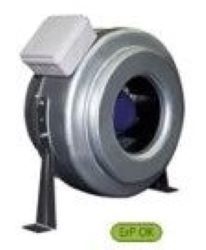
Controlled inline ventilation kit 150 BT3
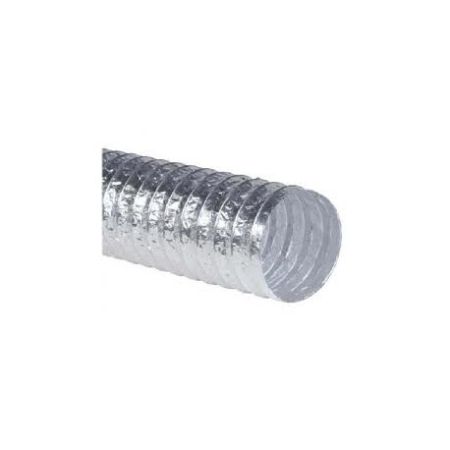
Complete Plug & Play solution for standard residential attics. The kit includes everything needed: BT3 150 centrifugal fan (450 m³/h), aluminium flexible ductwork 2×10 m, circular intake grille and external grille with gravity closure, speed controller.
Recommended for 50 m³ at 9 ACH or 75 m³ at 6 ACH — studio attic, attic bedroom, converted loft office.
👉 Controlled inline ventilation kit 150 BT3
Medium attic 40–80 m² — Vent-Axia ACM inline range
Vent-Axia ACM 150 (558 m³/h) / ACM 200 (1,056 m³/h) / ACM 250 — mixed flow inline fans. EC motor, exceptionally low noise, IP54, 0-10V control for integration with thermostat or humidity sensor.
👉 Vent-Axia ACM 150 — silent inline 👉 Complete ACM inline range
Large attic 80–200 m² — BOX BD 7/7 M4 soundproofed
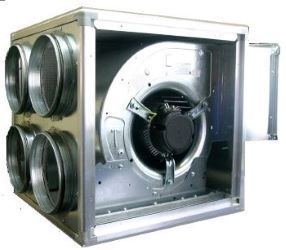
Centrifugal fan in soundproofed box BOX BD 7/7 M4 0.13kW
For large attics with 200–600 m³ volume. Airflow 1,400 m³/h. PA6 DWDI impeller in soundproofed plenum box. Maximum working temperature 55°C.
| Model | Airflow | Power | Suitable for |
|---|---|---|---|
| BOX BD 7/7 M4 | 1,400 m³/h | 0.13 kW | Attic 150–230 m³ |
| BOX BD 9/9 M4 | 2,500 m³/h | 0.37 kW | Attic 250–400 m³ |
| BOX BD 10/10 M4 | 3,500 m³/h | 0.55 kW | Attic 350–580 m³ |
Large or commercial attic — 2,800 m³/h BOX 20 kit
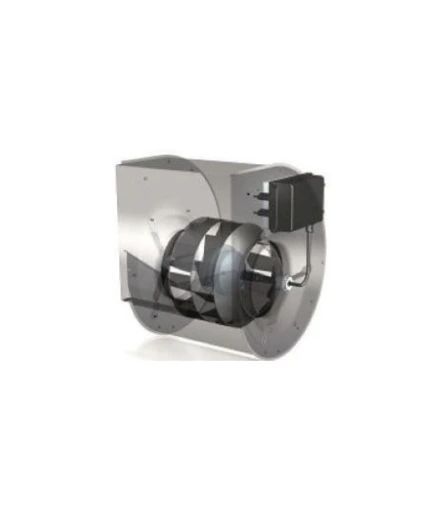
Variable speed extraction kit 2,800 m³/h
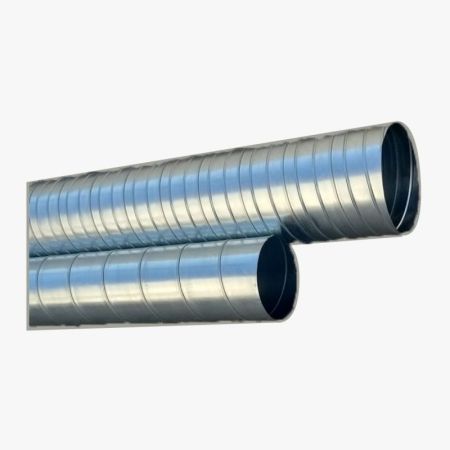
Complete solution for large attics (~300 m³) or commercial attic spaces. Includes: DWDI centrifugal fan in soundproofed plenum box + 4 boxes × 10 m aluminium flexible ductwork Ø200mm + 4 anodised aluminium intake grilles + variable speed controller.
👉 Extraction kit 2,800 m³/h BOX 20
The complete solution — MVHR for permanently occupied attics
If your attic is a primary bedroom, permanent office or daily living space — simple extract ventilation is not sufficient. It removes stale air but does not supply filtered fresh air and does not recover the thermal energy paid for in winter.
MVHR (Mechanical Ventilation with Heat Recovery) supplies fresh outdoor air and exhausts stale air simultaneously, recovering 75–85% of thermal energy. In winter you no longer pay to heat the cold air entering — the heat exchanger transfers warmth from extracted air to the incoming fresh supply.
Vent-Axia HR 500 — Plug & Play without ductwork
Vent-Axia HR 500 — single-room heat recovery unit, mounted directly in the exterior wall of the attic, no ductwork, no complex installation. Supplies and exhausts air alternately through the same opening, recovering heat in the internal thermally active ceramic.
- No ductwork — mounted directly in wall, single Ø160mm opening
- Plug & Play — standard plug, no HVAC installer required
- Silent — suitable for bedroom
- Heat recovery — reduces heating consumption in winter
Suitable for: studio attic or single room up to 40–70 m² used as permanent bedroom or office.
👉 Vent-Axia HR 500 — single-room MVHR without ductwork
Casals CHR 800 / CHR 1500 — centralised MVHR with ductwork
Casals CHR range — centralised heat recovery units for multi-room attics with duct network distributing to each zone.
CHR 800 — for attic up to 80 m² with 2–3 rooms CHR 1500 — for attic 80–150 m² with 3–5 rooms
Advantages over simple extract ventilation:
- Continuous filtered fresh air in every room — F7 filters standard included
-
80% thermal energy recovery in winter — energy bill savings exceed fan cost within 2–3 seasons
- CO₂ elimination — bedroom air remains fresh throughout the night
- nZEB compliance — mandatory by law for new buildings authorised from 2023
👉 Casals CHR 800 — MVHR heat recovery 👉 Complete MVHR guide 2026
Quick selection guide
| Attic volume | Approx. area | Use | Recommended solution |
|---|---|---|---|
| Up to 75 m³ | ~30 m² | Occasional | BT3 150 kit — 450 m³/h |
| Up to 90 m³ | ~35 m² | Permanent bedroom | Vent-Axia HR 500 — MVHR no ductwork |
| 75–130 m³ | ~50 m² | Regular | Vent-Axia ACM 150 — 558 m³/h |
| 130–200 m³ | ~80 m² | Regular | Vent-Axia ACM 200 — 1,056 m³/h |
| Up to 200 m³ | ~80 m² | Permanently occupied | Casals CHR 800 — centralised MVHR |
| 200–250 m³ | ~100 m² | Regular | BOX BD 7/7 M4 — 1,400 m³/h |
| Up to 375 m³ | ~150 m² | Permanently occupied | Casals CHR 1500 — centralised MVHR |
| ~300 m³ | ~120 m² | Regular | BOX 20 kit — 2,800 m³/h complete |
FAQ — EN
Does attic ventilation permanently solve condensation? Yes — if correctly sized and running continuously, including winter at minimum speed. Condensation occurs when moist air reaches cold surfaces. Ventilation evacuates moist air before it condenses. Running 24/7 at reduced speed, power consumption is a few tens of watts — negligible compared to the cost of repairing timber structure.
Can I install the fan myself? Mechanical installation (mounting the fan, ductwork, grille) can be done with intermediate DIY skills. Electrical connection must be carried out by a qualified electrician. The BT3 kit and BOX 20 kit include all components and installation instructions.
What speed in winter vs summer? Winter: 30–50% of maximum speed — minimum airflow for moist air evacuation. Summer: 80–100% for heat evacuation. The speed controller included in the BT3 kit and BOX 20 kit allows this adjustment.
Is simple ventilation sufficient or do I need MVHR? Simple extract ventilation (BT3, ACM, BOX BD) removes stale air — solves condensation and stale air at low cost. MVHR (Casals CHR, Vent-Axia HR) supplies filtered fresh air and exhausts simultaneously, recovering 75–85% of thermal energy. If the attic is a permanent bedroom or office, CHR or HR delivers incomparably better air quality and reduces heating bills. For occasional-use attics, simple extract ventilation is sufficient and more economical to install.
Related articles: Attic fan — air conditioning ally · Heat recovery MVHR 2026 · Mould in bathroom and apartment


Post comment