








 Solutions KIT
 Sales
Sales










 My account
 View cart
Ventilation in Paint Shops and Auto Repair Workshops in 2026: What ATEX Means, Why It Is Mandatory and What Equipment You Need
A standard fan costing a few hundred lei mounted in a spray booth can trigger an explosion. This is not an exaggeration — it is basic physics: solvent vapours at explosive concentration plus a spark generated by a conventional motor equals deflagration. This is the rationale behind ATEX legislation and the reason ventilation equipment in a paint shop or auto repair workshop is not an ordinary product.
This article explains what an ATEX zone means, what certification fans must carry, how to correctly size the installation, and what products you can order today in Romania to be both compliant and safe.
Why Paint Shops and Auto Workshops Are Explosion Risk Zones
Solvent-based paints — lacquers, primers, thinners, enamels — release flammable vapours during application and drying. These vapours are heavier than air and accumulate at floor level and in areas with insufficient ventilation. The main volatile compounds in automotive paints — toluene, xylene, ethyl acetate, acetone — have lower explosive limits (LEL) between 1% and 2.5% of air volume. A few litres of evaporated thinner in a 50 m³ room are sufficient to reach explosive concentration.
Conventional electric motors generate sparks at commutators or starting contacts. In an atmosphere containing solvent vapours, a single spark is enough.
Practical consequences:
- Risk of explosion and fire — life-threatening for personnel
- Legal liability in the event of an accident — penalties and civil damages
- Fines from authorities (ITM, ISU, DSP) during inspections
- Insurance invalidation in the event of a claim if the installation is non-compliant
This is not a theoretical risk. Explosions in non-compliant paint shops occur every year in Romania and across Europe — and the identified cause is frequently inadequate electrical equipment for the classified zone.
What ATEX Means and How Zones Are Classified
ATEX derives from the French "ATmosphères EXplosibles" and refers to European Directive 2014/34/EU, which regulates equipment used in potentially explosive atmospheres. In Romania, the requirements are transposed into national law through Government Decision HG 245/2016.
Zone classification based on frequency of explosive atmosphere occurrence
| Zone | Definition | Explosive atmosphere presence |
|---|---|---|
| Zone 0 | Continuously or for long periods | Permanently — inside tanks, pipelines |
| Zone 1 | Occasionally during normal operation | Active paint shops, spray booths during spraying |
| Zone 2 | Rarely, for short periods | Adjacent areas, workshops with occasional solvent operations |
Where paint shops fall:
- Inside the spray booth during active spraying → Zone 1
- Within 1 metre around the booth → Zone 1
- General workshop with occasional painting operations → Zone 2
- Drying room → Zone 1 or Zone 2, depending on working temperature
What ATEX equipment category is required
The ATEX Directive classifies equipment into categories based on the zone of use:
| Zone | Required equipment category |
|---|---|
| Zone 0 | Category 1G (II1G) |
| Zone 1 | Category 2G (II2G) |
| Zone 2 | Category 3G (II3G) or better |
The full marking on an ATEX fan looks like this: II 2G Ex ec IIC T3 Gc
- II = Group II (surface industry, not mines)
- 2G = Category 2, Gas
- Ex ec = Protection mode (increased safety)
- IIC = Gas subgroup (most restrictive — covers hydrogen and acetylene)
- T3 = Temperature class (maximum surface temperature: 200°C)
- Gc = Equipment Protection Level (EPL)
What Romanian and European Regulations Require
HG 245/2016 (transposing ATEX Directive 2014/34/EU) — mandates the exclusive use of ATEX-certified equipment in classified zones.
SR EN 60079 (series) — standards for electrical equipment in explosive atmospheres.
Romanian Electrical Standard I7-2011 — Romanian standard for low-voltage electrical installations, with specific provisions for zones with explosion risk.
Law 319/2006 (Occupational Safety) — the employer is responsible for explosion risk assessment and the implementation of protective measures. The absence of compliant ATEX equipment constitutes a violation and can result in criminal liability in the event of an accident.
What ITM and ISU inspectors check:
- CE Declaration of Conformity + ATEX certificate for every piece of electrical equipment in the classified zone
- Zone classification diagram (prepared by an accredited designer)
- Periodic inspection register for the electrical installation
- Appropriate personal protective equipment
How Many Air Changes Per Hour Are Required
European standards and industry best practices require:
| Situation | Air changes per hour |
|---|---|
| During active spraying | Minimum 10 ACH — recommended 15–20 ACH |
| Drying after spraying | Minimum 6 ACH |
| Standby (no activity) | Minimum 4 ACH (maintaining below LEL) |
Airflow calculation formula
Required airflow (m³/h) = Booth volume (m³) × Air changes per hour
Practical example:
- Spray booth: 6m × 4m × 3m = 72 m³
- Active spraying: 72 × 15 = 1,080 m³/h minimum airflow
- Recommended with 20% safety margin: ~1,300 m³/h
Important note: Duct pressure loss must be factored into the calculation (length, bends, grilles). An axial fan selected purely on airflow can prove insufficient if the ductwork is long or has many bends. In these cases, a centrifugal fan is the correct choice.
Axial vs Centrifugal ATEX Fan for a Paint Shop — Which to Choose
| Criterion | Axial ATEX | Centrifugal ATEX |
|---|---|---|
| Static pressure | Low (up to ~100 Pa) | Medium/high (100–800 Pa) |
| Ductwork | Short, direct | Long, with multiple bends |
| Small booth, direct exhaust | ✅ Appropriate | Over-specified |
| Workshop with duct network | ❌ Insufficient | ✅ Appropriate |
| Cost | Lower | Higher |
| Noise | Higher | Lower |
Practical rule: if the distance from booth to exterior is under 3 metres with no bends — axial ATEX. If the ductwork exceeds 5 metres or has more than 2 bends — centrifugal ATEX.
ATEX Products Available on ventilation.ro
Ventilation.ro stocks in Romania products for the Paint Shop application and for Mechanical Workshops — all ATEX-certified, with complete documentation.
Axial ATEX Fans — for small booths and direct exhaust
HCX 45 T4 0.25kW — Casals
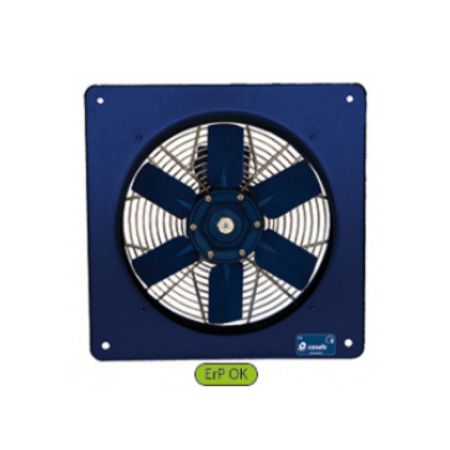
Circular-frame axial ATEX fan, certified II2G Ex-d / Ex-e, II3GD Ex-nA — suitable for both Zone 1 (II2G) and Zone 2 (II3G). The motor-rotor assembly is modular — components can be replaced individually without dismantling the casing. ATEX-certified asynchronous motor, IP-55, Class F. Aluminium impeller with variable blade angle — enabling airflow adjustment. Short casing, suitable for direct wall mounting or short-run ductwork.
Ideal for: small spray booths (under 100 m³), auto workshops with direct through-wall exhaust, powder coating booths with low airflow.
HCX 63 T4 1.1kW — Casals
More powerful version of the HCX series, same certification II2G Ex-d / Ex-e, II3GD Ex-nA, significantly higher airflow. IP-55, Class F. Aluminium impeller with variable blade angle. Suitable for Zone 1.
Ideal for: medium spray booths (100–200 m³), larger workshops with direct or short-run exhaust.
HBX 45 T4 0.25kW — Casals
Axial ATEX fan with circular frame, with casing protected against corrosion by epoxy resin coating. ATEX asynchronous motor, IP-55, Class F. Modular motor-rotor assembly.
Ideal for: paint shops where the air also contains mildly corrosive vapours (water-based lacquers + solvents), bodywork reconditioning workshops.
HBX 63 T6 0.75kW — Casals
More powerful version of the HBX series, T6 (6-pole motor — lower speed, reduced noise). Same ATEX construction, IP-55 motor, Class F. Epoxy anti-corrosion casing.
Ideal for: paint shops where noise is a factor, workshops located adjacent to working areas or offices.
Centrifugal ATEX Fans — for long ductwork and higher pressure
MBX 22/9 T2 2.2kW — Casals
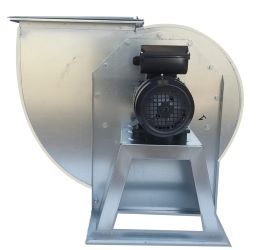
Medium-pressure centrifugal ATEX fan. Steel casing, single-inlet aluminium impeller with an aluminium/copper anti-spark ring — an essential safety element that prevents spark generation through accidental contact between the impeller and casing. Complete epoxy anti-corrosion finish. ATEX asynchronous motor, IP-55, Class F. Maximum working temperature: 80°C. Voltages available: 230V single-phase or 230/400V three-phase.
Ideal for: auto workshops with medium-length duct networks, paint shops with multiple work stations connected to the same extraction system, applications where static pressure exceeds 100 Pa.
MBX 31/12 T4 2.2kW — Casals
More powerful version of the MBX series, higher airflow at the same 2.2kW power — different impeller construction (modified diameter and dimensional ratio). Same safety features: aluminium/copper anti-spark ring, epoxy casing, ATEX motor IP-55, Class F. Maximum working temperature: 80°C.
Ideal for: industrial paint shops with high airflow requirements, continuous painting production lines, large bodywork workshops.
MAX 28 T2 1.1kW — Casals
Medium-pressure centrifugal ATEX fan, certified Zone 2 (Ex ec IIC T3 Gc). Steel casing and aluminium impeller. ATEX motor, IP-55, Class F. Suitable for Zone 2 — workshops with occasional solvent operations, areas adjacent to spray booths.
Ideal for: mechanical workshops with periodic painting or degreasing operations, paint preparation areas.
Anti-corrosion ATEX Fan — for aggressive chemical environments
MBPCX 20 T2 0.25kW — Casals
Centrifugal ATEX fan constructed entirely in polypropylene — the solution for environments where the air simultaneously contains flammable vapours and corrosive agents (acids, alkaline solutions, halogenated compounds). Certified Zone 2 (Ex db IIC T4), II2G Eex-d motor, 230/400V supply. Compliant with Directive 94/9/CE.
Ideal for: bodywork stripping and phosphating workshops, chemical-base paint preparation laboratories, electroplating installations adjacent to solvent zones.
Quick Selection Table
| Application | ATEX Zone | Recommended product |
|---|---|---|
| Small spray booth, direct exhaust | Zone 1 | HCX 45 T4 |
| Medium spray booth, direct exhaust | Zone 1 | HCX 63 T4 |
| Paint shop with mildly corrosive vapours | Zone 1 | HBX 45 T4 |
| Paint shop — low noise required | Zone 1 | HBX 63 T6 |
| Workshop with medium ductwork | Zone 1 | MBX 22/9 T2 |
| Industrial paint shop, high airflow | Zone 1 | MBX 31/12 T4 |
| Workshop with occasional solvent operations | Zone 2 | MAX 28 T2 |
| Aggressive chemical + explosive environment | Zone 2 | MBPCX 20 T2 |
Common Mistakes That Lead to Fines and Accidents
1. Standard (non-ATEX) fan in a spray booth The most frequent and most dangerous error. Reason given: "I didn't know it was mandatory" or "I bought something cheaper." Consequence: explosion risk and a violation carrying fines between 3,000 and 10,000 lei under HG 245/2016.
2. Zone 2 ATEX fan installed in a Zone 1 location A II3G (Zone 2) device is not sufficient for Zone 1 — which requires II2G. A frequent error when the designer misclassifies the zone or when procurement is made without verifying the equipment's full marking.
3. Axial fan on long ductwork The static pressure generated by 8–10 metres of ductwork with 3–4 bends can exceed 200–300 Pa. An axial fan selected on airflow alone, without checking pressure, will perform at 30–40% of its rated airflow at the system's actual resistance.
4. Missing anti-spark ring on centrifugal fans Even a fan with a certified ATEX motor becomes hazardous if the impeller can contact the casing and generate mechanical sparks. The aluminium or copper anti-spark ring on the Casals MBX range explicitly prevents this risk.
5. Unfiltered fresh air supply Dust from external air deposited on wet paint is a quality issue, not a safety one — but it costs more than a filter. Solution: F5 or F7 filter on the fresh air inlet to the booth.
6. Missing pressure balance A sealed spray booth without balance between extraction and supply airflow will generate over-pressure or under-pressure — doors no longer close correctly, draughts disrupt paint application and finish quality.
What a Compliant Installation Looks Like — Mandatory Components
A compliant ventilation installation for a spray booth includes:
Extraction:
- ATEX fan (axial or centrifugal, depending on duct length)
- Metal ductwork with floor-level air intakes (vapours are heavier than air)
- External protection grille
Fresh air supply:
- Supply fan (may be non-ATEX if located outside the classified zone)
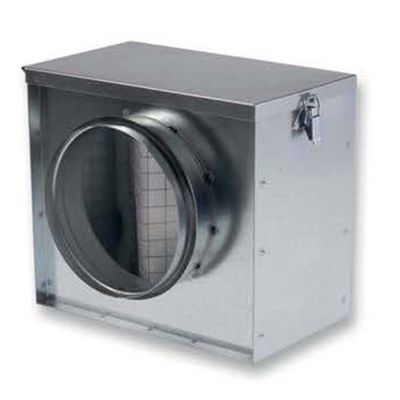
- F5–F7 air filter (paint quality protection)
- Heating battery for cold seasons (optional but recommended)
- Uniform distribution via perforated ceiling or diffusers
Controls and safety:
- Ventilation–spray gun interlock (spraying cannot start if ventilation is not running)
- Flammable gas sensor (optional, recommended for Zone 1)
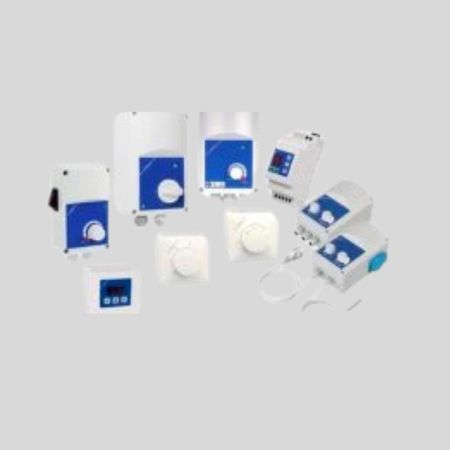
- Speed controller for airflow adjustment (if the process requires flexibility)
Documents Inspectors Check
At an ITM, ISU or DSP inspection, inspectors may request:
- CE Declaration of Conformity + ATEX certificate for every fan mounted in the classified zone
- ATEX zone classification diagram prepared and signed by an accredited designer
- Ventilation installation schematic with technical specifications
- Periodic inspection register for the electrical installation in the ATEX zone
- Explosion risk assessment under HG 1058/2006 (Explosion Protection Document — EPD)
All Casals products from ventilation.ro are supplied with complete documentation: CE Declaration of Conformity, ATEX certificate, technical datasheet and performance curve.
Frequently Asked Questions
Is ATEX mandatory even for a small workshop with occasional painting? It depends on the frequency and volume of solvent operations. If the activity involves organic solvents — even occasionally — the zone is classified as at least Zone 2, and electrical equipment must be at minimum Category 3G (II3G). The assessment is carried out by an accredited designer through the preparation of the Explosion Protection Document.
Can I use an ATEX fan from another application (e.g. from a chemical plant)? Technically yes, if the certification and marking correspond to the zone in the paint shop. In practice, it is essential to verify that the marking shows Group II (surface industry), not Group IM (mines), and that the temperature class T covers the maximum possible surface temperature in your application.
How much does a complete ATEX ventilation installation cost for an auto spray booth? For a standard booth (6×4×3m): ATEX extraction fan 5,000–10,500 lei + supply fan (non-ATEX) 800–2,000 lei + ductwork + filters + control panel + labour. Indicative total budget: 15,000–35,000 lei, depending on specification and complexity.
How often must the ATEX installation be inspected? Standard SR EN 60079-17 requires inspections at intervals of no more than 3 years for Category 2 installations. ITM inspectors may request proof of inspections at any audit.
Are the Casals products on ventilation.ro valid in Romania? Yes. All Casals ATEX products are certified under Directive 2014/34/EU (transposed in Romania through HG 245/2016) and are supplied with a CE Declaration of Conformity valid throughout the European Union, including Romania.
Conclusion
Ventilation in a paint shop or auto repair workshop is not an accessory — it is a legal obligation and a safety component with a direct impact on the lives of personnel. Using a non-ATEX fan in a classified zone is not a saving: it is an explosion risk and a violation that can result in the suspension of operations.
Ventilation.ro stocks in Romania the complete Casals range of ATEX fans for paint shops and mechanical workshops — axial and centrifugal, for Zone 1 and Zone 2, with complete documentation and clear pricing.
Request a quote or free technical consultation →
If you are working on ventilation for an auto workshop or paint shop, these articles complete the picture:
Regulation and approval — essential reading:
- ATEX Fans in 2026: Classified Zones, Categories, Temperature Classes and Documents for Approval — the complete guide to ATEX certifications, with all markings explained
- Regulation P118-1:2025 and Its Impact on Ventilation and Smoke Extraction Systems — if the paint shop has a large floor area and requires a smoke extraction system
If your project also includes a paint drying oven:
- High-Temperature Fans: F400 vs Continuous 250°C Operation — The Difference Nobody Explained to You — why an F400 fan cannot be used on a drying oven and which product is correct
Equipment selection and sizing:
- Axial vs Centrifugal Fan: What Is the Difference and When to Use Each — the fundamental constructive decision before any other specification
- Ventilation Ductwork: Complete Guide to Choosing Diameter, Material and Accessories — static pressure calculation across the network, essential for correct fan selection
If you are working on the hall ventilation as a whole:
- Production Hall Ventilation: Technical Requirements, Industrial Risks and Solutions by Industry Type — the paint shop is one part of a broader system within the production hall
- Industrial Fans: Complete Buying Guide — everything you need to know before placing an order
Legislative and technical references: ATEX Directive 2014/34/EU, HG 245/2016, HG 1058/2006, SR EN 60079 (series), Romanian Electrical Standard I7-2011, Casals technical documentation.


Post comment