











 Solutions KIT
 Sales
Sales














 My account
 View cart
Summer in the Factory: Why It Reaches 45°C and What You Can Do — A Practical Guide for Managers and Technical Staff
At 35°C outside, a metal factory building without mechanical ventilation reaches 50–55°C inside. Workers operate under severe heat stress, productivity drops dramatically, equipment overheats and the risk of incident rises. This is not a comfort issue — it is an occupational health and safety issue, an efficiency issue and a problem with concrete costs.
If you are the manager or technical director of a production hall or warehouse and you are thinking about this in May or June — you are in the right place. This article explains why it happens, what does not work and what solutions exist, with real costs and clear selection criteria.
Why the Hall Overheats — 4 Real Causes
Temperature in a production hall does not rise by chance. There are four distinct mechanisms acting simultaneously in summer, and understanding them directly determines which solution is appropriate.
1. The metal roof — the main source of radiant heat
A metal roof exposed to sunlight accumulates heat and radiates it inward. At midday, the internal surface temperature of an uninsulated metal roof can exceed 70–80°C — a giant radiator suspended above the work zone. Even roofs with standard thermal insulation transmit significant amounts of heat through convection and radiation.
2. Machinery and people — internal heat sources
Every electric motor, compressor, welder or machine tool generates heat that stays in the building if it is not extracted. In a hall with 20 workers and machinery in operation, internal heat generation can be equivalent to several tens of kilowatts continuously — regardless of the outside temperature.
3. Natural ventilation — insufficient in summer
Natural ventilation through rooflights or side openings works through the temperature difference between the warm indoor air and the cooler outdoor air. In summer, when the outside temperature is 30–35°C, the difference from the interior is small, natural draught becomes negligible and air stagnates.
4. Air stratification — the work zone is hotter than you think
Hot air rises. In a hall with a height of 8–12 metres, the temperature at floor level can be 5–8°C higher than the temperature measured at head height — due to heat radiated from machinery and people that remains trapped at the working level. Simultaneously, under the roof the temperature can exceed 60°C, creating a layer of extremely hot air that radiates continuously toward the work zone.
The Real Impact on Productivity and Health & Safety
These are not estimates — they are figures documented in occupational medicine research:
| Working temperature | Impact on productivity |
|---|---|
| Below 28°C | Normal productivity |
| 28–33°C | 10–15% reduction |
| 33–38°C | 30–40% reduction |
| Above 38°C | 50%+ reduction and incident risk |
From an occupational health and safety perspective, EU Directive 89/654/EEC and national implementing legislation require employers to ensure appropriate microclimate conditions at the workplace. Temperatures that exceed the permitted limit for light physical work (28°C) or medium physical work (26°C) may constitute a violation identified by labour inspectors.
Quick calculation of the cost of inaction:
Annual cost of lost productivity =
  Number of workers × Average monthly salary × 3 summer months × 30% productivity loss

Example: 30 workers × 4,000 lei × 3 months × 0.30 = 108,000 lei per year
A ventilation investment of 30,000–50,000 lei pays for itself in the first season for a hall with 30 workers.
What Does Not Work — Common Mistakes
Before seeing what works, it is worth clarifying what does not solve the problem — because these solutions are frequently tried and produce disappointment.
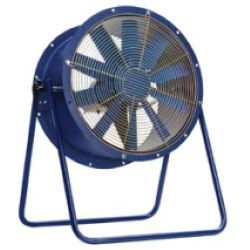
Portable floor fans They move hot air from one place to another. They do not extract heat from the hall. They can create an evaporative cooling effect on skin, but the air temperature in the hall remains identical. Useful as a temporary emergency measure, useless as a permanent solution.
Air conditioning without extraction Cools air in a localised zone, but if the hall has no mechanical extraction ventilation, the hot air generated by machinery and people remains in the building. Air conditioners fight permanently with a heat source they cannot eliminate — they consume a great deal of electricity and their efficiency drops rapidly as the outdoor temperature rises.
Open rooflights Work well in spring and autumn when the temperature difference creates draught. In summer, with 35°C outside and 50°C in the hall, the difference is too small for significant draught. If there is wind — they help. If there is no wind — zero effect.
Roof thermal insulation alone Reduces radiant heat input but does not evacuate the heat generated internally by machinery and personnel. It is an important component of the complete solution but does not solve the problem on its own.
What Works — 3 Solutions in Order of Cost
Solution 1 — Industrial Axial Wall Fans
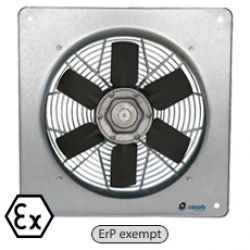
The principle: mechanical extraction through the side walls of the hall, with fresh air introduction on the opposite side. A horizontal airflow is created through the work zone that extracts hot air and replaces it with cooler outside air.
When this is the right solution:
- Halls with a height below 8 metres
- Spaces with moderate internal heat generation
- Limited budget, need for rapid implementation
- Halls where roof intervention is not possible
How to size the system:
Required airflow (m³/h) = Hall volume (m³) × Number of air changes per hour

Recommended air changes:
- Warehouse without intensive activity: 6–10 ACH
- Light production / assembly: 10–20 ACH
- Production with hot machinery: 20–40 ACH
- Welding, foundry, hot processes: 40–60 ACH

Example: Hall 50m × 30m × 7m = 10,500 m³
Medium production → 20 ACH → 210,000 m³/h total airflow
→ 6 fans at 35,000 m³/h each
Correct placement:
- Extraction fans on the wall opposite the prevailing wind direction
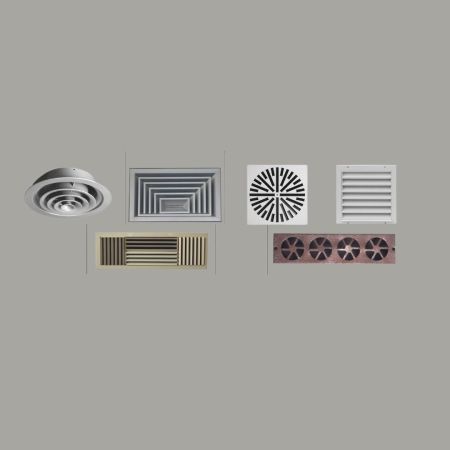
- Air inlets (grilles or openings) on the windward wall
- Positioned at 1/3 of the hall height — not at floor level, not under the roof
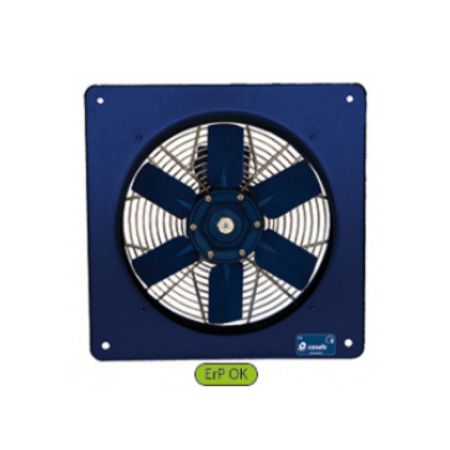
Recommended Casals products available on ventilation.ro:
| Model | Max airflow | Power | Suitable for |
|---|---|---|---|
| HBF 56 T4 1.5kW | ~22,000 m³/h | 1.5 kW | Small halls, workshops |
| HBF 71 T4 3kW | ~40,000 m³/h | 3 kW | Medium halls 2,000–5,000 m² |
| HMF 80 T4 4kW | ~55,000 m³/h | 4 kW | Large halls 5,000–10,000 m² |
| HMF 100 T4 7.5kW | ~90,000 m³/h | 7.5 kW | Very large halls, warehouses |
All models in the HBF/HMF series have IE3 motor, IP55, Class H insulation — designed for continuous operation in industrial conditions.
Indicative cost for complete solution: 5,000–40,000 lei (depending on number of fans required)
👉 View the industrial axial fan range on ventilation.ro →
Solution 2 — Roof Ventilation Turrets
The principle: the hot air that accumulates under the roof is extracted directly through turrets mounted on the roof. Combined with air inlets at floor level or through side walls, this creates a vertically driven natural circulation amplified mechanically — the most efficient way to eliminate thermal stratification.
When this is the right solution:
- Tall halls (over 8–10 metres)
- Halls with intense heat generation under the roof (welding, foundry, ovens)
- Buildings where wall fans cannot be installed
- Combined solution with wall fans for very large halls
The advantage over wall fans: Extracts the hottest air directly — the air under the roof — rapidly reducing the temperature of the entire hall by eliminating the upper radiant layer.
Correct placement:
- Evenly distributed across the roof area
- No more than 2× the hall height between units
- On the longitudinal axis of the hall, not on the edges
- Air inlets at +0.5m above floor level — not at ceiling height
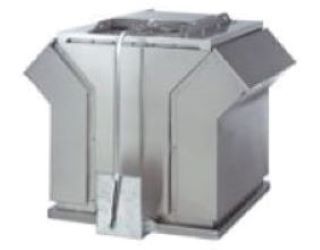
Recommended Casals products available on ventilation.ro:
| Model | Max airflow | Type | Suitable for |
|---|---|---|---|
| HBT 45 T4 0.75kW | ~14,000 m³/h | Axial roof | Small halls, workshops |
| HBT 56 T4 1.5kW | ~25,000 m³/h | Axial roof | Medium halls |
| DHUMAT 355 T2 2.2kW | ~18,000 m³/h | Centrifugal roof | Halls with duct pressure |
| DHUMAT 450 T4 5.5kW | ~38,000 m³/h | Centrifugal roof | Large halls, warehouses |
Indicative cost for complete solution: 8,000–60,000 lei
👉 View the roof turret range on ventilation.ro →
Solution 3 — Fully Designed System (Halls Over 5,000 m²)
When it is necessary:
- Large halls with complex industrial processes
- Specific airflow, pressure or air distribution requirements
- Processes generating fumes or vapours in addition to heat
- Need for CFD calculation or airflow simulation
What it includes:
- Airflow calculation per thermal zone
- Optimised equipment placement
- Distribution ductwork where required
- Documentation for building authority approval
Ventilation.ro offers free technical consultation for system sizing — send us the hall dimensions, activity type and number of workers and receive the configuration recommendation within 4 hours.
Combined Solution — The Best Result
The most effective system for a medium production hall combines both approaches:
Roof turret extraction → evacuates the extremely hot air from under the roof and reduces the overall hall temperature.
Axial wall fans → create horizontal airflow through the work zone, providing the air velocity needed to cool personnel and equipment through convection.
Fresh air inlets at floor level or through side walls → supply the system with cooler outside air to replace the extracted air.
Typical result for a 3,000 m² production hall: reduction of the working zone temperature by 8–15°C compared to the temperature without mechanical ventilation, at a running cost of a few hundred lei per month.
What Documents and Approvals Are Required
Axial fans mounted in existing openings (windows, doors, existing wall apertures) generally do not require a building permit — they are electrical equipment, not construction works.
Roof-mounted turrets may require a structural assessment if the roof is not dimensioned for the additional load, or local authority approval if the building is in a protected area. Check with an architect or structural engineer before installation.
Health and safety documentation: if you are installing the system in response to an H&S requirement, the installation acceptance record and temperature measurement reports after installation are the documents that demonstrate compliance at a potential labour inspection.
Checklist Before Ordering
Before requesting a quote or ordering equipment, prepare these details — with them, the ventilation.ro team can complete the sizing in 4 hours:
- [ ] Hall dimensions: length × width × height (m)
- [ ] Activity type: warehousing / light production / intensive production / welding / other
- [ ] Number of workers at peak shift
- [ ] Main machinery and approximate power (kW)
- [ ] Current estimated summer temperature inside
- [ ] Possibility of mounting fans on side walls: yes / no
- [ ] Possibility of mounting on roof: yes / no
- [ ] Available voltage: 230V single-phase / 400V three-phase
→ Send your details and receive free sizing
Tel: +40 722 667 239 · WhatsApp: +40 790 721 172
Frequently Asked Questions
How long does installation of an industrial axial wall fan take? An axial fan in an existing wall opening takes 2–4 hours to install. If a new opening needs to be cut, add one day for the masonry or carpentry work.
Can industrial fans run 24/7? Yes. Axial fans from the Casals HBF/HMF series are designed for S1 duty — continuous operation. IE3 motor, IP55, Class H insulation — dimensioned for permanent running.
What is the electricity consumption? A 3kW fan running 12 hours per day = 36 kWh/day = approximately 18–20 lei/day at current industrial tariffs. For 5 fans at 3kW each: approximately 90–100 lei/day in the hot season.
Is a licensed designer required? For halls under 1,000 m² with a simple solution (wall fans without ductwork), it is generally not mandatory. For large halls with a complex system or combined smoke extraction requirements, yes. Ventilation.ro can connect you with collaborating HVAC designers.
Are the fans very noisy? The Casals HBF/HMF series has noise levels of 65–80 dB(A) at 1 metre — audible in the hall but acceptable in an industrial context. If noise is a concern, speed controller variants are available that reduce both airflow and noise simultaneously during less demanding periods.
Conclusion
Summer overheating in industrial halls is not inevitable and is not solved by portable fans or air conditioning. The correct solution is properly sized mechanical industrial ventilation — extraction through walls or roof, combined with fresh air introduction.
The investment pays back quickly: productivity recovered, health and safety risk eliminated, equipment less thermally stressed and lower maintenance costs.
Ventilation.ro stocks in Romania the complete Casals range of industrial axial fans and roof turrets — with free technical consultation for system sizing.
→ Request free sizing for your hall
→ View the complete industrial fan range
Related Articles
- Production Hall Ventilation — Technical Requirements and Solutions by Industry Type
- Logistics Hall and Warehouse Ventilation — Obligations and Solutions
- EC Motors vs AC Motors for Industrial Fans — What to Choose in 2026
- Axial vs Centrifugal Fan — The Difference and When to Use Each
- Ventilation Airflow Calculation — Formulas and Real Examples
Technical references: EU Directive 89/654/EEC — Workplace health and safety, Casals technical documentation, Romanian Labour Code and occupational health regulations, I5-2022 ventilation standard.


Post comment